
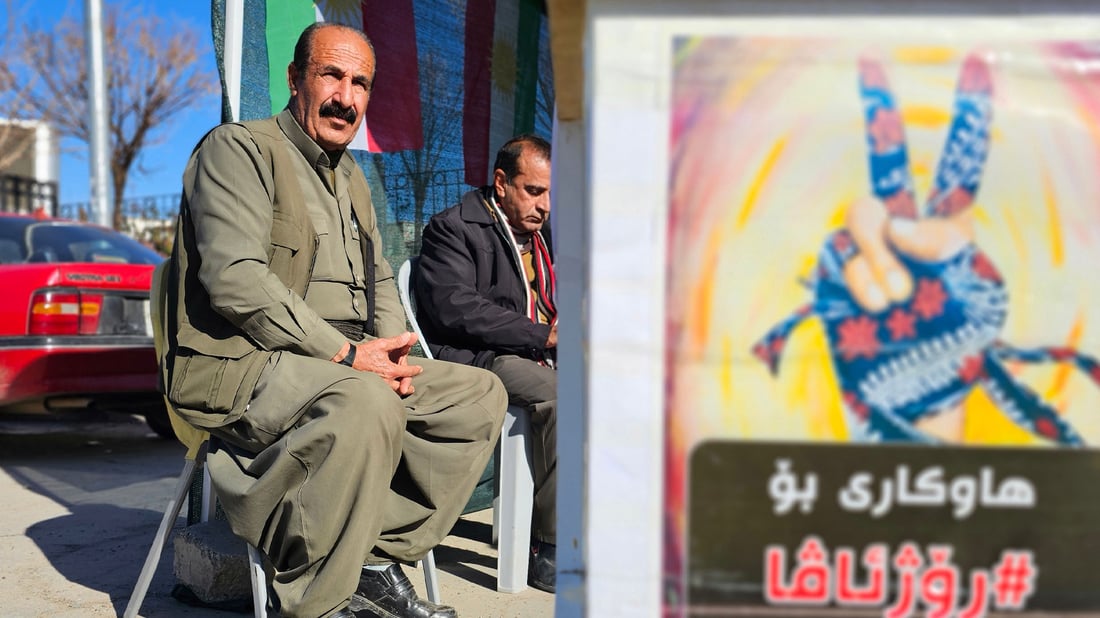
Fuad Qadir, a survivor of the 1988 Anfal genocide campaign, joins ongoing demonstrations and humanitarian aid initiatives in the Kurdistan Region in support of Kurds in Rojava. (Photo: 964media)
'We must not forget'
Anfal survivor who lost 39 family members joins daily rallies for Rojava
ERBIL — Fuad Qadir, a survivor of the 1988 Anfal genocide carried out by the former Iraqi Baath regime against the Kurds, said he has been participating in daily rallies and collecting aid for six consecutive days in support of Kurds in Rojava.
Qadir, a resident of Erbil governorate’s Koya district, lost 39 family members during the Anfal campaign.
Speaking to 964media, he said he cannot remain silent in the face of assaults on Kurds in Syria. “I know what it feels like to lose your home, children, land, and people,” he said. “I lost 39 family members during Anfal genocide, we should not allow this generation to face another Anfal. We must all stand with Rojava.”
According to Human Rights Watch, the Anfal campaign resulted in the killing of an estimated 50,000 to 100,000 Kurds, while Kurdish sources have put the death toll as high as 182,000.
Since early January, Kurds in northeastern Syria and Rojava have come under attacks by Syrian government forces and affiliated Islamist armed groups. Rights organizations and local reports have documented abuses and violations targeting civilians based on their Kurdish identity. In a recent report, Community Peacemaker Teams said six members of a single Kurdish family were killed and six others injured by Syrian government forces because they were Kurdish.
Qadir said the memory of Anfal helps him understand what he described as the seriousness of the attacks on Kurds in Syria. “We must all defend our Kurdish identity together, with one heart and one hand. If Rojava falls, another Anfal may happen here too,” he said.
He emphasized the importance of remembering the past. “We must not forget,” he added.
His comments follow a directive by Syria’s Ministry of Religious Endowments that referenced the term “Anfal” in connection with the attacks on Kurds, prompting renewed concerns among Kurdish communities.
Al-Anfal, the eighth chapter of the Quran meaning “The Spoils of War,” carries deep historical trauma for Kurds. The term is closely associated with the 1988 Anfal campaign carried out by Saddam Hussein’s regime in Iraq, which involved chemical attacks, mass executions and the destruction of thousands of Kurdish villages.
Religious scholars and imams in the Kurdistan Region condemned the directive, rejecting the use of Islamic language to justify violence against Kurdish communities.
Religious cleric Abdulmalik Sargati told 964media the directive echoed past atrocities. “What the Syrian Ministry of Religious Endowments is saying is against Islam. This is not a religious war-it is a war over land, nationhood, language, and culture,” he told 964media. “Today in Syria, just like during Saddam’s rule, they are using the language of Anfal again. They want to occupy the land of Kurdistan in the name of religion.”