
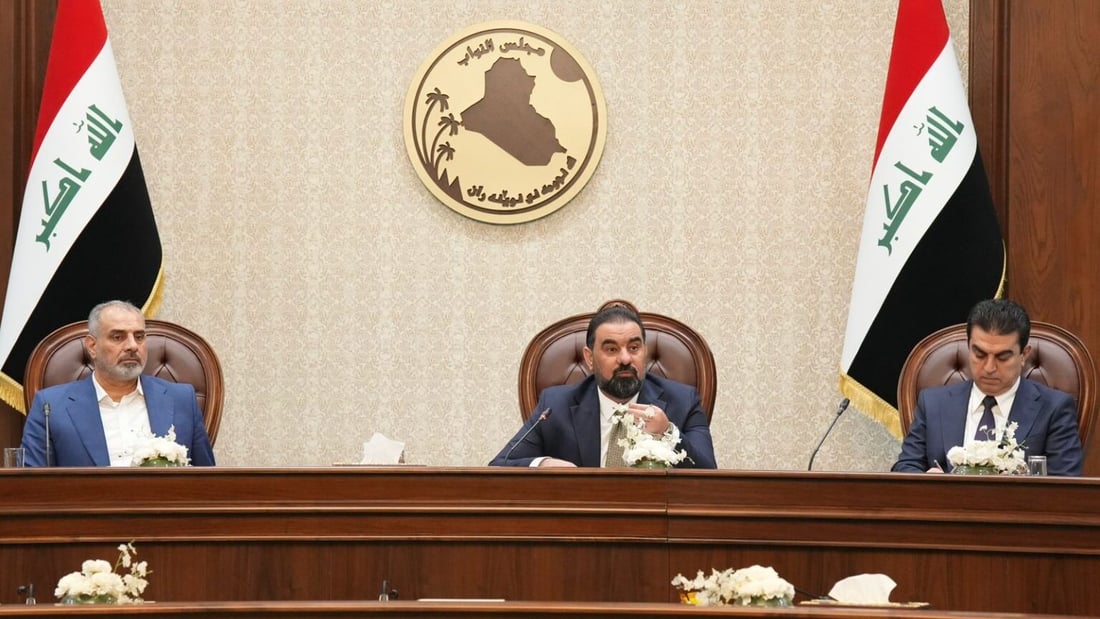
FILES: Speaker of Parliament Haibat al-Halbousi presides over a session of the Council of Representatives in Baghdad
Iraq parliament schedules session to elect president
BAGHDAD — Parliament will hold a session on Tuesday to elect Iraq’s next president, Speaker of Parliament Haibat al-Halbousi announced Sunday. The Media Department of the Council of Representatives said in a statement that “next Tuesday [Jan. 27] will be the session to elect the president of the republic,” following the completion of constitutional and legal steps related to the nomination process.
The announcement follows the completion of the nomination process and the publication of the final list of candidates eligible to run for the largely ceremonial post, which plays a central role in forming the next government.
On Friday, parliament released the final list of 19 presidential candidates after the Federal Supreme Court ruled on objections submitted by applicants whose names were initially excluded. The court upheld the exclusion of 24 objections and ruled that four candidates had been improperly excluded, ordering parliament to add their names to the official list.
In its ruling, the court said it had decided on “twenty-eight objections submitted” and “ruled that the exclusion of four of them was invalid,” adding that parliament was obligated to include them in the final list. The decisions were described as final and binding.
The confirmed list includes incumbent President Abdul Latif Jamal Rashid, former Foreign Minister Fuad Hussein, and senior Patriotic Union of Kurdistan figure Nizar Amedi, who was formally nominated earlier this month by the PUK after the nomination window closed. Parliamentary sources previously said Rashid submitted his candidacy independently, without the endorsement of the PUK bloc.
The Kurdistan Democratic Party has nominated Fuad Hussein for the post, reflecting ongoing competition between the two main Kurdish parties over the presidency.
Under Article 72 of Iraq’s constitution, parliament must elect a president within 30 days of its first session following the election of the speaker and deputies. Article 76 stipulates that the newly elected president has 15 days to task the nominee of the largest parliamentary bloc with forming a government.
The presidency has traditionally been held by a Kurd since 2003 as part of Iraq’s post-war power-sharing arrangement, which allocates the premiership to a Shiite Arab and the speakership of parliament to a Sunni Arab.
On Saturday, Iraq’s Shiite Coordination Framework announced it nominated State of Law Coalition leader Nouri al-Maliki for prime minister by “majority vote.”