
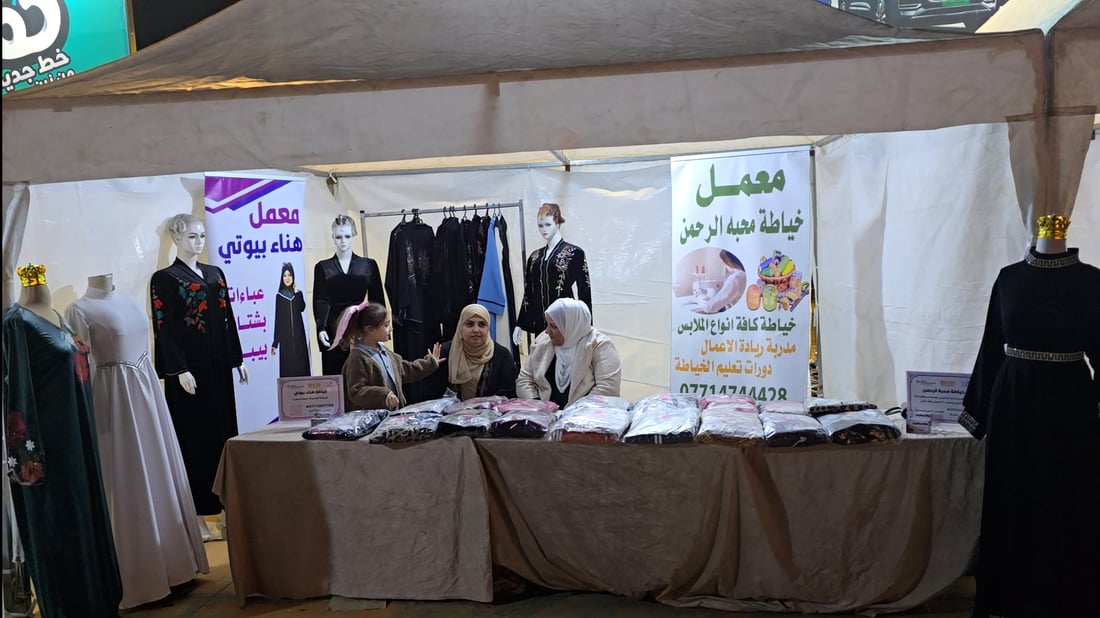
Women display handmade abayas and garments at the “Hanaa Beauty” tailoring booth in Mosul’s Nabi Yunus market, where locally produced designs are prepared for sale to traders in Mosul and Erbil. Photo by 964media.
Mosul workshop supplies abayas to markets in Erbil and beyond
MOSUL — A women-led tailoring workshop in Mosul produces about 200 abayas each week and supplies them to Erbil’s popular Sheikh Allah market, tailoring designs to suit different tastes among Kurdish and Arab customers.
Ghada Khoshnaw, a tailor from Sulaymaniyah, runs her “Hanaa Beauty” project in Mosul’s Nabi Yunus market on the city’s left bank. She specializes in women’s abayas and cloaks and said years of experience working with diverse communities have helped her master subtle differences in preferences.
Khoshnaw works with eight seamstresses at the workshop, alongside about 50 women who embroider beadwork from their homes. The team sends around 200 pieces weekly to traders in Erbil’s Sheikh Allah market, as well as to some shops in Mosul’s Nabi Yunus market.
She distinguishes between Kurdish and Mosuli styles by measurements and finishes. Kurdish abayas are typically 148 centimeters long with 71.5-centimeter sleeves, designed to show jewelry on the hands, with a fitted cut and more shine. Mosuli abayas are usually 150 centimeters long with 73-centimeter sleeves and a 21-centimeter neckline opening, made wider, calmer in tone and with less shine.
Prices vary by design. Beaded abayas sell for between 16,000 and 35,000 Iraqi dinars ($10.88–$23.81), while abayas decorated with “strass” — small shiny plastic stones — range from 16,000 to 20,000 dinars ($10.88–$13.61). Weekly output reaches about 200 strass-pattern pieces, while beaded designs total between 200 and 250 pieces every 10 days due to the longer production time.