
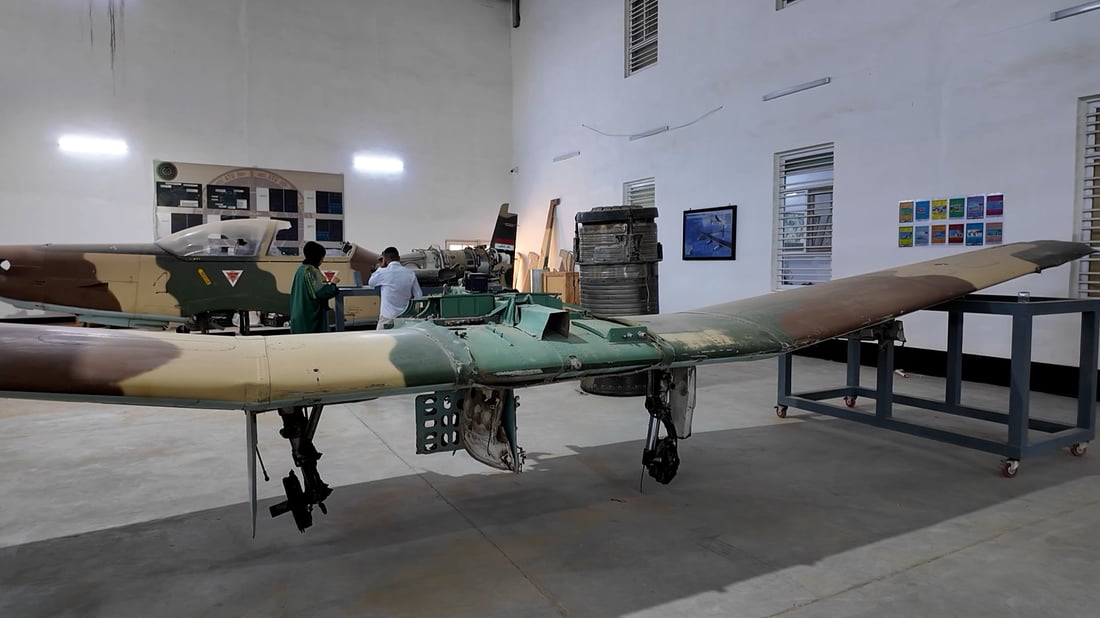
A drone airframe is displayed inside the Aviation Technologies Engineering Department workshop at the Engineering Technical College in Najaf. Photo by 964media.
Aircraft, engines, drones
Najaf college showcases Iraq’s only aviation engineering program
NAJAF — When the Border Ports Commission announced in May that an aircraft had been found inside a shipping container at Umm Qasr port, the discovery set off a familiar round of speculation. Online and in local media, theories ran from a forgotten cargo to an abandoned import to something smuggled and quietly stored. A sealed 40-foot container with a disassembled plane inside invites suspicion.
The answer was more prosaic. The aircraft, a twin-engine Piper Aztec PA-23-250, had been legally imported by Al-Furat Al-Awsat Technical University as a teaching aircraft for the Engineering Technical College in Najaf, officials told 964media. Procurement documents reviewed by 964media identify it by serial number 27-3498 and registration N171WM, shipped disassembled through Umm Qasr and fitted with two Lycoming engines and a KX170 navigation system. “The aircraft arrived in Iraq at the end of 2025 as a gift from the Najaf Reconstruction Authority for student training,” college dean Hassanein Ghani said, explaining that its transfer to the college was held up by the administrative approvals required between government agencies, the delay that left it sitting in a container long enough to look suspicious.
What the plane was destined for is what the college wanted to talk about: an aviation program its officials describe as the only one of its kind in Iraq. During a visit to its workshops and laboratories, staff said students train on real aircraft, helicopters and engines provided by state institutions, learning maintenance, engine systems and aviation technologies on equipment retired from service. “There are a group of aircraft engines, most of which are gifts from the Ministry of Defense and the Iraqi Air Force, including engines for military aircraft,” Shakir said. Among the training hardware are a PC-9 fuselage and an Mi-8 helicopter donated by the Agriculture Ministry.
Shakir said the department has spent years aligning its curriculum with Iraqi Civil Aviation Authority requirements and European Union Aviation Safety Agency standards, recently adding courses on the use of artificial intelligence in aviation. A parallel program at the Najaf Technical Institute specializes in drones, and played a part in Iraq’s early domestic drone work during the war against the Islamic State.
University president Hassan Latif al-Zubaidi said the university worked with the Defense Ministry to build six Iraqi drones that entered service during the war, a program that later expanded to produce nearly 20.
Hazem Ali, head of the institute’s drone technologies department, said students now use simulation software, 3D printers and digital systems to design parts and learn to fly unmanned aircraft, with 3D printing used to make plastic components and cut costs.
Graduates have gone on to work at civilian and military airports across Iraq, with some continuing through the department’s master’s program, officials said. The university also hosts international students through the federal “Study in Iraq” initiative, including from Afghanistan and Nigeria, and Shakir said alumni now in the aviation sector help update the curriculum and supply retired equipment for the workshops.