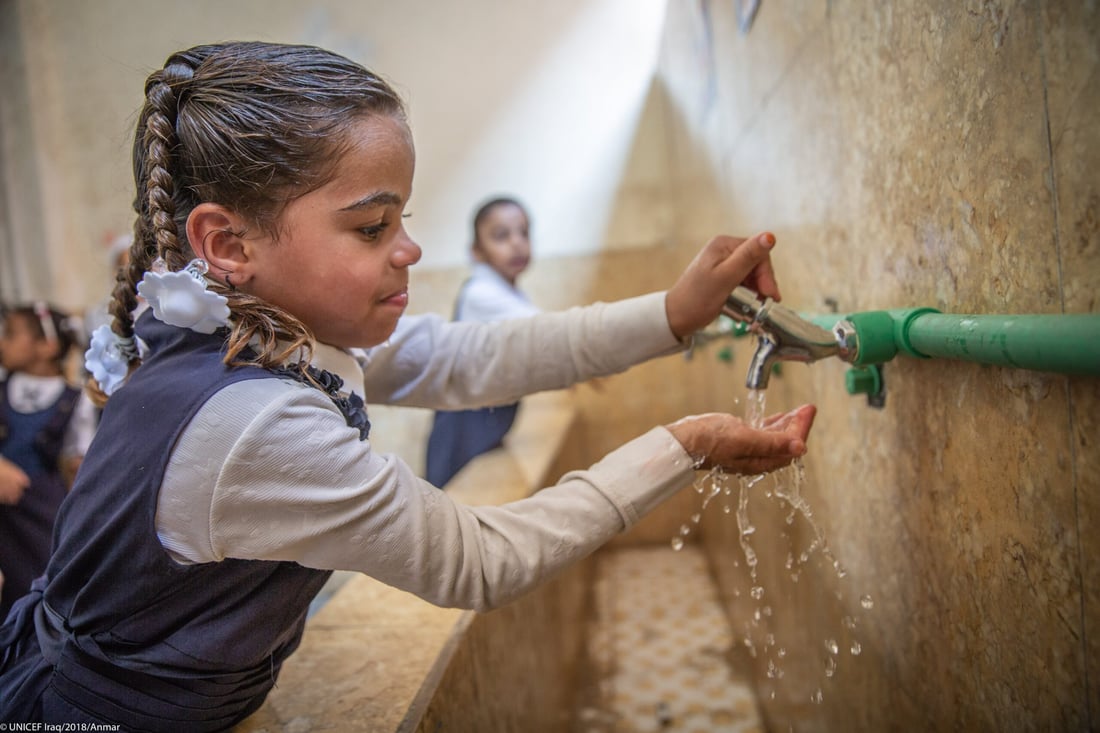
A student washes her hands at a school in Anbar, where access to clean water remains a daily challenge for many families.
UNICEF warns water crisis is stripping millions of Iraqi children of basic rights
BAGHDAD — On World Children’s Day, UNICEF warned that Iraq’s deepening water crisis is depriving millions of children of their fundamental rights as the country’s national reserves fall to their lowest point in more than eight decades.
In a statement, UNICEF said Iraq “faces its most severe water crisis in modern history,” noting that reserves have dropped to just 4 billion cubic meters. The organization said children “pay the highest price now and will continue to do so in the future if no action is taken.”
Christian Skoog, UNICEF’s representative in Iraq, said “every child has the right to safe drinking water and to grow up in a clean and healthy environment.” He added, “Without safe water, children cannot stay healthy, learn or reach their full potential. And if we do not protect Iraq’s water today, we will fail to protect its children and youth tomorrow.”
Iraq is facing what officials describe as its worst drought since 1933. National reserves have fallen from 55 billion cubic meters in 2019 to less than four billion in recent months due to low rainfall, rising temperatures and upstream dam projects. Early forecasts from the General Authority for Meteorology suggest the possibility of higher-than-average rainfall this winter, and the first widespread showers on Nov. 15 — including mountain snowfall in the Kurdistan Region — have brought cautious hope for recovery.
UNICEF said many families receive water in their homes for only a few hours a day, and in some areas only on certain days of the week. When taps run dry, families depend on expensive trucked water or private sources that are often unsafe.
Skoog said Iraq is “one of the youngest countries in the world,” and that its children and youth “are its greatest asset.” He said UNICEF is working with the government on five urgent priorities, beginning with tackling water shortages and climate risks to ensure that “every child can survive, grow and learn in a safe environment free of violence.”
UNICEF frames water scarcity as part of a wider set of challenges affecting children’s rights, including climate impacts; gaps in early childhood services and health care; exposure to violence and harmful practices such as early marriage; unequal access to learning; and weak social-protection systems for vulnerable families.
The organization reaffirmed its commitment to work with the Iraqi government, international and local partners, civil-society groups and the private sector. It said its efforts in Iraq are supported by the European Union, the German Federal Government through KfW, the Government of the Netherlands and other partners.