
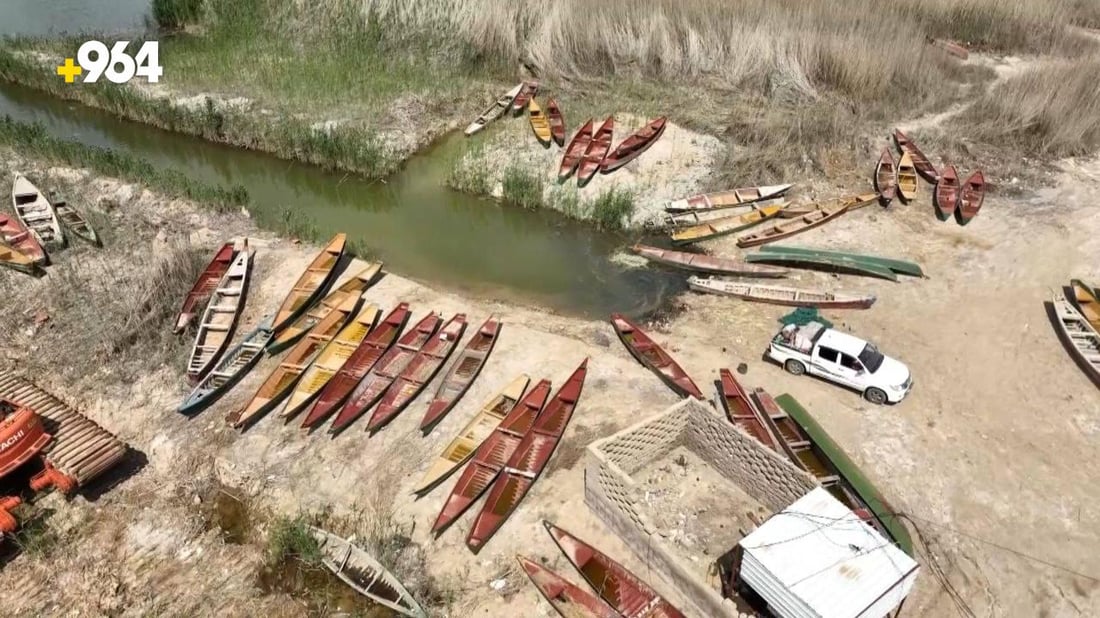
Boats lie idle along a dried waterway in Iraq’s southern marshlands
Green Iraq Observatory warns of ‘worst drought in 90 years’
BAGHDAD — The Green Iraq Observatory warned Saturday that Iraq is facing its most severe drought in nearly a century and said the country needs more than three months of heavy rainfall to restore dangerously low water levels in the Tigris and Euphrates rivers and in nearly depleted reservoirs.
“The Green Observatory announces that Iraq needs rain for more than three months at high rates to try to raise water levels in the Tigris, Euphrates, regulators, and dams that have almost been drained,” the group said in a statement.
It accused the government of having “completely neglected the water issue in favor of political and economic files and conflicts,” adding that the crisis has spread beyond southern governorates to western and northern regions as well.
The observatory cited the minister of water resources in calling the situation “the most severe crisis in 90 years,” warning that reserves could fall “to less than 4% in the coming months if rainfall is delayed in Baghdad and other governorates.”
It added that irregular rainfall “may not solve the problem,” stressing that Iraq requires “heavy, sustained rain for over three months” to secure water for next summer’s agriculture and domestic use.
The group also cautioned against what it described as “a second deception by Turkey,” referring to Ankara’s earlier pledge to release one billion cubic meters of water into the Tigris and Euphrates rivers. “Turkey seeks to pressure Iraq into making more political, security, and economic concessions in the coming period,” the statement said.
In July, Water Resources Minister Aoun Dhiab said Turkey had failed to deliver the promised volumes, contradicting earlier remarks by Parliament Speaker Mahmoud al-Mashhadani, who claimed Turkish President Recep Tayyip Erdoğan had agreed to increase releases beginning July 2.
Despite repeated announcements of progress in talks with Turkey, Iraq has seen no measurable improvement in river flows.
In late September, the General Authority for Meteorology said early forecasts point to higher-than-average rainfall at the end of autumn or the start of winter, raising hopes of recovery after what officials described as the driest year since 1933.
Media director Amir al-Jabri told Al-Sabah newspaper that “the winter season promises good amounts of rain compared to the past two years,” though it remains too early to estimate total precipitation.
Iraq’s water reserves have plummeted from 55 billion cubic meters in 2019 to less than four billion in recent months — about 8% of capacity — amid drought, climate change, and upstream dam projects. Officials warn that continued shortages could accelerate desertification, damage agriculture, and devastate the southern marshlands.