
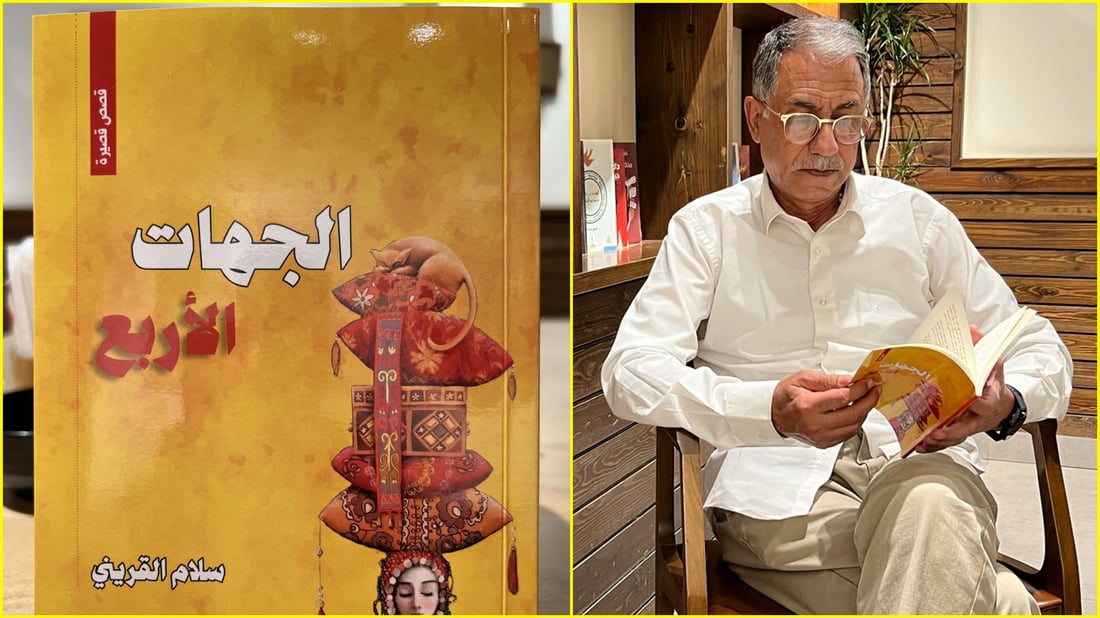
Author Salam Al-Quraini with his new short story collection, The Four Directions. (Photo: 964media)
Iraqi author Salam Al-Quraini’s new story collection explores life under Baath repression
KARBALA — Iraqi author Salam Al-Quraini has released his fifth short story collection, The Four Directions, published by Dar Tulip in Baghdad. The book contains nine stories examining life under authoritarian rule during the Baath era, particularly the regime’s persecution of Iraqi communists, and has attracted attention for its personal and politically reflective tone.
“The stories carry the suffering of the writer, which is also the suffering of the Iraqi individual, endured daily during the long struggle against oppressive regimes,” Al-Quraini told 964media. “Especially those years when the Baathist regime waged its fierce assault on communists in 1978.”
Al-Quraini said the collection combines narrative poetics and autobiography. “Reality and poetic storytelling are essential to short fiction,” he said. “The autobiographical side is also part of the storytelling and continues from my previous works.”
He explained that the title story inspired the name of the book and ties all nine stories together. “The Four Directions is an extension of the agony the Iraqi person endured during that historical era,” he said.
Set against the geography of Iraqi cities, the stories trace their political and social evolution, with Karbala playing a central role. Al-Quraini reflected on the city’s transformation: “The streets once had national names, but during the Baathist era they were renamed with politically charged terms. Today, they carry religious and sectarian names. The change in political power is reflected in the city’s landscape.”
The new collection follows Al-Quraini’s earlier publications, including Al-Mahjuz (2024), which centered on prison literature.
Poet and critic Salah Hassan Al-Silawi described The Four Directions as a blend of simplicity and historical depth. “The stories reflect Iraq’s social realities, highlighting the darkness of the dictatorship era,” he said, pointing to “The Colored Photograph” as emblematic. “A single photo becomes the center of events, portraying the Iraqi family’s search for hope and escape, often heading north in search of happiness.”
Beyond literature, Al-Quraini discussed the state of the Iraqi left and its historical suppression. “The left includes many trends, and the Iraqi Communist Party, like others, was deeply shaken after the collapse of the socialist bloc,” he said. “This shook the faith of leftist forces that once believed in the promise of socialism. Many changed their names and slogans, but the core idea of the left remains as long as exploitation exists.”
He added that leftist movements are regaining strength globally. “In many countries — particularly Latin America and parts of Europe — the left is recovering,” he said. “In Iraq, it will take time. The Communist Party was absent from the Iraqi street for 40 years, and rebuilding will require time.”
Al-Quraini blamed sectarian politics and the rise of political Islam for weakening Iraq’s left. “After 2003, with the rise of sectarian politics, Islamic parties used religious platforms to marginalize the Communist Party,” he said. “Some used every means to bury the left.”