
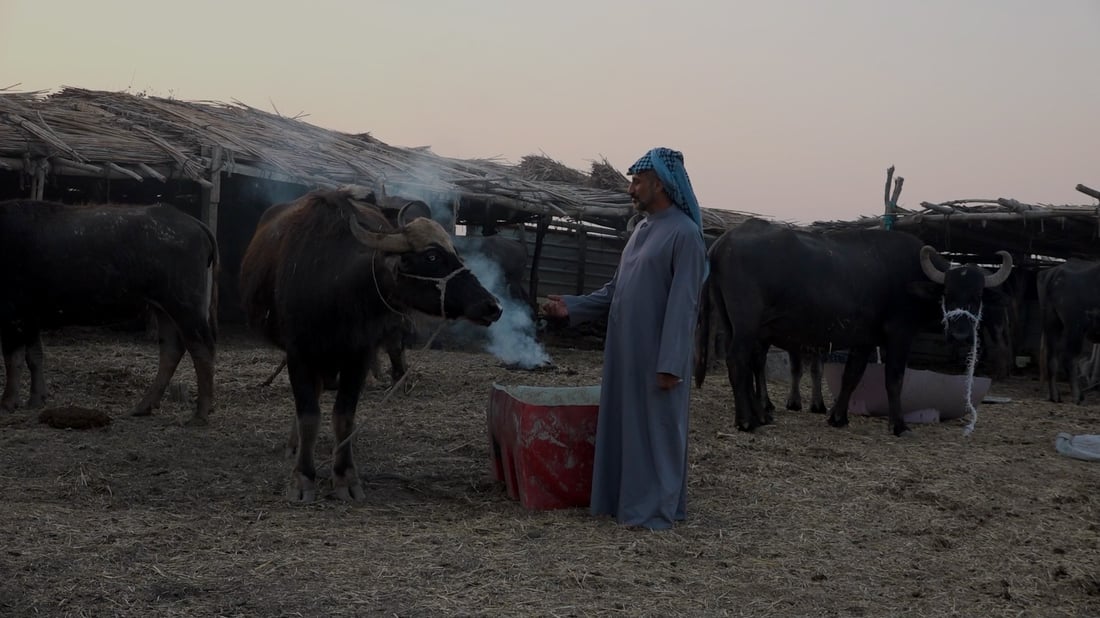
A buffalo herder tends to his animals in the dried marshes of Al-Mashrah in Maysan Governorate, where residents struggle to sustain livestock as water sources vanish. Photo by 964media
Maysan
Marshes vanish and buffalo herders struggle as drought deepens in Iraq’s Al-Mashrah
MAYSAN — Once nestled between rivers and wetlands, the town of Al-Mashrah in Maysan province is now a parched landscape where buffalo herders struggle to survive amid Iraq’s worst drought in decades.
Qasim Jabbar, a herder from the area, has seen his family’s centuries-old livelihood wither alongside the drying marshes. “I inherited buffalo breeding from my ancestors, passed down from the seventh grandfather until today,” he told 964media. “It was our only source of income.”
Jabbar recalled fleeing to Iran during the 1991 Shaaban uprising, taking his herd with him. “They were our means of work and living during the asylum period,” he said. “Our conditions were good thanks to buffalo breeding.”
Today, however, he stands in what remains of Hoor Al-Sauda, once a thriving wetland and now barren. “My house is located between the river and Hoor Al-Sauda, and both have completely dried up,” he said. “We are forced to buy water from Al-Mashrah, which is 20 kilometers away.”
To keep his surviving animals alive, Jabbar purchases four 500-liter tanks of water daily at a cost of 20,000 dinars (around $14). His herd has been reduced by half, and government assistance has yet to materialize. “This is a real tragedy for buffalo breeders,” he said.
Iraq’s Ministry of Water Resources warned in July that the country is experiencing its most severe drought since 1933, with water reserves dropping to just 8% of capacity. Inflows from the Tigris and Euphrates rivers fell to 27% of 2024 levels.
Since 2020, the drying of Iraq’s marshes has devastated rural communities. By 2024 and 2025, areas like Hoor Al-Sauda, Al-Azim, and Al-Jakah had lost their entire water reserves. Some herders sold off their livestock and moved to cities. Others, like Jabbar, continue to endure by selling animals to pay for water hauled from distant filtration plants.
Now, he says he waits for “any idea to save what remains.”