
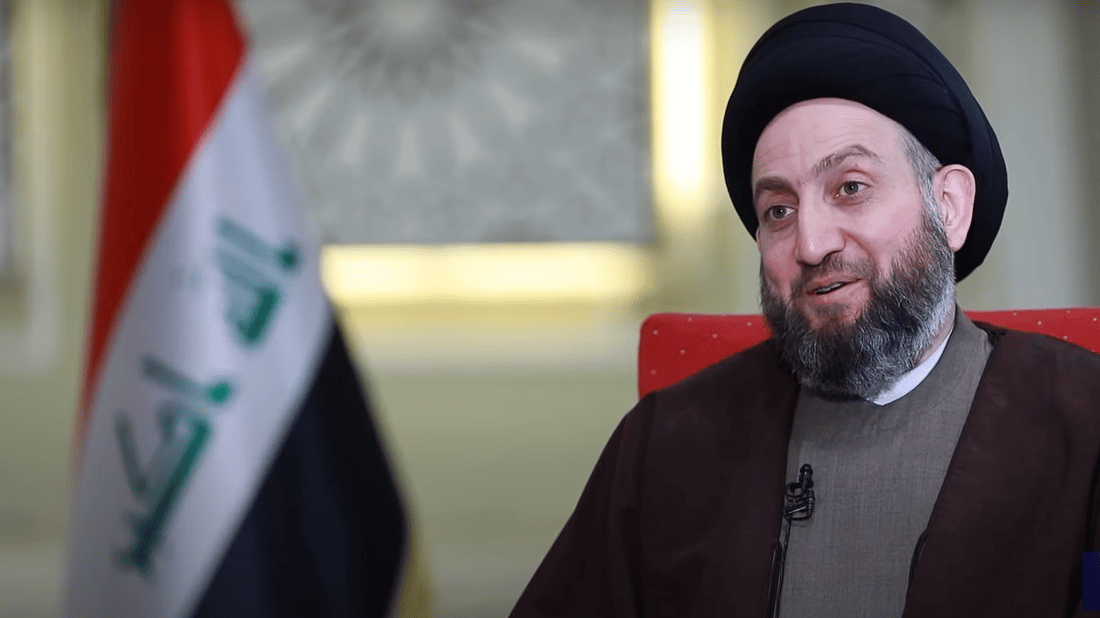
Ammar Al-Hakim, head of Al-Hikma Movement
Hakim says political forces ‘agree’ on restricting weapons to the state
BAGHDAD — Ammar al-Hakim, leader of the Hikma Movement, said Tuesday that Iraq’s political forces have reached a consensus on restricting weapons to state control, describing it as part of efforts to strengthen state institutions.
Speaking to supporters in Baghdad’s Al-Khilani Square in a speech marking the start of Muharram, Hakim devoted much of his remarks to weapons outside state authority. “All political forces have affirmed the necessity of limiting weapons to the hands of the state,” he said. “If yesterday’s priority was protecting the state from collapse, today’s priority is completing the building of the state and consolidating its strength and stability.”
Hakim said “the strength of the state is not complete unless its decision is one and its weapon is one,” adding that the measure “is not targeting anyone, nor diminishing anyone’s sacrifices, but is one of the pillars of building a stable and capable state.” He said wisdom and dialogue were the best path to address the issue “in a way that preserves sacrifices, strengthens the state and reassures all Iraqis.”
He cautioned that the measures should not be read as weakening state security institutions, particularly the PMF. “These procedures do not mean abandoning state institutions and their military formations, foremost among them the Popular Mobilization Forces, which enjoy legal protection and possess great national importance,” he said. “We will not allow it to be targeted or its value diminished, regardless of the circumstances or challenges.”
The remarks come as Iraq formally began integrating Saraya al-Salam into the state security structure at a ceremony in Samarra earlier this month, following Muqtada al-Sadr’s May 27 announcement that the group would come under state authority. The precise command structure for compliant factions has not been publicly detailed, with official statements using broad terms such as “integration” and “restructuring” without specifying whether fighters will be absorbed individually into army units or remain as intact formations.
Harakat al-Nujaba, Kataib Hezbollah and Kataib Sayyid al-Shuhada have rejected disarmament, describing their weapons as “a trust and a duty.” The U.S. State Department’s Rewards for Justice program has offered up to $10 million each for information on Harakat al-Nujaba’s Akram al-Kaabi, Kataib Hezbollah leader Ahmad al-Hamidawi and Kataib Sayyid al-Shuhada secretary-general Abu Ala al-Walaei.
Since the regional war began in late February, Iran-aligned factions under the Islamic Resistance in Iraq umbrella have carried out repeated drone, rocket and missile attacks on U.S. military and diplomatic targets in Baghdad and the Kurdistan Region, while the United States has struck PMF-linked positions across multiple governorates, killing dozens of fighters.