
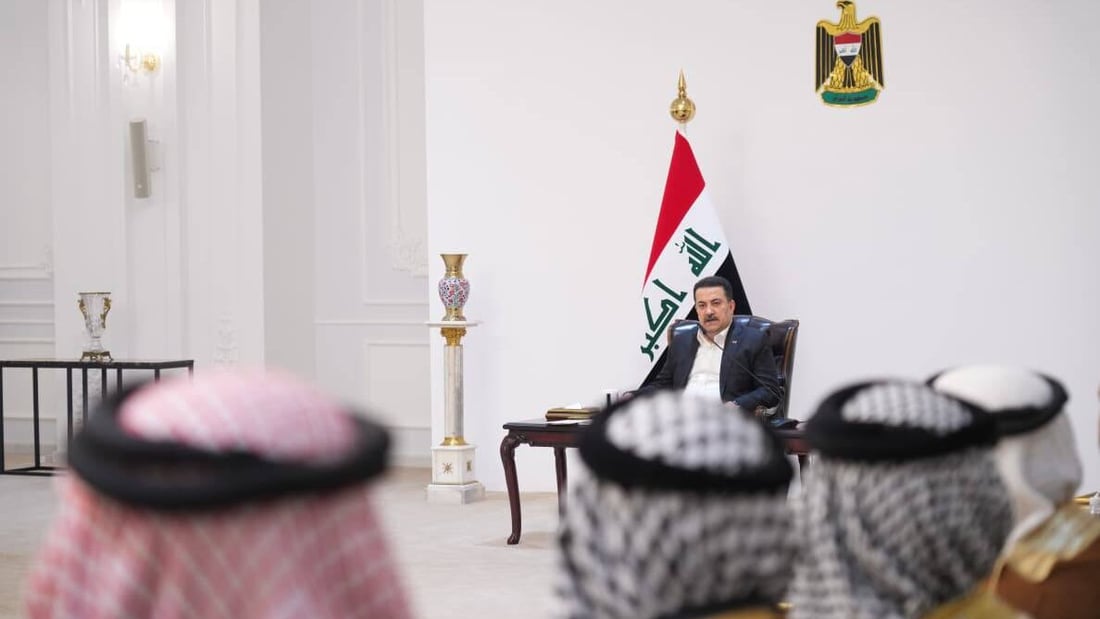
(Photo: Al-Sudani's media office)
Monitor
Al-Sudani calls for ‘professionalism’, warns against vote-buying ahead of November election
BAGHDAD — Prime Minister Mohammed Shia Al-Sudani on Friday urged voters and political actors to maintain professionalism and integrity in the upcoming parliamentary elections, set to take place on November 11, warning against misinformation and coercion.
In a meeting with tribal leaders, community figures, academics, and intellectuals from Latifiya, Yusufiya, and Mahmudiya, Al-Sudani said that electoral competition should be “based on programs and service plans, not coercion or favoritism.” He added, “Such practices do not build a state.”
He called for active participation in the elections and emphasized the importance of preserving the democratic process. “Competition should remain professional—free from misinformation, manipulation, or vote-buying,” he said.
Al-Sudani also urged citizens to continue supporting the rule of law and state institutions, describing this support as essential for the success of national development projects.
Statement from Al-Sudani’s media office:
Prime Minister Mohammed S. Al-Sudani met today, Friday, with a group of tribal leaders, community figures, academics, and intellectuals from the areas of Latifiya, Yusufiya, and Mahmudiya. The Prime Minister expressed his appreciation for such meetings with different segments of society, noting that these areas south of Baghdad represent a vital part of Iraq’s social fabric and its deeply rooted Arab tribes.
He stated that the people of these regions have endured the tragedies of terrorism, which spared no one, and have made great sacrifices, emphasizing that the backbone of victory over terrorism was the unity and solidarity of Iraq’s tribes and communities.
The Prime Minister praised the role of national and social forces, particularly the Iraqi tribes, as the foundation of state-building. He affirmed that the government’s duty is to provide services and address the challenges faced by these regions. He added that the government’s program has prioritized infrastructure and service projects, with the Service and Engineering Effort Team completing major projects in Yusufiya, Mahmudiya, and Latifiya—demonstrating the government’s seriousness and commitment to reconstruction and development.
The following are the key highlights of Prime Minister Al-Sudani’s remarks:
We intensified efforts to complete 2,583 stalled or delayed projects across Iraq.
We launched new projects throughout the provinces, tailored to each province’s specific needs.
The rapid population growth in cities, especially Baghdad, has placed immense pressure on services.
We have implemented solutions through well-defined plans and visions, resulting in important infrastructure projects across the country.
We launched projects to ease traffic congestion, improve infrastructure, and build hospitals—vital for citizens’ well-being.
Despite regional turmoil and conflicts, our government has achieved significant progress in less than three years.
The total value of Arab and foreign investments in Iraq has exceeded 102 billion USD, despite regional challenges.
These investments have created approximately 500,000 job opportunities for Iraqi youth.
The government has developed a comprehensive plan to rehabilitate and operate Baghdad International Airport according to global standards, with 14 international consortiums applying for its development.
Iraq is well-positioned for economic takeoff, backed by abundant opportunities and a strong investment climate.
Iraq cannot continue to rely solely on oil revenues; the country possesses vast industrial, agricultural, and tourism resources, in addition to its strategic trade position through the Development Road Project.
Active participation in the elections is essential, and competition should remain professional—free from misinformation, manipulation, or vote-buying.
Competition must be based on programs and service plans, not coercion or favoritism—such practices do not build a state.
We call on our people to continue supporting the rule of law, the state institutions, and national development projects.