
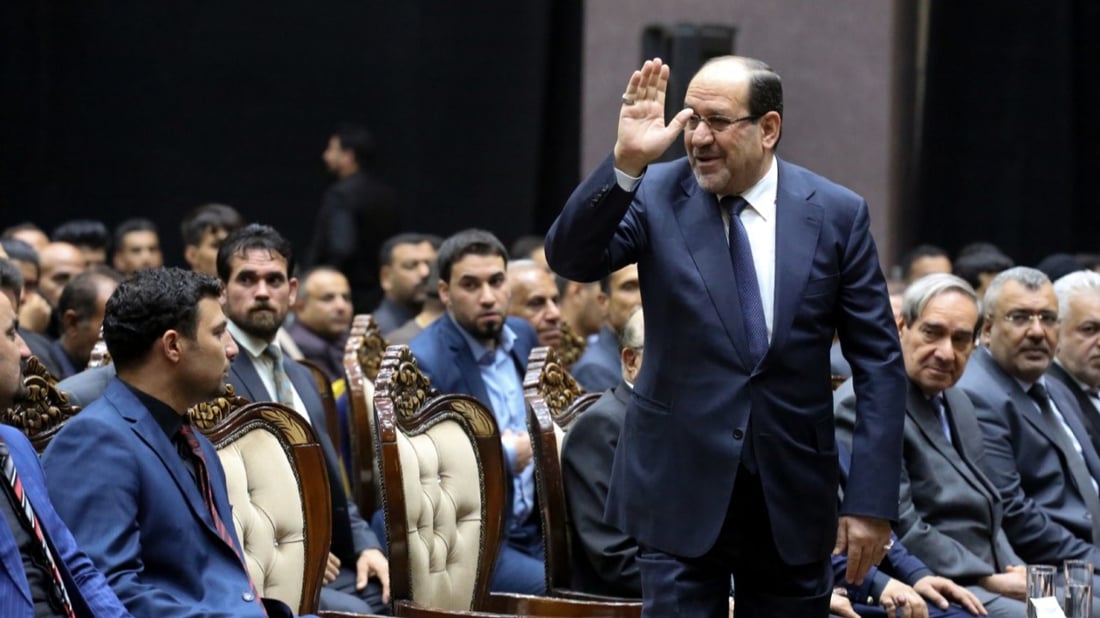
Nouri Al-Maliki, head of the State of Law Coalition, greets attendees during a political gathering in Baghdad.
Monitor
State of Law’s Al-Moussawi backs Sadr’s call to curb protests
BAGHDAD — Abbas Al-Moussawi, a leader in the Nouri Al-Maliki-led State of Law Coalition, said Iraq’s political process needs “an observer who identifies mistakes,” pointing to recent remarks by cleric Muqtada Al-Sadr as highlighting internal and external challenges facing the country.
“I always say we in the political process need an observer who identifies mistakes. If you are inside the government formation, many matters will be hidden from you. Mr. Muqtada Al-Sadr’s tweet yesterday was an observation and identification of many issues… especially the risks of the Zionist entity, normalization, protecting the Popular Mobilization Forces’ position, and the problems related to electricity and services,” Al-Moussawi told Al-Rabiaa TV.
Al-Moussawi also said Sadr’s call to ban armed appearances and demonstrations “brought relief to all Iraqis,” adding that it showed awareness of attempts by groups to exploit unrest or delay elections.
Al-Sadr on Tuesday ordered his followers to halt all protests and avoid armed displays, directing them instead to respond only through social media amid rising tensions following allegations of an assassination plot.
“To block the corrupt and ward off the sedition they are seeking… all armed appearances are prohibited, even for Saraya Al-Salam [his movement’s armed wing], except in areas of direct contact with terrorism,” Al-Sadr said in a statement. “Gatherings and demonstrations, even peaceful ones, are also prohibited unless directly ordered by us.”
The announcement came a day after Al-Sadr made a public appearance at the shrine of his father, Grand Ayatollah Mohammed Sadiq al-Sadr, in Najaf. His visit followed large rallies by supporters in Basra sparked by claims of a drone plot to kill the cleric.
Excerpts from Abbas Al-Moussawi’s interview with Al-Rabiaa TV:
I always say we in the political process need an observer who identifies mistakes. If you are inside the government formation, many matters will be hidden from you. Mr. Muqtada Al-Sadr’s tweet yesterday was an observation and identification of many issues related to Iraq’s internal and external situation, especially the risks of the Zionist entity, normalization, protecting the Popular Mobilization Forces’ position, and the problems related to electricity and services, among others. I was pleased with this tweet.
Mr. Al-Sadr’s talk about the Baath was describing it as a crumbling party, and this is true, but we have concerns about Baathists trying to infiltrate the political process by penetrating Islamic lists. These people exploit political freedom and the democratic process to return once again to political life through demands for services and the like.
Mr. Al-Sadr’s tweet today banning gatherings, demonstrations, and armed appearances brought relief to all Iraqis. It means Mr. Al-Sadr is closely monitoring the Iraqi reality and knows there are parties that may exploit these gatherings. He knows there are parties that do not want elections to be held, that do not want them to take place on time. We in the State of Law Coalition supported the return of the Sadrist Movement, and when the registration period closed and we heard there were intentions for their return, the position of Al-Maliki and Al-Amiri was to reopen registration again. This stance is known to our brothers, because their boycott would disrupt the political process, even though their participation does not affect our momentum and votes. Their audience is ideological and will not vote for us.
The political agreement to form the government stipulated holding early elections one year after its formation, but the government delayed this agreement and did not hold elections after a year. We had serious concerns about similar procrastination in not holding legislative elections on time as well, leaving us with a de facto government. This is what some media outlets close to the government promoted when they began talking about an emergency government.
Mr. Al-Sadr calls for reform, and this does not mean he wants to overthrow the system. We also call for some reforms—at the level of government spending, governors’ powers, and stopping the electoral exploitation of state resources. This is what we agreed upon with [Prime Minister] Al-Sudani, and men stand by their words, but none of this has been implemented. Therefore, in the coming period, we will move toward a constitutional amendment to prohibit a second term for any prime minister and limit it to one term only, because any prime minister who comes will seek a second term from the very first day in power.