
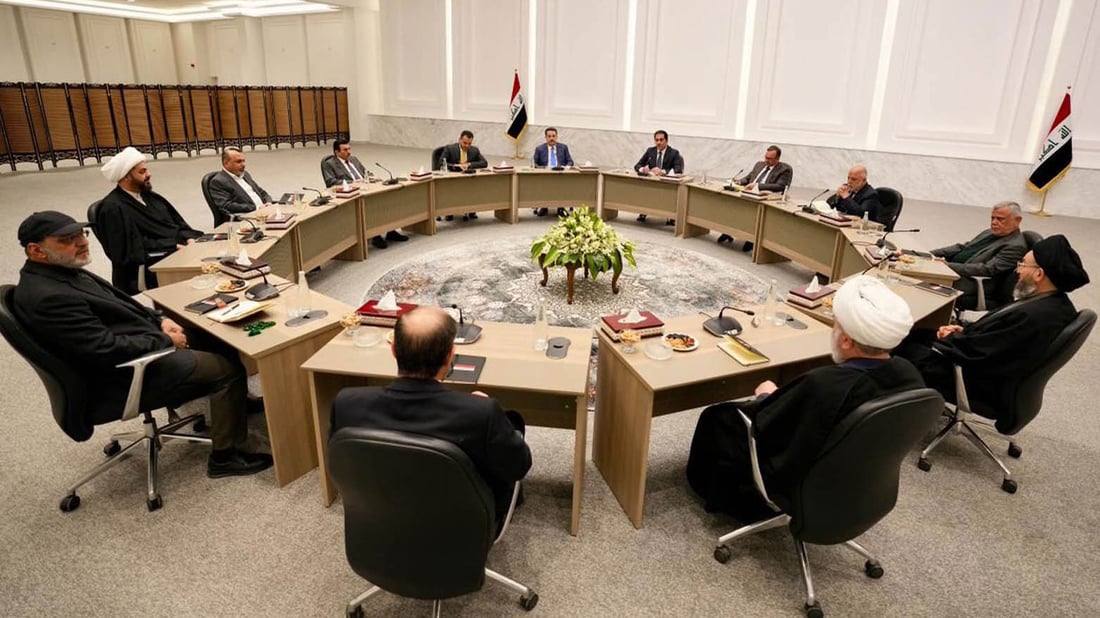
FILES: Leaders of Iraq’s Coordination Framework meet in Baghdad
Alliances tested
Iraq enters constitutional breach with no PM nominee named and no resolution in sight
BAGHDAD — Iraq passed the first day of a constitutional breach Monday after political blocs failed to nominate a prime minister within 15 days of President Nizar Amedi’s April 12 election, with political activity continuing in routine fashion and no immediate resolution in sight.
The lapse marks what legal interpretations describe as a second constitutional breach. The first occurred when the presidency itself remained unfilled for 71 days beyond its deadline.
Some politicians have argued the deadline remains valid if official holidays are excluded, but Mashreq al-Furaiji, a leader in the Reconstruction and Development Coalition, rejected that view, saying the 15-day period had already ended. He blamed “one party that disrupted four meetings with weak justifications” and “itself hindered consensus and fueled crises in most previous governments” — an apparent reference to the State of Law Coalition led by Nouri al-Maliki, which continues to insist on its nominee.
Frustration has grown within Sudani’s bloc, which considers itself the election winner and has waited more than five months for the position to be finalized. Furaiji raised the idea of forming a “new largest bloc,” a proposal previously outlined by lawmaker Alia Nassif, who said Sudani’s allies within the framework hold 116 lawmakers — potentially enough to secure a parliamentary majority if enough external parties and factions are courted.
The proposal faces legal hurdles. Legal expert Abbas al-Aqabi said the largest bloc is not a formally registered alliance, making it difficult to establish a new one without all signatories to the original agreement submitted in December 2025. He also pointed to restrictions preventing lawmakers and parties from changing alliances after elections until a government is formed. “The largest bloc was formed from several parties, and it is not an officially documented alliance with a head or spokesperson,” he said, adding that a key issue would be identifying who is authorized to submit a nominee on its behalf.
Some leaders have downplayed the breach. Supreme Council head Hammam Hamoudi said the delay “is not an Iraqi flaw or a personal battle,” while Abbas al-Moussawi, an adviser to Maliki, said exceeding the deadline “does not result in any legal consequence affecting the legitimacy of the political process or the validity of assigning a prime minister afterward.” Hadi al-Amiri and Ammar al-Hakim have continued to call for adherence to constitutional timelines while emphasizing framework unity.
Political observer Hussein Arab said a nominee could be selected within “hours,” describing the expected figure as a “compromise candidate” who may not be among the prominent names discussed in recent months. A scheduled framework meeting on Sunday was postponed again without agreement. Parliament extended its legislative term by one month after Speaker Haibat al-Halbousi called on the framework to submit a nominee before the extension was approved.