
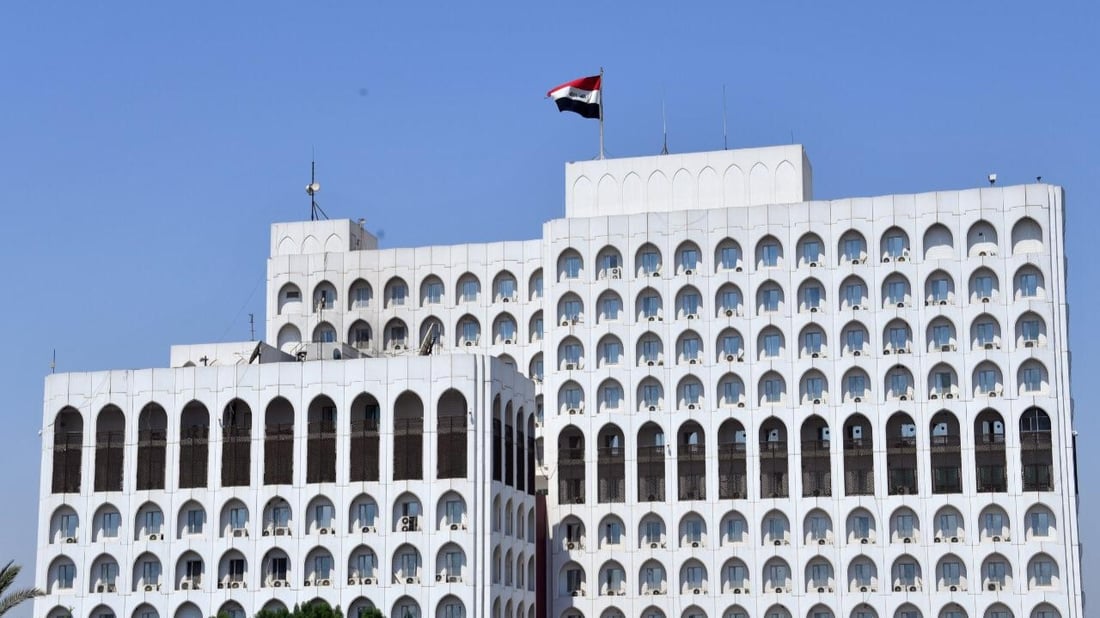
The headquarters of Iraq’s Ministry of Foreign Affairs in Baghdad
Monitor
Iraq condemns Netanyahu’s ‘Greater Israel’ comments
BAGHDAD — Iraq has joined a growing list of Arab states voicing concern over Israeli Prime Minister Benjamin Netanyahu’s recent endorsement of a “Greater Israel” vision — a political idea dating back decades that envisions Israeli control over territories beyond its internationally recognized borders. In a statement Thursday, Iraq’s Ministry of Foreign Affairs said the remarks reveal “expansionist ambitions” and threaten “security and stability in the region.”
“The Ministry of Foreign Affairs expresses the Republic of Iraq’s strongest condemnation of the statements made by the occupying entity regarding what it calls the ‘Greater Israel Vision,’ which clearly reveal this entity’s expansionist ambitions and reaffirm its pursuit of undermining security and stability in the region,” the ministry said.
It described the comments as “a blatant provocation to the sovereignty of states and a flagrant violation of international law and the Charter of the United Nations—matters that require a clear and resolute Arab and international stance to confront such policies.”
The ministry also said the remarks “come in parallel with the continued adoption by the occupation authorities of aggressive policies and the perpetration of crimes against the Palestinian people,” and called for “effective action to put an end to the occupation’s transgressions and to halt the policy of impunity.”
Netanyahu told Israel’s i24 channel in an interview on Aug. 12, 2025, that he is on a “historic and spiritual mission” and strongly supports a “Greater Israel” vision. He said the vision includes the occupied Palestinian territories and parts of Jordan, Lebanon, Syria and Egypt. “I am on a mission of generations… So, if you are asking whether I feel this is a historical and spiritual mission, the answer is yes,” he said.
The term “Greater Israel” emerged after the 1967 Six-Day War, when Israel captured East Jerusalem, the West Bank, Gaza, the Sinai Peninsula and the Golan Heights. While the Sinai was returned to Egypt in 1982, the concept remains a reference point for some political platforms calling for Israeli control over these and additional territories.