
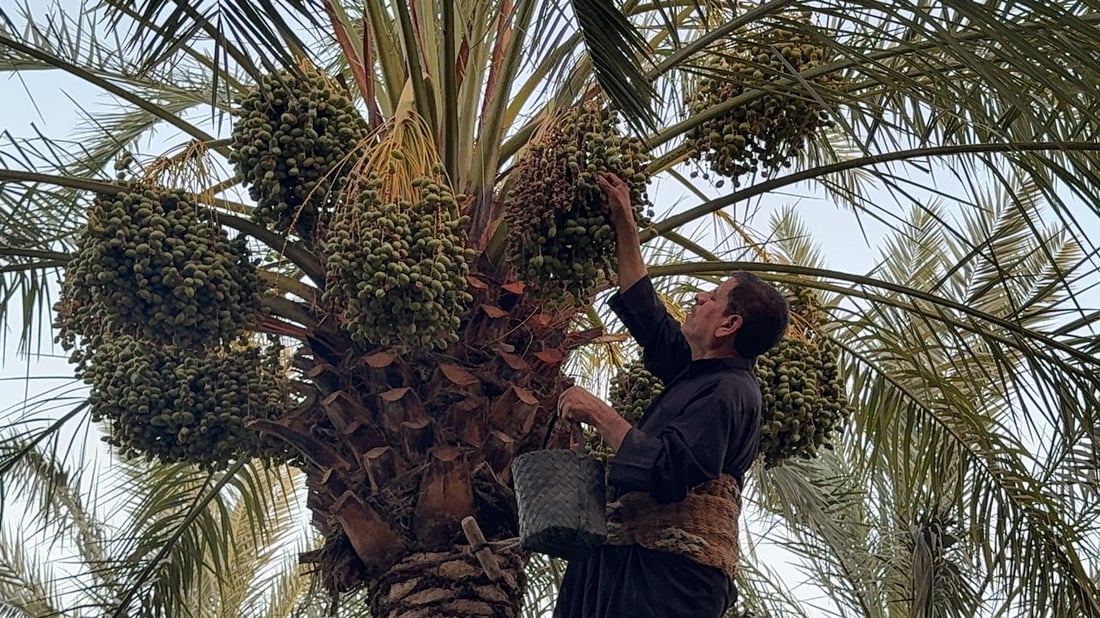
FILES: A farmer in Hoair, north of Basra governorate, harvests early-ripened dates from a palm tree, using a traditional basket strapped around his waist. Photo by 964media
Basra’s date harvest picks up, but heat delays premium varieties
BASRA — The date market on Basra’s Bashar Street is taking in about 7 metric tons of fresh rutab dates a day as the harvest gathers pace, though traders say premium varieties are running late this year after a delayed onset of extreme summer heat.
Wholesale trader Haider Abdul Hassan told 964media that supplies had risen as temperatures climbed, with farmers now bringing five to 10 boxes at a time instead of one. The market is receiving Halawi and Sayer for now, he said, with Oweidi, Dikal, Barhi and Buraim expected in the coming days; he alone had taken in about 1.5 metric tons. Halawi, wrinkled and sweet, is the favorite in Basra, he said, while Sayer sells better elsewhere in Iraq. Wholesale prices run about 5,000 dinars (about $3.30) a kilogram.
Trader Mohsen Jaafar said shipments to other governorates had already begun, with three metric tons headed to Baghdad and Karbala, and that farmers were harvesting around the clock. Badr Jumaa, another wholesaler, said supplies remained limited but should grow as Buraim and Barhi come in. He said buyers in Baghdad and Najaf prefer Sayer while Halawi is stronger in Hilla and Karbala, and that shipments to other governorates were holding at about 200 kilograms each because of lower production tied to earlier water shortages and high prices.
The market’s fortunes have tracked Basra’s water troubles for years. In July 2025, traders at the same market reported reduced yields and worsening salinity pushing prices up even as demand from other governorates held strong. Basra remains a cornerstone of Iraq’s date production: in December 2024 the Basra Agriculture Directorate put the governorate’s palm count at more than 2.63 million, crediting government support for expanded cultivation.
Iraq was once known as the land of 30 million palms, with dates its second-largest export after oil, but decades of war and environmental damage have thinned the groves. The Iran-Iraq War of 1980 to 1988 destroyed vast plantations around Basra in particular.