
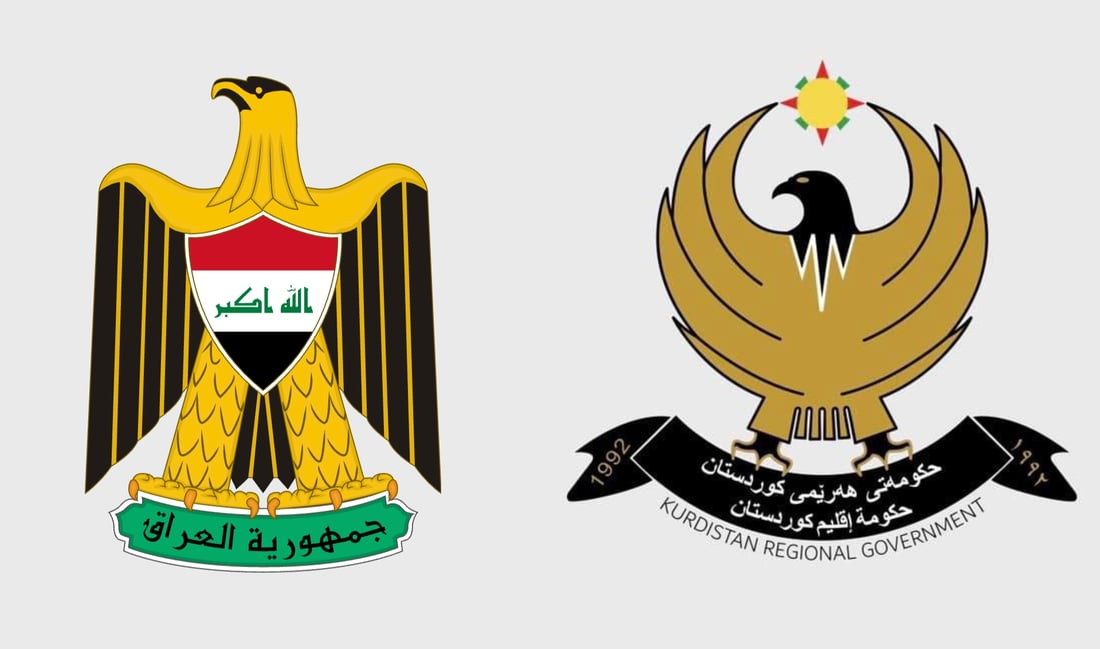
Emblems of the Iraqi Federal Government (left) and the Kurdistan Regional Government (right).
Interior minister remarks
Erbil says it knows source of drone attacks, awaits joint probe findings
ERBIL — Kurdistan Regional Government Interior Minister Rebar Ahmed said Saturday that Erbil has detailed knowledge of who is behind the recent wave of drone attacks in the Kurdistan Region but is awaiting the results of a joint investigation with Baghdad before releasing specific findings.
“We know where the drones are made, how they are launched toward the Kurdistan Region, and what their targets are,” Ahmed said at a press conference. “But we are waiting for the joint committee to complete its work and issue an accurate, fair, and honest report.”
A joint technical committee, formed by the KRG and the federal government, is currently investigating the type of drones used and identifying which armed groups in Iraq are responsible. “The groups and parties behind these attacks must be punished,” Ahmed said.
Nearly 20 drone-related incidents have been recorded across the Kurdistan Region in recent weeks, targeting oil infrastructure and civilian areas in Erbil, Duhok, Kirkuk, and Makhmour.
On July 30, an explosive drone crashed near the village of Duwgirdkan in Makhmour without detonating. Two days earlier, three drones crashed in Erbil, Duhok, and Kirkuk. No casualties were reported, and no group has claimed responsibility.
Earlier in the month, explosive drones struck oil fields in Sheikhan, Chamanke, and Bahrka, temporarily halting production at five facilities and disrupting over 200,000 barrels per day.
Aziz Ahmed, deputy chief of staff to KRG Prime Minister Masrour Barzani, said the drones that struck oil sites were launched from Dibis district in Kirkuk.
“The suicide drones that targeted oil fields in the Kurdistan Region last week flew from Dibis, Kirkuk,” he wrote on X. “We know exactly who’s behind these attacks and where they’re coming from.”
In response to the escalation, Iraq’s National Security Adviser Qasim al-Araji led a federal delegation to Erbil on July 28. The delegation included representatives from the Popular Mobilization Forces, the Iraqi Intelligence Service, the National Security Service, and counter-terrorism units.
At a joint press conference, al-Araji said the security of the Kurdistan Region and Baghdad are interconnected.
“The strength of the region is the strength of Baghdad, and vice versa. Any targeting of economic interests in Iraq harms Iraq and all Iraqis,” he said. He confirmed that technical teams had begun their investigation but noted it was too early to assign blame.
While Rebar Ahmed described the visit as “reassuring,” he voiced frustration over the lack of accountability for past incidents.
“Several committees had investigated previous incidents and reached conclusions, but no action was taken against the groups responsible, and no boundaries were set for them,” he said.