
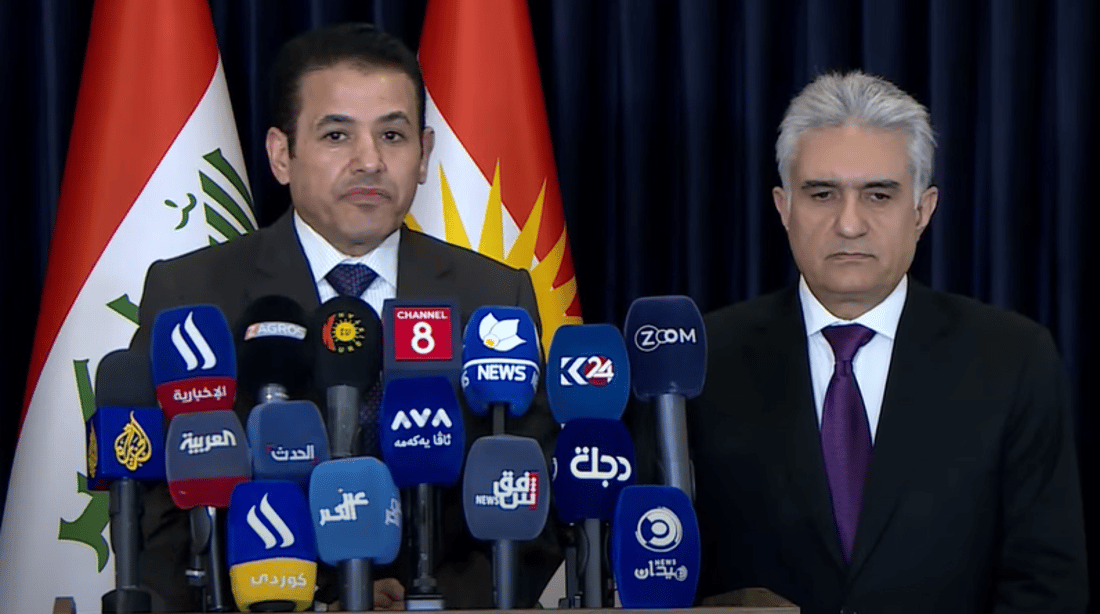
National Security Advisor Al-Araji (left) and KRG Interior Minister Rebar Ahmed (right) at a press conference in Erbil on Monday.
Iraq’s national security adviser leads delegation to investigate drone attacks on Kurdistan Region
ERBIL — Iraq’s national security adviser, Qasim al-Araji, arrived in Erbil on Monday with a high-level security delegation to investigate a series of recent drone attacks in the Kurdistan Region this month that have targeted oil infrastructure and raised tensions between federal and regional authorities.
The delegation, dispatched from Baghdad, included representatives from the Popular Mobilization Forces, the Iraqi Intelligence Service, the National Security Service, and the director of counter-terrorism intelligence.
Their visit came the same day that three explosive-laden drones crashed in Erbil, Duhok and Kirkuk governorates, according to local officials and residents. No group has claimed responsibility for the latest incidents.
Earlier this month, explosive drones struck multiple oil facilities in the Kurdistan Region, temporarily halting production at five fields, including two operated by U.S. companies. The strikes, which hit areas in Sheikhan and Chamanke in Duhok governorate and Bahrka in Erbil, knocked more than 200,000 barrels per day offline.
Speaking at a joint press conference with Kurdistan Regional Government Interior Minister Rebar Ahmed, al-Araji said the federal government was committed to uncovering the source of the attacks. “The strength of the region is the strength of Baghdad, and vice versa,” he said. “Any targeting of economic interests in Iraq harms Iraq and all Iraqis.”
Al-Araji cautioned that it was too early to assign blame but said both the KRG and federal government had shared intelligence. “It is too early to determine the responsible parties, but there will be technical committees to uncover the truth,” he said. “The guarantee from the federal government to prevent such attacks is the enforcement of the law against perpetrators. All those who are negligent or responsible must be held accountable.”
He added that Prime Minister Mohammed Shia al-Sudani is “determined” to identify those behind the recent drone attacks.
Minister Ahmed welcomed the federal delegation and said al-Araji’s inclusion in the investigation was “reassuring.” He added, “We hope Kurdistan Region will no longer be viewed as an enemy.”
Ahmed said the attacks had severely impacted oil production and caused some companies to withdraw. “Because of these attacks, we were unable to export oil to SOMO on time,” he said.
He also criticized the federal government’s failure to act on findings from previous investigations. “Several committees had investigated previous incidents and reached conclusions, but no action was taken against the groups responsible, and no boundaries were set for them.”
The newly formed security committee began its work Monday, with Ahmed confirming that a technical team would examine drone remnants to help identify their origin and the parties responsible.