
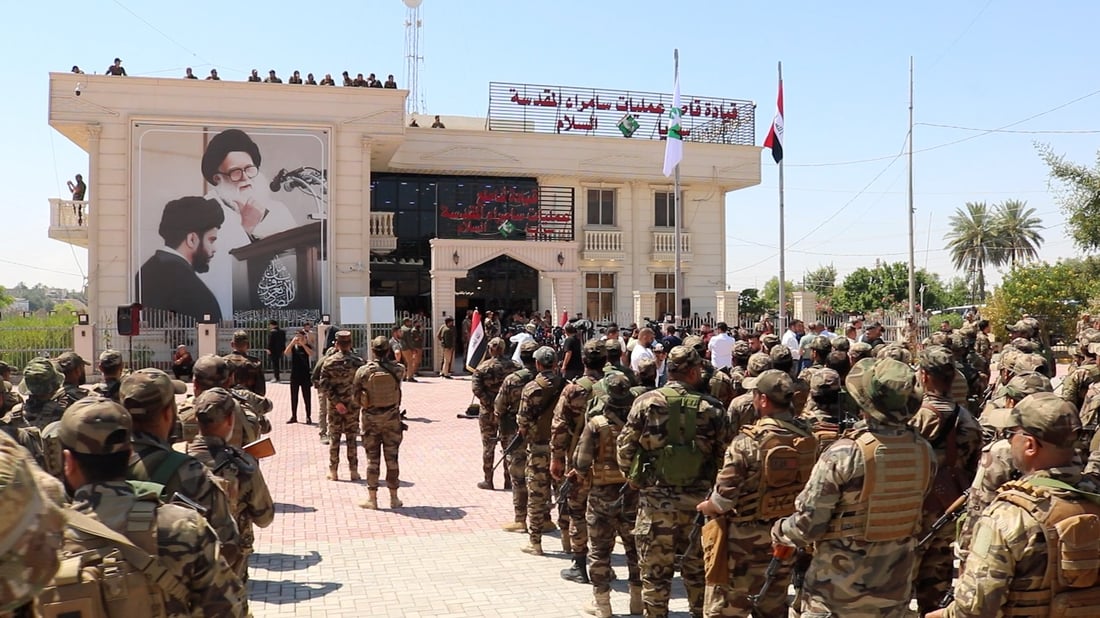
Iraq begins ‘integration’ of Saraya al-Salam into state security structure
SALAH AL-DIN — Iraq has begun the formal process of integrating Saraya al-Salam into the state security structure, the Deputy Commander of the Joint Operations Command announced Thursday at a ceremony in Samarra attended by local officials and Saraya al-Salam commanders.
“Implementing the government program and in line with the initiative of Sayyid Muqtada al-Sadr, we announce the start of restructuring, full integration and the transfer of military affiliation to the commander-in-chief of the armed forces,” Qais al-Muhammadawi said. He said a committee formed by executive order would reorganize and redistribute armed formations, moving them away from political affiliation and placing them under state authority. Weapons will be handed over based on classification — light, medium or heavy — before formations are relinked to security forces according to priorities and sectors.
Al-Muhammadawi praised Saraya al-Salam’s role in previous security operations and said Asaib Ahl al-Haq and the Imam Ali Battalions had also shown readiness to implement similar measures quickly in light of regional and domestic developments.
The move follows Sadrist Movement leader Muqtada al-Sadr’s announcement on May 27 that Saraya al-Salam would separate from the movement and come under state authority. It is not the first such announcement: Sadr made similar declarations in 2017 and 2019. Saraya al-Salam was formed in 2014 following the rise of the Islamic State and is officially part of the PMF. Sadr and his movement have not participated in Iraqi elections since 2022, when Sadrist lawmakers resigned en masse following a prolonged political deadlock, allowing rivals within the Coordination Framework to fill the vacant seats.
The precise command structure for Saraya al-Salam and other compliant factions has not been publicly detailed. Official statements use broad terms such as “integration,” “restructuring” and “limiting weapons to the state” without specifying whether fighters will be absorbed individually into army units or remain as intact formations — effectively the arrangement under which much of the PMF already operates on paper, with brigades nominally answering to the prime minister while retaining distinct identities and leadership networks.
Other factions staked out opposing positions. Harakat al-Nujaba, Kataib Hezbollah and Kataib Sayyid al-Shuhada rejected disarmament, describing their weapons as “a trust and a duty.”