
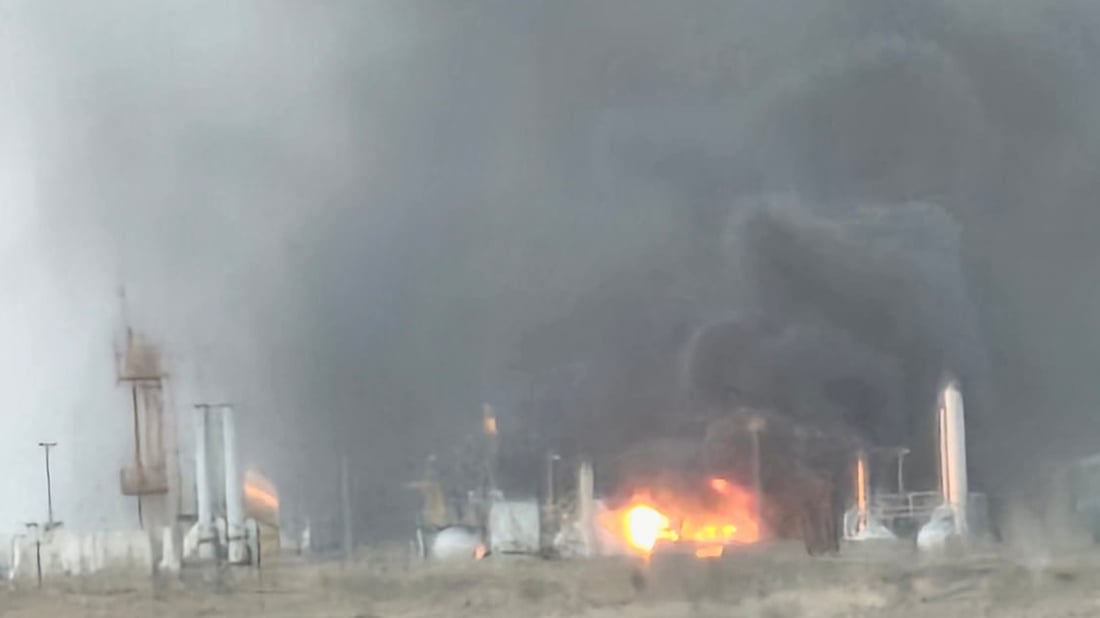
A scene from an oil field in Sheikhan, Duhok, after being struck by a drone for the second time in July, resulting in a large fire and visible black smoke.
'Calculated campaign'
Drone strikes hit oil facilities across Kurdistan Region, halting output and drawing US condemnation
KURDISTAN REGION — A series of drone strikes targeted oil infrastructure in the Kurdistan Region on Wednesday evening, escalating a wave of attacks this week that have forced production halts and drawn sharp condemnation from the United States and regional officials.
At 7:10 p.m., a drone struck an oil facility in the Sheikhan district of Duhok, igniting a large fire, according to local officials and video shared by residents. The attack followed an earlier strike at 7:14 a.m. on the same site, which is operated by U.S.-based Hunt Oil, the Erbil-based Directorate General of Counter-Terrorism said.
Roughly three hours after the evening strike in Sheikhan, another drone targeted the Berkiyat oil field in Chamanke subdistrict, also in Duhok governorate. Video posted on social media showed security personnel firing at the drone, but it was not brought down.
A third drone incident was reported overnight. At 1:27 a.m. Thursday, a drone crashed near the village of Jezhnikan in Bahrka district, Erbil. No injuries or damage were reported.
The Association of the Petroleum Industry of Kurdistan strongly condemned the attacks and said production had been suspended at multiple sites across the region following the July 15–16 strikes, even at locations not directly hit.
“These attacks threatened the lives and safety of our predominantly Iraqi workforce and expatriate staff of various nationalities, and also damaged facilities,” the association said. It reported a production shutdown totaling more than 200,000 barrels per day and urged the Iraqi federal and Kurdistan Region governments to bolster security.
The Kurdistan Regional Government’s Ministry of Natural Resources also condemned the continuing strikes, describing them as “terrorist acts” that endangered oil production, public safety, and the lives of sector workers. The ministry called on Baghdad and the international community to intervene to prevent further attacks and safeguard vital infrastructure.
In a post on X, formerly Twitter, Aziz Ahmad, deputy chief of staff to KRG Prime Minister Masrour Barzani, said, “The Kurdistan Region has lost nearly 200,000 barrels of oil production after a spate of drone attacks by criminal militias on the Iraqi government payroll.”
He said five oil fields were targeted, including two operated by U.S. companies, and warned that “the Region’s very survival — and its infrastructure — hangs in the balance.”
“This production keeps the lights on and the government running,” Ahmad wrote. “Our American partners have long denied us the tools to defend our energy and civilian infrastructure. We need them now to help us defend ourselves — we know exactly who’s behind these attacks and where they’re coming from.”
He added that the KRG had welcomed U.S. investment and companies, but said the current conditions were driving them out. “Now, those same investors are being pushed out in a calculated campaign to economically strangle us,” he wrote. “Still no call from [Secretary of State Marco] Rubio. We need more than words.”
No group has claimed responsibility, but earlier this month the KRG Ministry of Interior formally accused factions linked to Iraq’s Popular Mobilization Forces of orchestrating a coordinated campaign of drone attacks to destabilize the region.
The U.S. Department of State on Wednesday night issued a condemnation of the strikes.
“These attacks imperil Iraq’s stability and economic future,” spokesperson Tammy Bruce said in a statement. She called the targeting of international energy companies “unacceptable” and stressed that Baghdad “has a duty to protect its territory and all of its citizens.”
“The United States remains committed to our partners across Iraq who are working to build a stable, federal, and sovereign state,” the statement said.
The U.S. Consulate General in Erbil issued a similar condemnation Tuesday after days of strikes, calling the attacks “unacceptable” and warning they undermine sovereignty and deter foreign investment. It urged Baghdad to investigate and hold those responsible to account.
On May 19, the Kurdistan Regional Government signed two multi-billion-dollar gas development deals in Washington with U.S. firms HKN Energy and WesternZagros, a move welcomed by U.S. officials but met with legal opposition from Baghdad.