
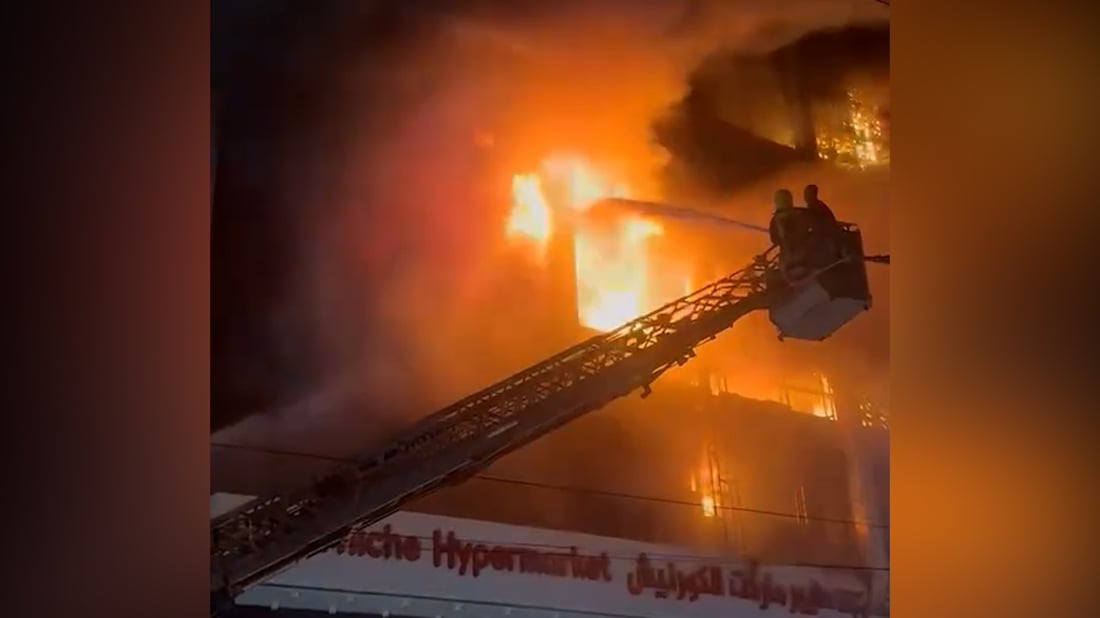
Firefighters battle intense flames engulfing a commercial building in central Kut late Wednesday night. The blaze, which broke out in a newly opened hypermarket, killed at least 61 people and injured dozens more.
Monitor
Iraqi leaders call for accountability, offer condolences after Kut fire kills dozens
BAGHDAD — Iraqi leaders issued a wave of condolences and demands for accountability Thursday following a devastating fire in the southern city of Kut that killed at least 61 people and injured dozens more. The blaze, which tore through a five-story commercial building late Wednesday, has drawn calls for urgent reform and legal action to prevent future tragedies.
According to Iraq’s Interior Ministry, the fire broke out in a building housing a newly opened hypermarket and restaurant. Most victims died of smoke inhalation, many found inside the building’s bathrooms. Civil defense teams rescued more than 45 people, and an investigation is underway.
President Abdullatif Jamal Rashid offered his condolences and called for action. “We urge a full investigation, accountability for those responsible and strict enforcement of safety measures to prevent such tragedies,” he said, adding a prayer for the victims and their families.
Parliament Speaker Mahmoud Al-Mashhadani echoed the demand for answers and urged lawmakers from Wasit governorate to report back. “We call on Wasit’s MPs to fulfill their parliamentary responsibilities by investigating the fire and submitting a detailed report to the Speaker’s office,” he said.
The Supreme Judicial Council announced it had directed the Wasit Appeals Court to investigate swiftly. “The council offered condolences to the people of Wasit and directed the Wasit Appeals Court to swiftly determine the fire’s cause and take legal measures against the negligent,” a statement read.
Kurdistan Region Prime Minister Masrour Barzani expressed solidarity and offered assistance. “The doors of the Kurdistan Region are open to the affected,” his government said. “The Ministry of Health and all relevant institutions have been placed on alert to provide medical treatment and all necessary assistance.”
Iraq’s Shiite Coordination Framework described the fire as a “painful incident” and called for transparency. “We express our deep condolences and sympathy to the families of the victims,” its media office said. “This painful incident requires a transparent investigation to determine its causes and hold those responsible to account.”
Prominent Shia cleric Muqtada Al-Sadr responded with a terse statement: “The Kut tragedy reveals their corruption.”
Grand Ayatollah Ali Al-Sistani, Iraq’s top Shia religious authority, offered condolences and prayers. “We offer our heartfelt condolences and deepest sympathy to the bereaved, especially those mourning loved ones in this terrible tragedy,” a statement from his office said.
Former Prime Minister Nouri Al-Maliki, leader of the State of Law Coalition, called it “a major humanitarian catastrophe.” He added, “We extend our deepest condolences to the people of Wasit governorate and the families of the victims. A transparent investigation is necessary to hold accountable anyone who was negligent. There is no value above the safety and lives of the people.”
Ammar Al-Hakim, head of the National Wisdom Movement, decried the repeated occurrence of such disasters. “We are astonished by the ongoing lack of measures to prevent such incidents,” he said, urging “a full and immediate investigation and accountability for those responsible.” He called the incident “a new tragedy that pained our hearts.”
Qais Al-Khazali, leader of Asaib Ahl al-Haq, also called for legal accountability. “We emphasize the need for a thorough and precise investigation to uncover the causes of this devastating fire and prevent its recurrence,” he said. He praised the efforts of emergency responders and extended his condolences to grieving families.
Mohammed Al-Hassan, the United Nations’ top representative in Iraq, expressed solidarity with the victims. “With great sadness, we received news of the tragic humanitarian catastrophe in Kut,” he said. “We express our deep solidarity with the people of Wasit governorate and offer sincere condolences to the families of the victims.”
He added that the UN stands ready to provide humanitarian assistance. “Protecting human life must remain the highest priority,” he said.