
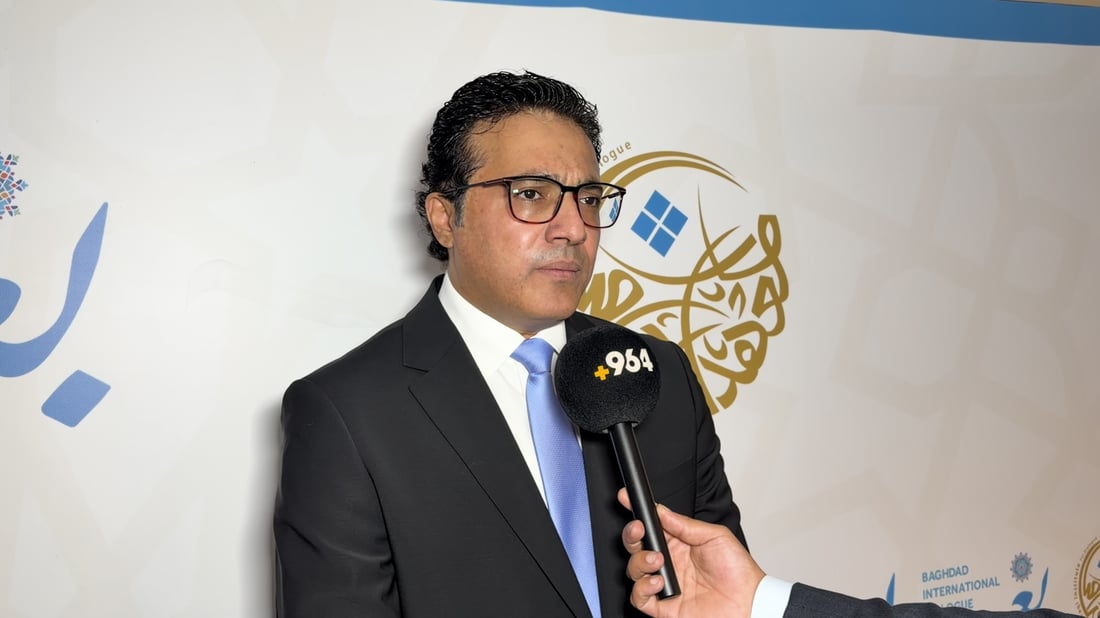
FILES: Iraqi government spokesperson Haider al-Aboudi speaks to 964media on the sidelines of the eighth Baghdad Dialogue Conference in Baghdad on Aug. 21, 2026. (Photo: 964media)
Iraq doesn’t rule out arresting politicians in Jurf al-Sakhar oil probe
BAGHDAD — Iraq has not ruled out arresting powerful figures, officials and politicians in the Jurf al-Sakhar oil smuggling case, government spokesperson Haider al-Aboudi said Saturday.
Asked in an interview with the state broadcaster Al-Iraqiya whether the case could reach influential figures or political groups behind smuggling networks, Aboudi said, “This is not ruled out.” The case went to the judiciary after a government investigating committee finished its work and backed the intelligence report’s findings, he said. “In practice, every name that appears in these investigations will be subject to legal accountability,” he said.
Aboudi rejected reports that the operation was based on foreign intelligence. The Iraqi National Intelligence Service, the National Security Service and other intelligence agencies had been told to track every suspicion of oil smuggling in Iraq and log the data in electronic systems, he said.
“On this basis, they submitted reports and information to the prime minister, and the picture was complete for the right decision to protect the Iraqi people’s wealth,” Aboudi said. No one may set up refineries, plants or processing facilities without a license and the legal procedures, he said.
Protecting the pipelines is the government’s job, and monitoring will not stop at one area but cover every region and the pipelines that feed the world market, he said. He tied the operation to the government’s program of strengthening sovereignty, keeping weapons in state hands and unifying security decisions. “No party or side can control the security decision and the protection of the state’s economic resources,” he said.
The gradual return of displaced residents began once the new joint command took charge, the units holding the area were replaced and crossings and bridges toward Karbala and Anbar were opened, Aboudi said. Residents will return through procedures set by those running the joint command, he said. Their return is “a natural result,” he said, because the area is not a battlefield and there is no feud between the parties, but he gave no timetable.
Sabah al-Numan, spokesperson for the commander-in-chief of the armed forces, said Friday that roads to Amiriyat al-Fallujah and the rest of Anbar would reopen once the deployment was complete and the area was secured. The road from Latifiya, south of Baghdad, through Jurf al-Sakhar to Karbala opened to civilian traffic on Saturday. Aboudi did not say which crossings toward Anbar had opened.
Asked about mines, Aboudi said there was information that some parts of the area could be dangerous and that forces were surveying them. Prime Minister Ali al-Zaidi ordered on Friday that a National Security Service center be set up in the area to help verify information and secure it, he said. Numan had said forces would search the area before residents can return.
Jurf al-Sakhar will get special treatment in rebuilding and in compensation for those harmed, and this will be taken into account in the 2027 budget, Aboudi said.
Iraqi forces began replacing the Popular Mobilization Forces’ 45th, 46th and 47th brigades, held by the Iran-aligned faction Kataib Hezbollah, on Friday morning, as a new joint command took charge under Federal Police leadership. The Energy Police took over the 5-kilometer stretch of oil pipeline that crosses the area.
The case broke on Nov. 9, when an Interior Ministry intelligence report began circulating. It alleged that oil was being drawn from holes in pipelines in the area and carried away in tanker trucks. On Nov. 14, Zaidi relieved nine security and oil officials and ordered those accused referred to the courts, after his committee confirmed smuggling and unlicensed refineries.
Ali Abdul Karim al-Mousawi, the ousted director general of the state-owned Oil Pipelines Company, has been arrested over confessions to the judiciary about oil smuggling, a source told 964media on Thursday. The source did not say whose confessions they were.
Kataib Hezbollah denies smuggling oil and has called the reports fabricated. The faction took over Jurf al-Sakhar, officially renamed Jurf al-Nasr in 2014, after Iraqi forces and allied armed groups recaptured it from the Islamic State group that year. Its residents are still displaced.