
Thermal cameras planned
Iraq to post guards every 500 meters on Jurf al-Sakhar oil pipeline
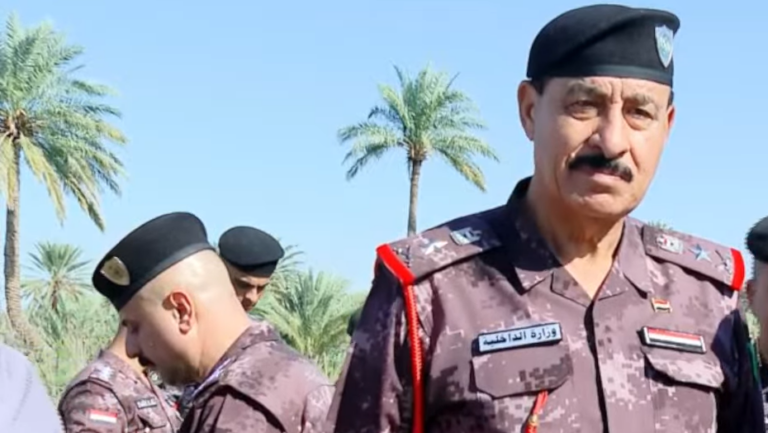
BABIL — Iraq’s Energy Police will post personnel every 500 meters and install thermal cameras along the 5-kilometer stretch of oil pipeline that runs through Jurf al-Sakhar, the force’s director general said Friday, after it took over guarding the section that day.
Lt. Gen. Hamed al-Husseini said the stretch is part of a 100-kilometer corridor of crude pipelines that runs from the strategic pipeline in Karbala to the Dora refinery in Baghdad. The strategic pipeline is the reversible crude line between Basra and Haditha, and the corridor’s lines measure 16, 18 and 26 inches across.
The Energy Police had already guarded the other 95 kilometers, Husseini said. Until Friday, the stretch inside Jurf al-Sakhar was the responsibility of the Popular Mobilization Forces. The northern Babil area, officially renamed Jurf al-Nasr in 2014, has been held by brigades of Kataib Hezbollah, an Iran-aligned armed faction, and is at the center of a government investigation into oil smuggling.
The 2nd Regiment of a commando brigade, sent from Amarah in Maysan governorate with heavy vehicles, now guards the section and its end point, working with the Oil Ministry’s state-owned Oil Pipelines Company, he said. The Energy Police was among the first forces to start work in Jurf al-Sakhar on Friday, coordinating with the PMF’s Operations Command and the new joint command for the area.
Husseini said the ground was difficult because the pipelines cross farmland cut by drainage canals, with homes and farms along the route. The plan sets clear buffer zones around the pipelines, and the Oil Pipelines Company will build a service road so patrols and vehicles can move along the corridor.
The security arrangements will take farmers’ work into account so they are not kept from their land, he said. He did not say when the cameras would be installed or how many personnel the deployment would need.
At a joint news conference in Jurf al-Sakhar earlier Friday, the Energy Police said the commando regiment had arrived and scouted the area Thursday, and that the force now controlled the whole 100-kilometer corridor.
Sabah al-Numan, spokesperson for the commander-in-chief of the armed forces, was more cautious later Friday. “As we speak, the energy regiment has taken over, and it may complete the whole bundle of oil pipelines in this area by the end of the day,” he said. He added that the 45th Brigade had begun handing its sector to a new PMF brigade.
The handover came as a new joint command took charge of Jurf al-Sakhar on Friday and Iraqi forces began replacing Kataib Hezbollah’s 45th, 46th and 47th brigades. The plan divides the area among the army, the Federal Police and other PMF units, with the Energy Police guarding the pipelines.
Prime Minister Ali al-Zaidi decided Wednesday to hand the pipeline to the Energy Police and replace the force holding the area. He also referred the government’s investigations into violations on the pipeline to the judiciary.
The standoff began after a report by the Interior Ministry’s Federal Intelligence and Investigations Agency began circulating Nov. 9. It alleges that crude was drawn from holes in pipelines crossing Jurf al-Sakhar and carried away in tanker trucks, and it cites satellite images from 2021 to 2026.
A government investigation then confirmed the report’s information, found refineries in the area and found cases of manipulation, and Zaidi relieved nine security and oil officials on Nov. 14. They included the commander of the Energy Police’s 6th Brigade and the director of the Oil Pipelines Company. On Thursday, a source told 964media that authorities had arrested Ali Abdul Karim al-Mousawi, the company’s former director general.
Kataib Hezbollah has held Jurf al-Sakhar since Iraqi forces and allied armed groups recaptured it from the Islamic State group in 2014. The faction denies smuggling oil, disputes that the pipelines were tampered with and has accused Zaidi’s office of circulating fabricated reports.