
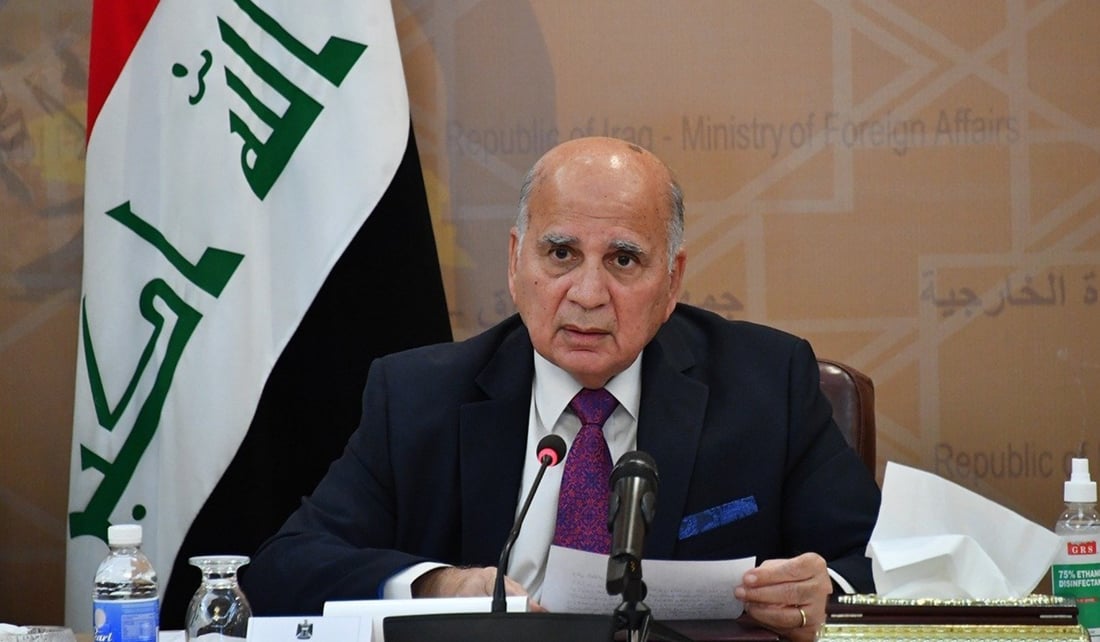
FILES: Iraqi Foreign Minister Fuad Hussein speaks during a news conference in Baghdad
Iraqi foreign minister says US asked it to close all but 2 crossings with Iran
BAGHDAD — The United States has formally asked Iraq to close all its border crossings with Iran except two, Foreign Minister Fuad Hussein said in an interview with Al Jazeera on Saturday, warning that a renewed war in the region was possible.
Hussein did not name the two crossings or say how Baghdad had responded in the excerpts the Qatari broadcaster released Saturday. Al Jazeera said it would air the full interview on Sunday.
The government gave other reasons when it shut the al-Sheib crossing in Maysan governorate to goods and travelers on Oct. 21 on Prime Minister Ali al-Zaidi’s instructions. Government spokesperson Haider al-Aboudi said the crossing’s technical and logistical facilities needed upgrading, while government adviser Abdul Amir Taiban said the closure was meant to stop drugs and counterfeit currency and ruled out U.S. pressure.
“We have many border crossings with Iran, and all of them are open. If the reason were related to a blockade, all crossings would have been closed,” Taiban said in a televised interview on Oct. 21.
No reopening of al-Sheib had been announced by Saturday.
Hussein also said Iraq had lost about $60 billion from the suspension of oil exports through the Strait of Hormuz and that shipments had resumed after understandings with Washington and Tehran. He did not say when they resumed or what the understandings involved.
Oil Minister Basim Mohammed Khudair al-Abadi said Oct. 19 that exports had climbed back above 3.4 million barrels a day in October, back to prewar levels, from an average of 3 million in September. The Ceyhan pipeline through Turkey carries about 200,000 to 230,000 barrels a day, according to oil expert Ziad al-Hashimi, so most Iraqi crude still leaves through Hormuz.
Exports fell from more than 99 million barrels in February to 18.6 million in March after the U.S.-Israeli war with Iran disrupted shipping through the strait, Oil Ministry figures show. Monthly revenue fell over the same period from more than $6.8 billion to about $1.95 billion. Oil provides more than 90% of government revenue.
Hussein said Iraq had told Iran it accepted friendship and an alliance with it but rejected its interference in Iraq’s affairs. He said Baghdad had information that outside parties were using Iraqi territory to attack neighboring countries, and that Iraq was seeking to settle its differences with Saudi Arabia through frank dialogue. Iraqi officials said in September that drones that struck Saudi Arabia’s East-West oil pipeline had been launched from Maysan.
Iranian Foreign Minister Abbas Araghchi briefed Hussein by phone on Friday on Tehran’s plan for resuming negotiations with Washington, which includes reopening the Strait of Hormuz, the Foreign Ministry said. Hussein proposed a committee of foreign ministers from the region to visit Tehran and Washington, the ministry said.
On the armed factions, Hussein said restricting weapons to the state must come through dialogue, not armed confrontation, and that Zaidi had reached understandings with four factions on the issue. Baghdad is also in contact with Tehran over the weapons held by Iraqi factions, he said.
Zaidi said on Oct. 5 that five factions had agreed to hand over their weapons and three had done so, without naming them.
Saud al-Saadi, head of the Kataib Hezbollah-linked Huqooq bloc in parliament, said in an Al-Rabiaa TV interview this month that a committee of the Coordination Framework, the ruling alliance of Shiite parties, had agreed with the factions on regulating their weapons but that Zaidi had not signed the deal for fear of U.S. pressure. He also said the closure of border crossings “came under American pressure.”
The government’s disarmament roadmap calls for a 90-day suspension of attacks from Sept. 30, followed by a six-month handover of weapons, with the process due to end by June 30, 2027. Zaidi has also pledged to disarm non-Iraqi armed groups in the country. Kataib Hezbollah, which the United States designated a terrorist organization in 2009, and Harakat al-Nujaba have refused to hand over their weapons.