
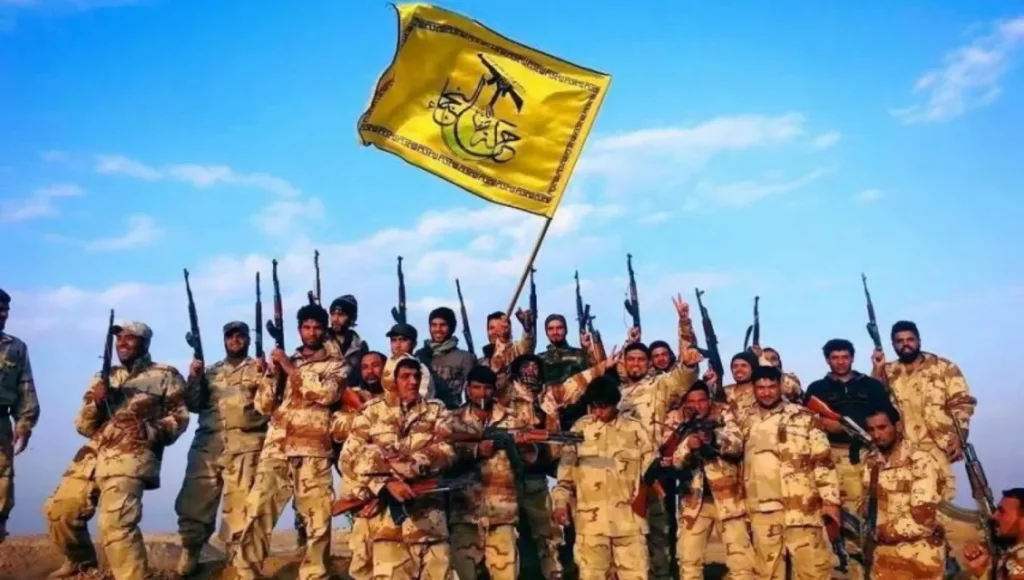
Fighters from Nujaba pose in military uniforms, raising their weapons and a yellow flag bearing the group’s emblem.
Nujaba blames ‘Wahhabi and Zionist hands’ for PMF law changes
BAGHDAD — Harakat al-Nujaba, an Iran-aligned armed faction, on Wednesday rejected amendments to a draft law governing the Popular Mobilization Forces, saying “suspicious Wahhabi and Zionist hands” were behind them.
In a statement, Nujaba called the amendments “unfair” and said they would weaken the PMF, break it up and shrink its role. It said the long-awaited law had been held up to appease U.S. President Donald Trump. Wahhabism is the ultraconservative Sunni doctrine associated with Saudi Arabia.
“At a time when we have long awaited the passage of the PMF law, which remained suspended to appease the criminal, child-killer, foolish Trump, we are surprised by unfair amendments that we can only explain by the presence of suspicious Wahhabi and Zionist hands behind them,” the statement said.
The statement did not say which amendments it meant. The bill the cabinet approved on Sept. 29 cuts the general goals of the Popular Mobilization Commission, the state body that runs the PMF, from nine to five and its tasks from 14 to eight, according to details 964media reported Tuesday.
The draft also drops the commission’s volunteer service department, its department for combating ideological terrorism, its contracts directorate and its military court of cassation. It leaves out of the force’s formations the Muhandis General Company, a state-owned company that former Prime Minister Mohammed Shia al-Sudani’s cabinet set up for the PMF in 2022.
A committee in the office of Prime Minister Ali al-Zaidi, who is commander-in-chief of the armed forces, is reworking about 20 clauses of the bill, a source told 964media. The changes under discussion include reorganizing the PMF into independent brigades and putting army and police officers in command posts. PMF Commission Chairman Falih al-Fayyadh opposes much of the restructuring, a member of parliament’s Security and Defense Committee told 964media.
Nujaba urged those who had held their ground to oppose the amendments. “As we reject these amendments in their entirety, we call on the honorable people who remain steadfast in their positions to take a stand of dignity, honor and rejection against these amendments that weaken, fragment and diminish the role of the Popular Mobilization Forces,” the statement said.
It said rejecting the changes was the least it owed to the blood of Abu Mahdi al-Muhandis and of other fighters it called “righteous martyrs.” Muhandis, the deputy head of the PMF, was killed with Iranian Gen. Qassem Soleimani in a U.S. drone strike at Baghdad airport in January 2020.
The statement said Arabs, Zionists and Americans had created the Islamic State group to conspire against Iraq and its holy places. It called the PMF “Iraq’s heart and backbone” and said its creed was the Islamic resistance.
“We reaffirm our firm position rejecting these suspicious amendments, and we will accept nothing less than a fair law that protects the rights of PMF members, places them on equal footing with their brothers in the security forces, and guarantees all their current and future rights,” the movement said.
The statement came a day after Abu Mujahid al-Assaf, Kataib Hezbollah’s security official, accused Zaidi and his office of tampering with the bill before it was sent to parliament. He asked whether PMF members and the bill’s defenders knew how far the changes went.
Asaib Ahl al-Haq’s Sadiqoun parliamentary bloc wrote to Speaker Haibat al-Halbousi last month asking why the PMF bill had not reached parliament nearly four weeks after the cabinet approved it.
The PMF was formed in 2014 after Grand Ayatollah Ali al-Sistani’s call to fight Isis and was recognized by law in 2016 as part of Iraq’s security forces under the commander-in-chief. It is an umbrella of dozens of brigades, some closely tied to Iran. The new law would replace the 2016 law and set out the force’s structure, powers and the rights of its personnel.
An earlier version reached a second reading in July 2025, when most Sunni and Kurdish lawmakers walked out, and the government withdrew it the following month. The United States opposed it: Secretary of State Marco Rubio warned Sudani in a July 2025 call that it would institutionalize Iranian influence and armed terrorist groups.
The United States designated Nujaba a Foreign Terrorist Organization in September 2025. The group and its secretary-general, Akram al-Kaabi, had been under U.S. terrorism sanctions since 2019.