
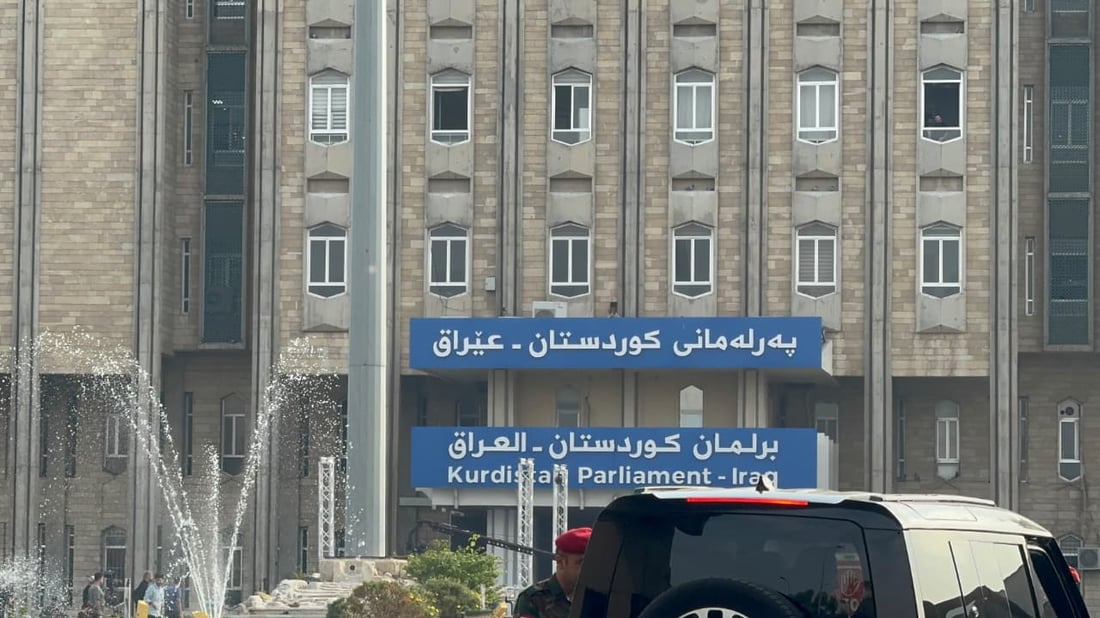
The Kurdistan Region Parliament building. (Photo: 964media)
Barzani welcomes parliament’s reactivation as KDP blames PUK, New Generation for delay
ERBIL — Kurdistan Democratic Party leader Masoud Barzani welcomed the resumption of the Kurdistan Parliament on Wednesday, calling on political parties that boycotted the session to participate, while KDP spokesperson Mahmoud Mohammed blamed the Patriotic Union of Kurdistan and New Generation Movement for the legislature’s two-year inactivity.
The statements followed Wednesday’s parliamentary session, during which lawmakers elected the parliament’s leadership more than two years after the Kurdistan Region’s October 2024 parliamentary elections.
The parliamentary blocs of the PUK and New Generation formally boycotted the session, although three of each party’s lawmakers attended. Two National Stance Movement lawmakers also attended, leaving its leader Ali Hama Salih the sole holdout.
Ala Barzanji, one of two lawmakers from the People’s Front, took part as well. Rebin Mohammed Haji Mahmoud, the only lawmaker from the Kurdistan Social Democratic Party, which ran in the 2024 election as the Kurdistan Region Alliance, was also present.
In his statement, Barzani congratulated the people of Kurdistan, the newly elected parliamentary leadership and all political parties on the legislature’s return. “Fortunately, after two years since the Kurdistan Region’s elections, the Kurdistan Parliament was reactivated,” Barzani said, adding that “I thank all the lawmakers who took a stand, fulfilled their legal and national duties and reactivated this constitutional institution of the Kurdistan Region.”
The Kurdistan Region’s parliament elected the KDP’s Vala Fareed as speaker with 52 votes, one more than the 51 the law requires. Lawmakers also elected Rami Nouri, a Christian lawmaker from Ainkawa, as deputy speaker and Muna Kahveci of the Turkmen Reform Party as secretary, each with 52 votes.
Barzani said the parliament’s resumption was intended to protect and strengthen the Kurdistan Region rather than target any political party. “Reactivating parliament is a step toward protecting and strengthening the Kurdistan Region. It is not directed against any person or party and will certainly serve the higher interests of the people of Kurdistan and the political process,” he said.
He also urged parties that did not participate in Wednesday’s session to reconsider their positions. “Now that parliament has resumed its work, I call on all those respected parties that did not participate in this process to join it and work together to serve the people of Kurdistan and support the other steps of the political process,” Barzani said.
Barzani did not specify what those next steps would entail. Parliament must still elect a new president for the Kurdistan Region, while political parties have yet to reach an agreement on forming a new government. It remains unclear whether the parliament’s reactivation will help resolve the political disputes or deepen existing divisions.
According to PUK-affiliated media on Wednesday, the Patriotic Union of Kurdistan’s Leadership Council is scheduled to hold a meeting Thursday under the chairmanship of party leader Bafel Jalal Talabani. The party is expected to announce its position on the reactivation of the Kurdistan Parliament following the meeting.
In a separate statement, KDP spokesperson Mahmoud Mohammed said the parliament had resumed its first session with the attendance of a majority of lawmakers and elected its leadership through what he described as “a legal and democratic process.” 52 out of 100 lawmakers attended the session.
The parliament swore in its members on Dec. 2, 2024, but had failed to elect a speaker until Wednesday. A second attempt in January 2025 drew only 26 members, all 15 New Generation lawmakers among them. In January this year, New Generation agreed to unite its bloc with the PUK’s, creating a 38-seat pact.
“This was a delayed but necessary step to preserve the constitutional status of the Kurdistan Region,” he said, accusing the leadership of the PUK and New Generation of being responsible for the parliament’s prolonged inactivity. “Unfortunately, for two years, this legitimate institution of the Region, which represents the voice and will of the people, was paralyzed because of a political decision by the leadership of the Patriotic Union of Kurdistan and New Generation,” Mohammed said.
“Today, the majority of lawmakers from the parliamentary blocs, recognizing their national duty, respecting the people’s votes and adhering to their legal oath, succeeded in the democratic process and ended that legal vacuum and the imposition of a political minority,” he said.
Mohammed also alleged that some lawmakers and their families had faced threats ahead of the session not to participate. “This happened despite numerous threats against some lawmakers and their families, which is a dangerous indication and a threat to democracy and the will of the people,” he said. The statement did not identify the threats or those allegedly responsible for the threats.
The KDP won 39 seats in the Oct. 20, 2024, election, the PUK 23 and New Generation 15, leaving no party with a majority. The deadlock has also held up a new cabinet: the current KRG cabinet, formed in 2019 and led by Kurdistan Region Prime Minister Masrour Barzani, remains in office.