
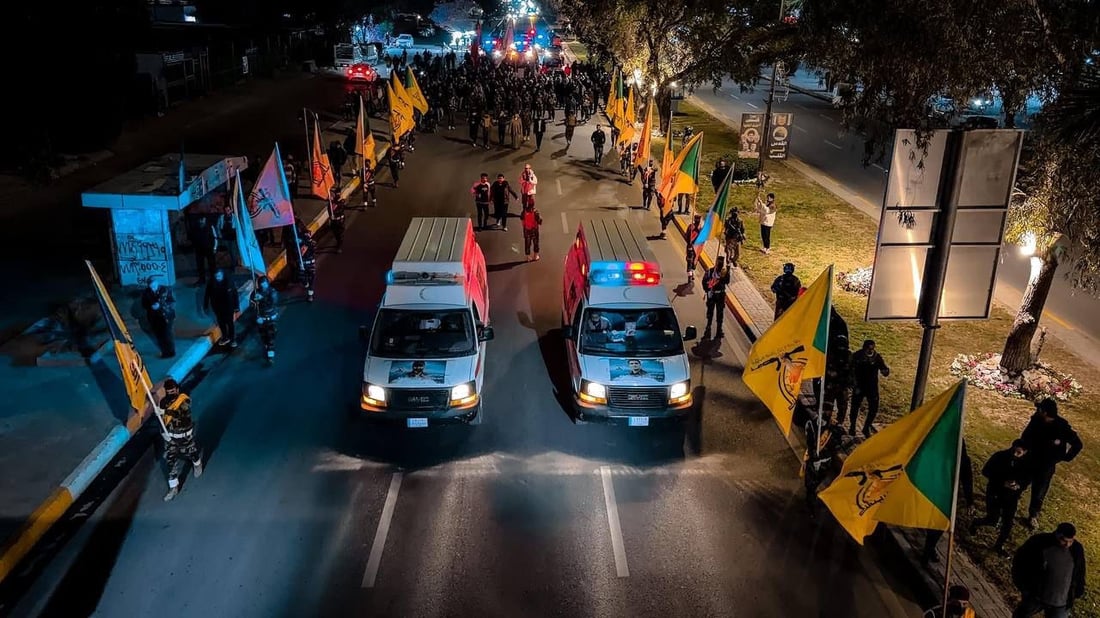
FILES: Supporters of Kataib Hezbollah carry flags and march during a funeral procession in Baghdad for two fighters killed in airstrikes on Jurf al-Sakher, Feb. 28, 2026.
Iran-aligned umbrella group sets a deadline and vows its own response
BAGHDAD — The Islamic Resistance in Iraq gave the government until early August to show it can defend Iraqi sovereignty without armed factions, and said it would respond to Wednesday’s U.S.-Saudi airstrikes itself once the Arbaeen pilgrimage ends — hours after Iraq’s national security council said responding was the state’s exclusive responsibility.
The umbrella name is used by Iran-aligned factions that have claimed repeated drone, rocket and missile attacks on U.S. military and diplomatic targets in Baghdad and the Kurdistan Region since the regional war began in late February, carried out without Iraqi government authorization. In March the group claimed dozens of operations. Saudi Arabia, Kuwait, Bahrain and the United Arab Emirates have all protested drone attacks or incursions they say originated from Iraqi territory, and on July 14 an Iraqi delegation in Riyadh gave an undertaking that Iraq would not allow its territory or airspace to be used to attack Saudi Arabia or other Gulf states.
The group denies involvement in the attacks on Saudi oil facilities that Riyadh cited as its justification, and called the strikes a new crime by the United States. It said that “to preserve the security of Arbaeen pilgrims and procession organizers” its response “will inevitably come” after the pilgrimage, and “may also target its tools in Saudi Arabia if circumstances require.”
Challenging the government’s weapons plan, it asked what Baghdad would do “if, at this critical stage, we were to hand over our weapons and missiles to the government so that it alone would assume responsibility for defending Iraq’s sovereignty, its territory and its people, what firm action will it take in this real test on the ground to prove to everyone that it can deter the aggressors?” It added: “We give the government authorities that demanded the resistance groups surrender its weapons until the 23rd of Safar to see what they will do.”
The Ministerial Council for National Security, chaired by Prime Minister Ali al-Zaidi, said earlier Wednesday that responding to the strikes was “the exclusive responsibility of the Iraqi government and its constitutional state institutions”, and reaffirmed both the plan to bring weapons under state control and the September deadline for the U.S.-led coalition’s withdrawal.
The PMF said the strikes hit its headquarters in Baghdad, Wasit, Nineveh, Basra, Kirkuk, Karbala and Diyala, killing at least 20 members and wounding 32 in a preliminary toll. U.S. Central Command said it and Saudi forces struck weapons-storage and logistical sites linked to Iran-backed groups after more than 30 drone attacks it attributed to Iran’s Revolutionary Guard. Saudi Arabia said the targets were connected to attacks on its energy facilities and that the drones were launched from Iraqi territory by Iran-backed militias. It did not name a faction.
Earlier Wednesday, Harakat al-Nujaba, one of the factions refusing to place its weapons under state control, demanded that the government expel U.S. forces, cut all cooperation with Saudi Arabia and acquire air defenses, and warned that the two countries would pay “a heavy price”.
Asaib Ahl al-Haq, Saraya al-Salam and the Imam Ali Battalions have moved to comply with the weapons plan; Kataib Hezbollah, Harakat al-Nujaba and Kataib Sayyid al-Shuhada have refused while U.S. forces remain in Iraq. At the White House on July 14, Zaidi said the government intended to bring all weapons under state control once the coalition mission ends. “After Sept. 30, there is no need for any faction,” he said.
The pilgrimage the group cited falls on the 40th day after Ashura, marking the killing of Imam Hussein, grandson of the Prophet Muhammad, at the Battle of Karbala in 680. Millions travel to Karbala to visit his shrine, many on foot.