
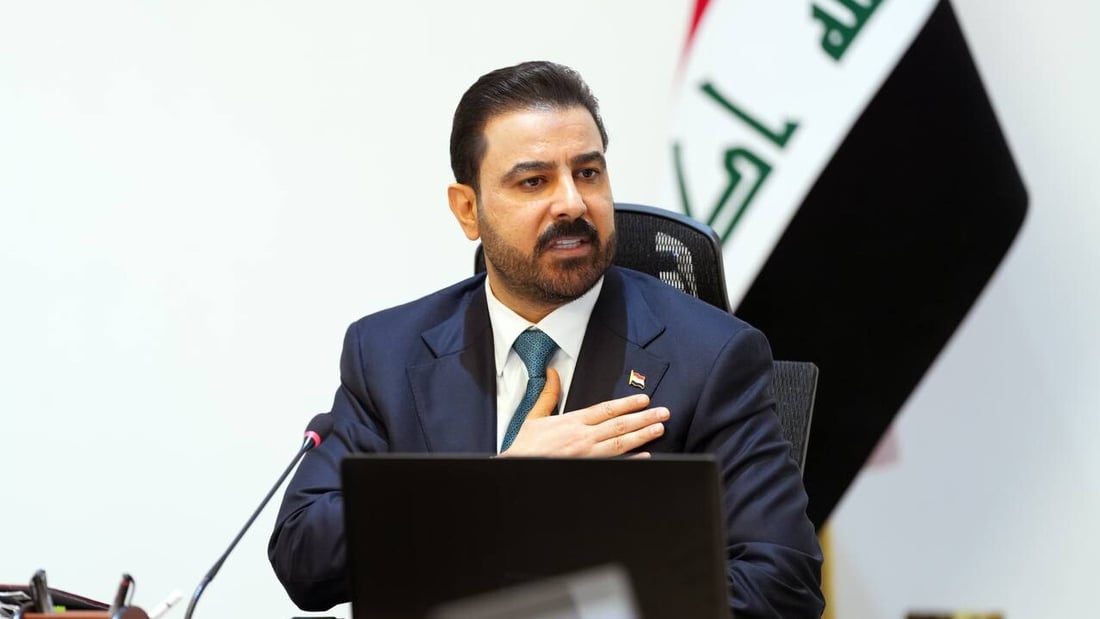
Prime Minister Ali al-Zaidi
‘No red lines’ in corruption drive, Iraq’s prime minister says
BAGHDAD — Leaders of the Coordination Framework have pledged support for the government’s anti-corruption campaign and told him there are “no red lines” protecting anyone accused of corruption, Prime Minister Ali al-Zaidi said Wednesday.
The Prime Minister’s Media Office published remarks from Wednesday’s Cabinet meeting in which Zaidi described a recent meeting with the Coordination Framework, the Shiite alliance that forms the backbone of Iraq’s governing coalition. Its leaders told him, “We have no red lines or yellow lines before any corrupt person. Even if the corrupt individual is affiliated with us, we prefer that you begin with those around us if there are suspicions of corruption,” he said.
Zaidi said the government does not protect corrupt officials and that most political forces he had consulted supported the campaign. He warned ministers against covering up administrative corruption, saying they would answer for misconduct by senior officials under their supervision. “Any minister who has a corrupt director general will bear responsibility,” he said. “If corruption is proven against a director general or deputy minister, the minister will bear part of the responsibility.” He added that a prime minister cannot know every director general and deputy minister across the state, and that each minister is responsible for selecting and overseeing senior officials in their ministry.
In earlier meetings, Zaidi instructed oversight bodies including the Federal Integrity Commission and the Federal Board of Supreme Audit to intensify monitoring of ministries and to report corruption or negligence.
The comments come nearly a month after authorities launched what the government called the first phase of a sweeping anti-corruption operation, which officials say has led to the arrest of dozens of current and former officials and lawmakers. The government has described the campaign as an ongoing effort rather than a one-time operation, with further investigations expected.
The campaign has expanded through the investigation of detained former Deputy Oil Minister for Refining Affairs Adnan al-Jumaili, arrested on May 29 after serving as deputy minister and as director general of the state-owned North Refineries Company. The Supreme Judicial Council said the investigation led to the seizure of properties, vehicles, cash, weapons and gold linked to Jumaili and others in the case, worth hundreds of millions of dollars.
The campaign has also drawn debate within the political establishment over how the operations are run. After large-scale raids in Baghdad’s Green Zone in late June, several senior Coordination Framework figures said they backed the arrests but questioned the deployment of tanks and armored vehicles. Coalition officials said the alliance had not sought advance access to the list of suspects and had authorized the prime minister to pursue investigations without political interference, arguing that reviewing the names beforehand could have raised accusations of leaks.
Zaidi took office in May after being nominated by the Coordination Framework and approved by Parliament, and has pledged to strengthen oversight of state institutions while pursuing administrative and economic reforms.
Iraq scored 28 out of 100 on Transparency International’s 2025 Corruption Perceptions Index, ranking 136th of 182 countries and territories and remaining among those perceived to have high levels of public-sector corruption. The score was an improvement on the previous year, when Iraq scored 26 and ranked 140th.
Corruption has been a central issue in Iraqi politics for decades and was one of the main grievances behind the nationwide Tishreen protests in 2019. Cases have spanned customs, taxation, procurement, state-owned companies, public contracts, oil and infrastructure.