
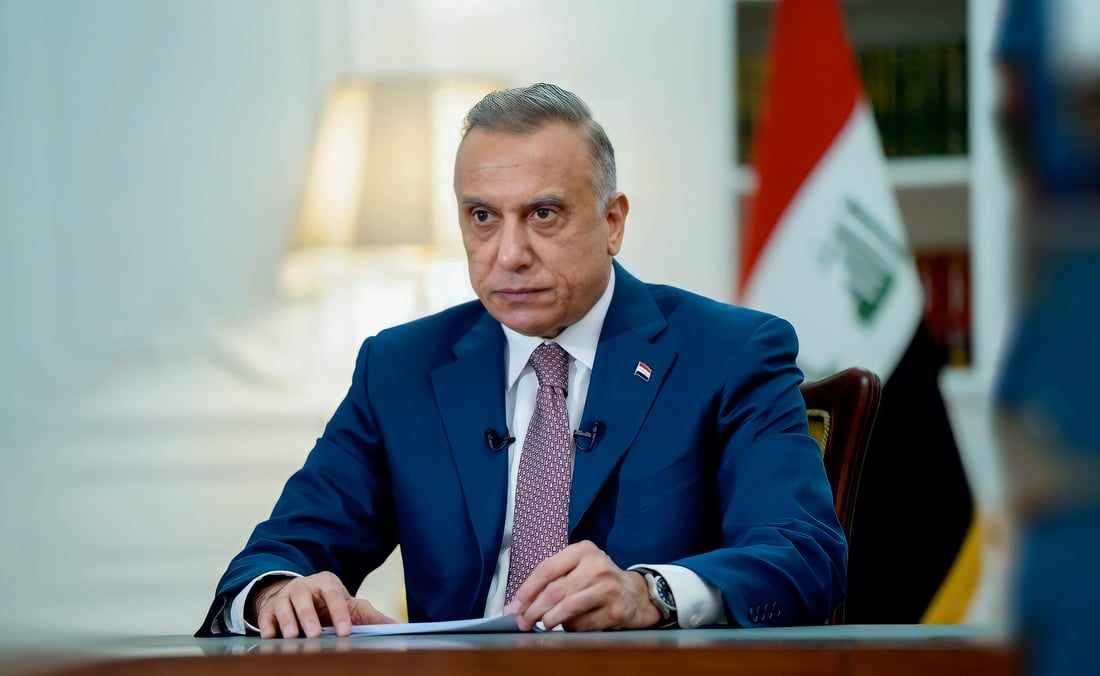
Former Iraqi Prime Minister Mustafa al-Kadhimi
Media Monitor
Kadhimi backs Zaidi’s push to curb corruption and armed groups
BAGHDAD — Former Prime Minister Mustafa al-Kadhimi expressed support for Prime Minister Ali al-Zaidi’s efforts to strengthen state authority, saying the current government has an opportunity to advance anti-corruption measures and bring weapons under state control.
Speaking in an interview on Al Arabiya TV, Kadhimi said his support was “not for a person as much as it is for the idea of the state. Any Iraqi effort that works to restore the authority and prestige of the state and fight corruption and uncontrolled weapons should receive support,” he said.
Kadhimi said his own government launched an anti-corruption campaign through an executive order despite facing the aftermath of the October 2019 protests, the COVID-19 pandemic, falling oil prices and an economic crisis. He served as prime minister from 2020 to 2022.
“The executive order on combating corruption returned billions of dollars stolen from Iraq,” he said, attributing the losses to armed groups, criminal networks and others who illegally obtained public funds. He said the campaign met resistance from groups whose interests were affected.
“The experience was demonized because it harmed the interests of some parties,” Kadhimi said. “Now, four years later, we are seeing apologies for misinformation and fabricated claims. Unfortunately, some state institutions participated in that campaign.”
On weapons outside state control, Kadhimi said his government had sought to address the issue but faced opposition from groups that used arms to gain “power, influence and money.” He said conditions are now more favorable for the current government and urged Iraqis to support armed groups that choose to surrender their weapons. “Many groups carrying weapons outside the framework of the state have begun to see those weapons as a burden,” he said.
The weapons control initiative gained momentum in early June after the Coordination Framework endorsed a plan to restrict weapons to state control and authorized Zaidi to implement it. A government committee including the Defense Ministry, Interior Ministry, Joint Operations Command and the PMF was formed to oversee the handover of weapons, equipment and military sites. Asaib Ahl al-Haq announced a committee to separate its forces from the PMF, Saraya al-Salam transferred security responsibilities in Samarra to state forces, and the Imam Ali Battalions said they would place their weapons under government control. Officials have said heavy weapons, including tanks, artillery, missiles and drones, will be moved to state storage before redistribution to the armed forces. Kataib Hezbollah, Harakat al-Nujaba and Kataib Sayyid al-Shuhada have rejected disarmament, arguing their weapons remain necessary as long as U.S. forces are in Iraq.
Government spokesman Haider al-Aboudi said in June that restricting weapons to state control remains “an Iraqi file” handled through domestic political and procedural mechanisms, with the goal of ensuring “the Iraqi state’s security decision becomes unified.”