
Notes on Khamenei
I am no wali over Najaf. Here I am, only its visitor.
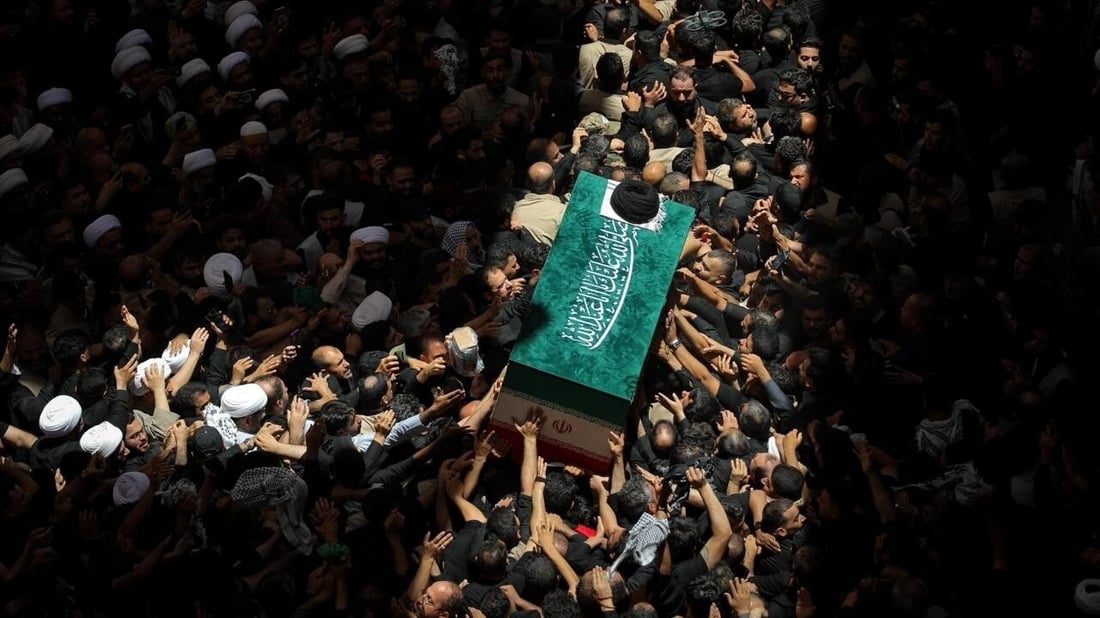
This essay by Sarmad Al-Taie was written as the funeral rites for Ali Khamenei, Iran’s supreme leader of thirty-six years, reached Iraq. Khamenei was assassinated in February as the war with Israel and the United States got underway. After days of processions through Tehran and Qom, mourners filled Najaf, bringing the leader of Iran’s revolution, in death, to the seat of the rival religious authority he spent his life measuring himself against. That rivalry is the essay’s subject: two centers of Shia Islam, Najaf and Tehran, parallel lines that do not meet.
The marjaiya is the supreme religious authority of Shia Islam, held today by Grand Ayatollah Ali al-Sistani in Najaf; the hawza is the seminary establishment around it. “Guardian Jurist” renders wali al-faqih, the doctrine and the office on which the Islamic Republic rests: rule by the jurist as deputy of the hidden Imam. Najaf’s quietist school never accepted that doctrine’s claim over it, and the essay turns on the refusal. When the author imagines Khamenei speaking from his own bier in the closing line, the dead man disclaims, at the gates of Najaf, precisely the office he held in Iran.
The Arabic kashf, rendered throughout as “unveiling,” carries two meanings at once: geographical discovery, as in the Age of Discovery, and, in Sufi usage, the lifting of the veil between the seeker and hidden truth. The author intends both: the ships that mapped these shores, and the revelation a death lets slip.
The Tishreen killings refer to the suppression of Iraq’s October 2019 protest movement, in which hundreds of demonstrators died.
I am no wali over Najaf. Here I am, only its visitor.
By Sarmad Al-Taie
My stipend is lower than Sistani’s
The first thing Supreme Leader Ali Khamenei did was cut the stipends he pays to the religious hawza, so that they would sit below the student allowance Grand Ayatollah Sistani provides to seminary students in Iran and Iraq. This happened in the mid-1990s. Khamenei’s standing instruction: we will not outdo the marja of Najaf. Then politics surged with the collapse of Saddam Hussein, and the air filled with accusations, fed by the contrast between Najaf’s cautious, quiet ritual temper and the swift, impulsive designs of Iran’s Guardian Jurist. In 2003 the question across the Middle East was: who will prevail, and to whom will the international Shia marjaiya fall?
The Leader’s emissaries: joining and parting
But Iran’s Leader understands what he wants. He is an heir to tradition. He kept telling his office: we will not outdo the marja of Najaf on clerics’ stipends. Even if it later emerged that Khamenei had begun dispatching representatives, who arrived one after another at the “Vatican of the Shia” in Iraq. And what harm in that? Should the Leader not have a plan for the “post-Sistani” era, even if his own stipend is lower?
First came Ayatollah Muhammad Mahdi al-Asifi, the Leader’s teacher and a son of Najaf. It was said Asifi entered the old city charged with “exploring the possibilities of what comes after Sistani.” He later died there: a jurist, an author, an ascetic.
Then Ayatollah Mahmoud Hashemi Shahroudi arrived in Najaf, or nearly did, as the Leader’s representative. He too had taught Khamenei, and he too was a son of Najaf. Then he died, having carried the legacy of modern juristic criticism and those openings into politics that reached their furthest ends in Tehran.
Years have passed. Today the funeral of the Leader himself arrives, ringed by something like admissions of discord, and by hopes that time still allows for interpreting and honoring the rules of “chivalry among those who differ”! Today that chivalry is closer to necessity than to choice, whenever the dust of mutual cursing and rivalry rises and the lightning of ambition flashes.
An “armada” funeral under forty sails
The Leader’s funeral has arrived wrapped in a shade of acknowledgment and hopes, and that is a rare kind of arrival in the history of Shia jurists. The funeral comes out of the strangest of wars, and there is no evading its forceful pull back into the past. We who are besotted with the histories of the seas cannot picture Khamenei’s war ending in a religious funeral or a coffin on a death cart. Centuries of charge and retreat suggest an image there is no escaping: the bier borne atop a Portuguese naval “armada.” Forty-sailed ships out of the Middle Ages, Atlantic patrols with towering masts, warships bristling with the artillery of the wars of Andalusia. Today they come toward Najaf with the majesty of death. The same forty-sailed ships that long wore down the English and prevailed over them, then wore down the Ottomans, the Safavid kings and the Arab emirs on both shores of the Gulf. It is the same “cannon,” still wailing whenever it sights a shore that will not yield. A war that never found its peace, though rifles, sea captains, clerics and tribal sheikhs lost themselves, again and again, in that bold, obscure crossing that kept searching for shores it never found. The fates of jurisprudence and politics mingled with those of roving adventurers and traders in spices, slaves and horses. The wailing women of Najaf will chant, as Khamenei’s funeral passes, something like “forbidden poems to forbidden melodies,” and a wager made in words that taste of a death echoing down the centuries.
The unveilings of Nasser, Saddam and the Guardian Jurist
The Leader’s funeral reaches Iraq. Yes, it drops anchor as well: Najaf has its own seasonal sea, one that fills and dries, with acknowledgment and hopes. What does it want to say to Iraq? The corpse is torn (like us) by gunpowder out of Portugal’s history and the temples of Jerusalem, and by a smell the geographic unveilings never forget. It once seemed an age the English had sealed shut. If only the unveiling had ended there. But the West’s scrutiny only mounted between the rise of Gamal Abdel Nasser and the absurdities of Saddam Hussein, and it understood that it had to go on unveiling us, further and deeper. It realized we had not fallen far enough with the fall of the Ottomans and the Persians. Not at Suez, not on the Shatt al-Arab, not at the Bushehr reactors… Religion and politics raged across both shores of the Mediterranean, and the waves laid bare the vanished roads of Alexander, who lived on the East’s obsession with repeating itself and forbidding questions.
Khamenei’s Samarkand and Sistani’s Najaf
The Leader’s funeral arrives, perhaps with acknowledgment and hopes. But Khamenei was an eloquent orator. He had the boldness not to hide his dispute with Najaf (indeed with the hawza of Qom itself), a dispute fiercer than politics. Khamenei is a son of Ali Shariati’s alley in Khorasan. There run the music and the trade routes of Samarkand. A spell drew the young Khamenei toward a passion for Saadi Shirazi and al-Mutanabbi, pushed him to translate the theories of the Muslim Brotherhood, then encouraged him to spend heavily in the nineties so that his students could study the philosophies that came after Newton, all the way to Bertrand Russell and Jürgen Habermas. And what harm in it, that he quarreled with those infatuated with the West and its philosophies!
Najaf’s tales, by contrast, are secrets and allusions woven from another cloth. The old city’s jurists secluded themselves in traditional study, and no harm either that Najafis indulged the same cultural passions as Khamenei, though as a secret rite. They held to the counsel of the jurists who fled Isfahan 200 years ago. No philosophy. No music. No Ali Shariati. And no Muhammad Baqir al-Sadr either!
Iran’s jurists in Iran… Iran’s jurists in Iraq
Time turned. In the nineties Khamenei was “the most dangerous intellectual in Iran.” The foremost of its thinkers, or their companion. An expert in managing Tehran’s intelligentsia, with “a degree of repression and discipline he believed in.”
Time passed, and Najaf kept sheltering in the old jurisprudence and in the memory of “the seditions of the ages and the turns of fate,” from before the First World War and after. It keeps the lessons of Istanbul and Tehran by heart. Khamenei wanted to press forward toward the old line of contact with the armies of Alexander and Persia, or ancient Babylon. Najaf, for its part, forgets Alexander’s battles. None of that occupies it. The city was founded on a grand design: the first priority was to slip free of the Iranian sultan’s appetites, ever since the jurists migrated, after the fall of Isfahan in the 18th century, to the desert bank of the Euphrates, on the edge of a vast cemetery where Persians and Arabs lie, the people who wove Abbasid civilization alongside Basra, and before Baghdad. This was a new gathering of great scholars beside the shrine of Ali. The caravan of Iranian jurists traveled a long road 200 years ago, to live amid the unspoiled instinct of the Iraqis of that age, and to free itself from Iran’s grip.
Jurists from Iran came to the land of Iraq in search of religious independence from the Iranian sultan, “whatever the price.” Tehran and Najaf are two parallel lines that do not meet even at the will of sultans, so long as their compasses point in such opposite directions.
Beneath what jurisprudence knows of itself
The Leader’s funeral arrives, with acknowledgment and hopes. Yes, Najaf, we differed.
Say the dispute was once over how to rule Iraq after Saddam.
Another time, over the relationship with the “Franks” and Washington.
And a third time we differed over the Tishreen killings. Do not forget that.
But let us admit it. Jurisprudence was founded on shifting realities. No matter if the Revolutionary Guard has no time to grasp that just now. But is there room to suppose that the Leader’s line has slowly begun to understand Najaf’s calm?
Where is the Leader?
Here we are today, talking with Washington. All of us, it seems.
“Adapting” to secularism. All of us, it seems.
And none of us, either, has issued fatwas branding Tehran’s unveiled young women infidels, now that their presence at jurists’ funerals has become permissible, as it has everywhere in the world since Hammurabi.
Perhaps these are surface matters among the stratagems of religious law. But when the color of the surface changes, it conceals, for the wise, what lies beneath the husk. A deeper movement rests below it. You may not like knowing it, but it encourages the stratagems of accommodation and easing, toward a law of purposes and causes, not of appearances and slogans. Will the Revolutionary Guard find time to contemplate that? And why not?
Iran’s throne surveys Najaf’s independence
The funeral of the Leader Khamenei comes… the most dangerous intellectual in Iran, the lover of Shariati, partisan of the setar’s music and Mutanabbi’s riddles. Born on the borders of Samarkand, its roads and its ancient opium, “the man with a doctrine for disciplining peoples,” addicted to reading the books of the Soviets in their rise and in their fall… And here those enamored of geographic unveilings ask: has the Leader left behind him, on the seat and throne of Iran’s kings, anyone who will read the Leaders’ maps after him? Will they know Najaf after you, as you knew this Najaf?
Here it is atop the armada… the majestic death cart. The Leader’s funeral arrives, wrapped in acknowledgment and hopes. As if those who love unveiling can hear the man it carries utter one wish… he wants to refute the final accusation: I am no Guardian Jurist over Najaf. Here I am, only its visitor.
Sarmad Al-Taie is the head of +964 Arabic