
Iraq races to reopen oil routes beyond Strait of Hormuz
BAGHDAD — Iraq is accelerating efforts to diversify its oil export routes after disruptions linked to the regional conflict of 2026 exposed the country’s near-total dependence on the Strait of Hormuz, with exports collapsing from more than 99 million barrels in February to 18.6 million in March as tanker traffic through the strait was disrupted.
Oil revenues dropped from more than $7 billion to about $1.95 billion in a single month. While Saudi Arabia and the United Arab Emirates have alternative export routes outside Hormuz, Iraqi officials and energy experts say Baghdad remains among the most vulnerable countries to any prolonged closure of the strait, alongside Kuwait, Bahrain and Qatar.
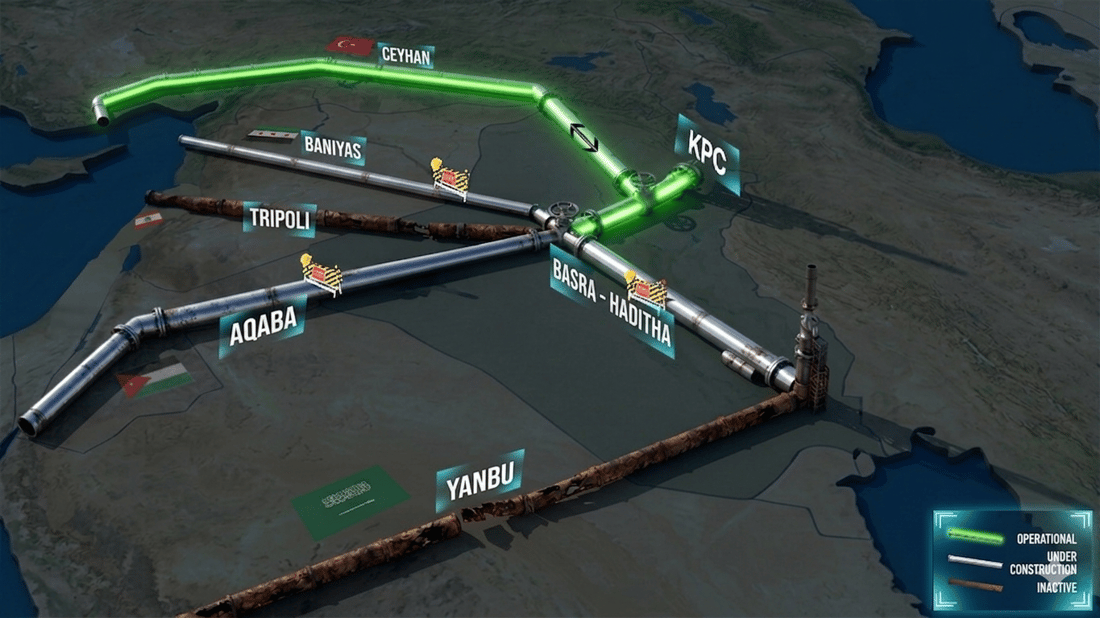
The Iraqi government has begun reviving long-discussed pipeline projects connecting Basra to Haditha, with future links planned toward Turkey, Syria and Jordan. Baghdad recently approved measures to accelerate construction of the Basra-Haditha pipeline, according to Iraqi officials and energy sector experts interviewed by 964media, including removing restrictions requiring locally manufactured materials.
The Oil Ministry describes the line as a “giant” pipeline — with a diameter of 56 inches, it would become Iraq’s largest oil pipeline, carrying up to 2.5 million barrels per day. Former Prime Minister Mohammed Shia al-Sudani ordered a special commission formed in April 2026 to oversee implementation, with government statements describing it as “a proactive measure in anticipation of current regional conditions.”
From Haditha, officials say the pipeline would create a distribution hub for exports toward Jordan’s Aqaba port on the Red Sea, Syria’s Baniyas terminal on the Mediterranean and Turkey through existing northern infrastructure. The Aqaba route carries political sensitivity inside Iraq, with some lawmakers arguing crude transported there could indirectly reach Israel because of geographic proximity — a concern that has complicated earlier discussions of the project despite recent government statements openly referencing the Haditha-Aqaba connection.
In the north, officials believe the Kurdistan Pipeline Company network connecting Kurdistan Region fields across Sulaymaniyah, Kirkuk, Erbil, Duhok and Nineveh to Turkey through Fishkhabour could immediately increase exports to between 700,000 and 1 million barrels daily if better integrated with federal infrastructure. The pipeline was designed to operate in both directions, allowing either northern exports to Turkey or southern crude to move north during emergencies. Its first shipment was pumped from the Taq Taq field on Dec. 13, 2013.
On March 18, 2026, Kurdistan Region Prime Minister Masrour Barzani authorized operation of the Sarlu export station north of Kirkuk to resume Iraqi exports through Ceyhan under what officials described as “exceptional circumstances,” despite unresolved disputes between Baghdad and Erbil over oil revenues. Federal Oil Ministry officials and KPC engineers jointly supervised the reconnection of Kirkuk fields to the pipeline network at Sarlu station in what participants described as a symbolic moment of cooperation.
Iraq currently exports around 50,000 barrels per day of Basra Medium crude to Syria by truck — a figure Damascus hopes to increase to 100,000 barrels per day. Experts from both countries told 964media that sustaining even 50,000 barrels daily requires around 1,000 tanker trucks operating continuously, increasing costs and logistical risks. Iraq also reopened the al-Waleed border crossing with Syria for the first time in more than a decade as part of emergency export measures, while fuel oil shipments to Syria’s Baniyas port resumed during the crisis. Many Iraqi experts now advocate rebuilding a direct Iraq-Syria pipeline from Haditha rather than relying on the older Kirkuk-Baniyas route.
Iraqi officials shared tanker details with Tehran during the crisis, including vessel names and cargo information, to secure safe passage for Iraqi crude through Hormuz. Iran later publicly exempted Iraqi oil shipments from strait restrictions. One Oil Ministry official told 964media that “Tehran did not show hostile intentions specifically toward Iraq during the war,” adding that Iraqi oil convoys heading toward Syria “reached Baniyas safely without being targeted despite the presence of drones over the tankers.” Officials inside Iraq’s oil sector nevertheless remain cautious when publicly discussing export alternatives outside Hormuz because of political sensitivities related to Iran.
Iraq is also examining revival of the old pipeline linking Basra to Saudi Arabia’s Yanbu port on the Red Sea, built before the Gulf War but later subject to disputes between Baghdad and Riyadh after operations stopped.
Energy analysts told 964media Iraq’s long-term concerns extend beyond the current conflict. Former parliamentary Energy Committee head Adnan al-Janabi warned that relying solely on Gulf exports “strategically is not correct” and called for “multiple export routes” to avoid future crises. Officials and experts differed over whether to prioritize Baniyas, Aqaba, Yanbu or Turkish routes, but nearly all agreed Iraq must restore multiple export corridors to reduce dependence on a single passage — and prepare for the possibility of increased competition if sanctions on Iran are eased and Iranian oil returns to global markets.