
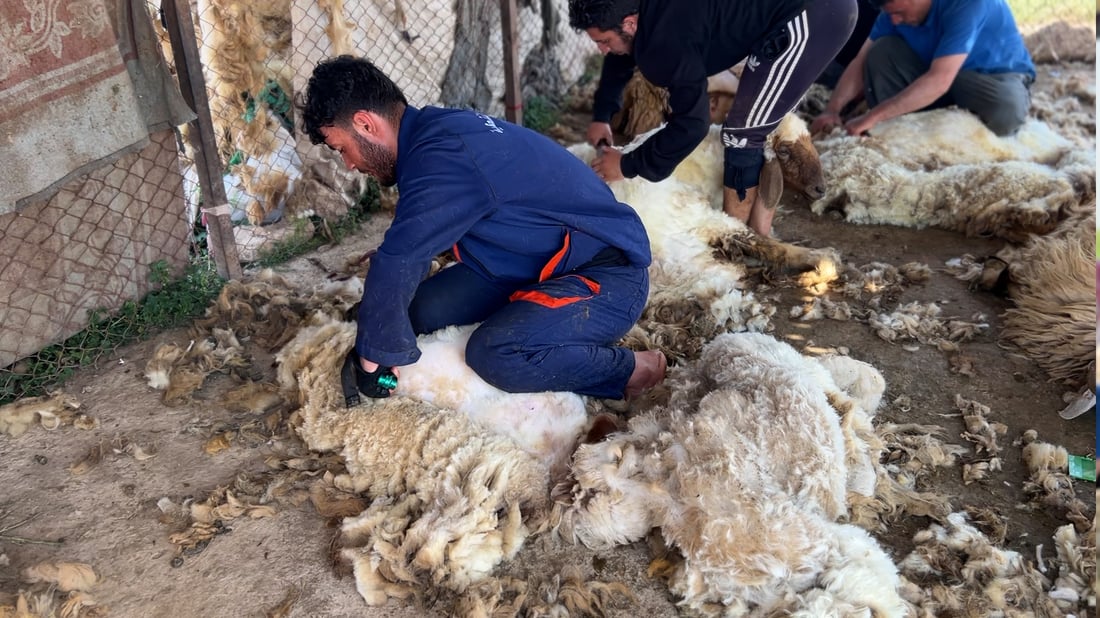
Workers shear sheep during the spring shearing season in Hatra district, where herders gather to remove wool in a traditional practice combining labor and celebration. Photo by 964media
In Hatra’s villages, sheep shearing season blends labor, poetry and tribal celebration
NINEVEH — As the sheep shearing season draws to a close in villages around Hatra district, Bedouin communities gather in a spirit of collective labor and celebration rooted in long-standing tradition, with poetry, tribal dances and celebratory gunfire accompanying work that begins at dawn.
The season, which runs from mid-March to the end of April, sees skilled shearers working through long hours to process entire flocks. Ahmed Jawhar, an experienced shearer, said he prefers manual scissors over electric machines, explaining that “it requires more effort but it is safer for the livestock and leaves a safe distance between the wool and the skin, while modern machines cause wounds that lead to poisoning and remove all the wool.”
Fellow shearer Mujbil al-Fadaghi said a beginner can shear five to seven sheep per day, while an experienced worker can complete 20 to 30, with each sheep taking between five and 15 minutes depending on its size.
Sheep owner Mohammed al-Aslami described the season as “days of joy filled with chants and dances that create enthusiasm and competition among young people to shear the largest number of sheep,” with around 400 sheep sheared daily. Tribes including Shammar and Aniza perform traditional dances during the work.
Jawhar noted a sharp decline in wool prices. “We used to sell one kilogram of wool for 1,000 dinars, but now it is sold for only 250 or 500 dinars,” he said. Wool is used in cities for clothing and in rural areas for bedding and covers.
At the end of the season, families mark the occasion by slaughtering a sheep in a spring festival celebrating the completion of the shearing and the renewal it represents for pastoral life.