
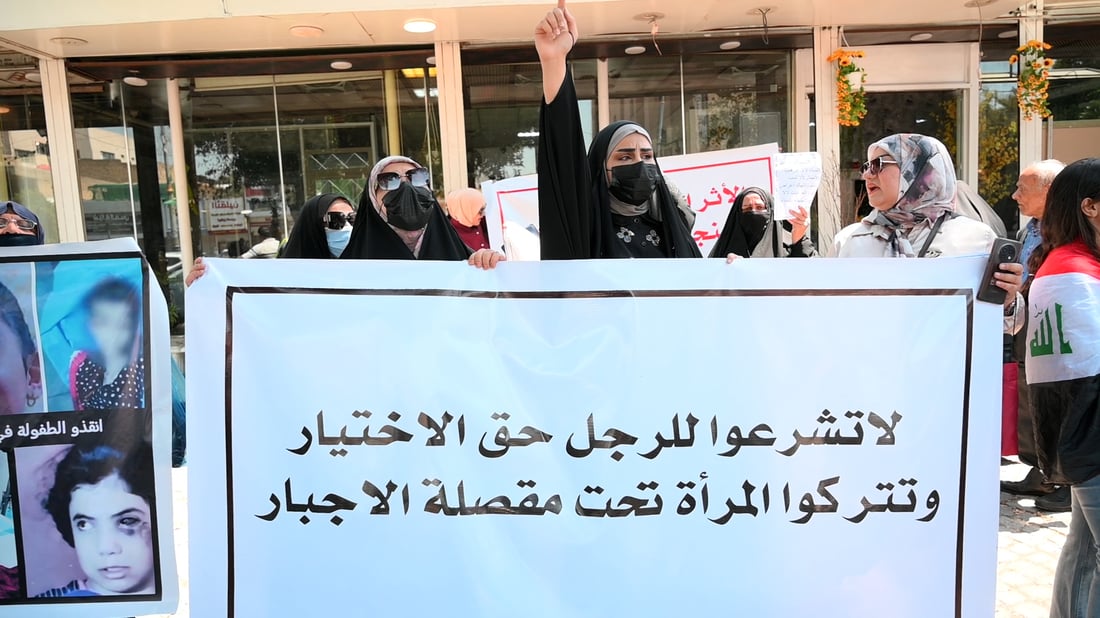
Mothers rally in Baghdad against custody law that takes children away at age seven
BAGHDAD — Dozens of women gathered in Firdos Square on Friday to protest proposed changes to Iraq’s personal status law that they say strip mothers of custody rights, with several sharing personal accounts of children taken from them or held for ransom by former husbands.
The protesters rejected amendments to Article 57 of Personal Status Law No. 188 of 1959, which currently grants mothers priority in custody during and after marriage unless a child is harmed. They also voiced opposition to the Jaafari personal status code, which they say removes children from their mothers after the age of seven and causes lasting psychological and social harm.
Um Hussein told 964media she had been divorced in absentia by her husband, who remarried a woman 23 years younger. “I raised my children alone with great difficulty and without any financial support,” she said. “And now they want to take them away from me.” She called for a clear civil law to protect mothers and children, saying, “the Jaafari code has become very unjust to women, and personal status courts must be changed because the judge’s decisions and the Jaafari code’s decisions that take the child from the mother are like a death sentence for mothers.”
Um Zahra said her former husband had taken their daughter and was demanding 35 million dinars ($22,700) for her to see the child or hear her voice. “It has been five days and I know nothing about my daughter. What did I do to deserve being asked for 35 million just to hear her voice once?” she said. “My daughter is 8 years old and I do not know what her fate is now. I ask the Iraqi judiciary to return her to me even without any financial support.”
Randa Khalil said Shiite mothers face clear injustice. “What is the mother’s fault to be deprived of custody of her children? I previously obtained custody, and today I am asked to return them to my ex-husband,” she said. She described the reduction of the custody age from 18 to seven as “an unjust decision,” and questioned what recourse a mother has when custody is transferred to a father’s new wife. “The child remains the biggest victim,” she said.
Women’s rights activist Um Abbas warned of broader social consequences, saying custody rules that remove children from their mothers after one year “leads to the child being lost and harmed psychologically and socially,” and may push some women away from the Jaafari sect. She called for urgent judicial intervention and accountability for those who harm Iraqi mothers, noting that some children face abuse from stepmothers.
Public prosecutor Nawar Obeid said Iraqi law does not include the term “parental abduction,” addressing such cases instead under “failure to hand over.” She noted that Article 382 of the Penal Code provides for imprisonment and fines where a child is not returned to the legal custodian, and said Iraq is a party to the Hague Convention on the Civil Aspects of International Child Abduction.
The protests come amid an ongoing legal dispute over the amended Personal Status Law No. 1 of 2025, which took effect on Feb. 18, 2025 and modifies the 1959 law to allow couples to choose between civil law and religious jurisprudence — Jaafari or Sunni — in matters of marriage, divorce, inheritance and child custody. Under the new framework, custody is granted to the mother until the child reaches seven, after which it transfers to the father. On Sept. 11, 2025, the Federal Supreme Court rejected all lawsuits challenging the amended law, with lawmaker Raed al-Maliki saying the ruling “closed the chapter on objections” and cleared the way for implementation. Courts across Iraq have begun applying the amendments.
On Aug. 27, 2025, parliament approved adding the Jaafari jurisprudence code on personal status matters to its agenda following a session attended by 167 lawmakers. Support for the amendments has also come from some divorced fathers. On Sept. 19, 2025, a group of fathers and grandfathers from the Sunni community staged a counter-protest in Baghdad’s Allawi area, calling to be included in provisions allowing a shift to Jaafari jurisprudence to gain custody and visitation rights.
Participants at Friday’s demonstration noted that such protests recur whenever mothers feel their rights are threatened. “This is not the first time Iraqi women have protested for custody rights,” they said.