
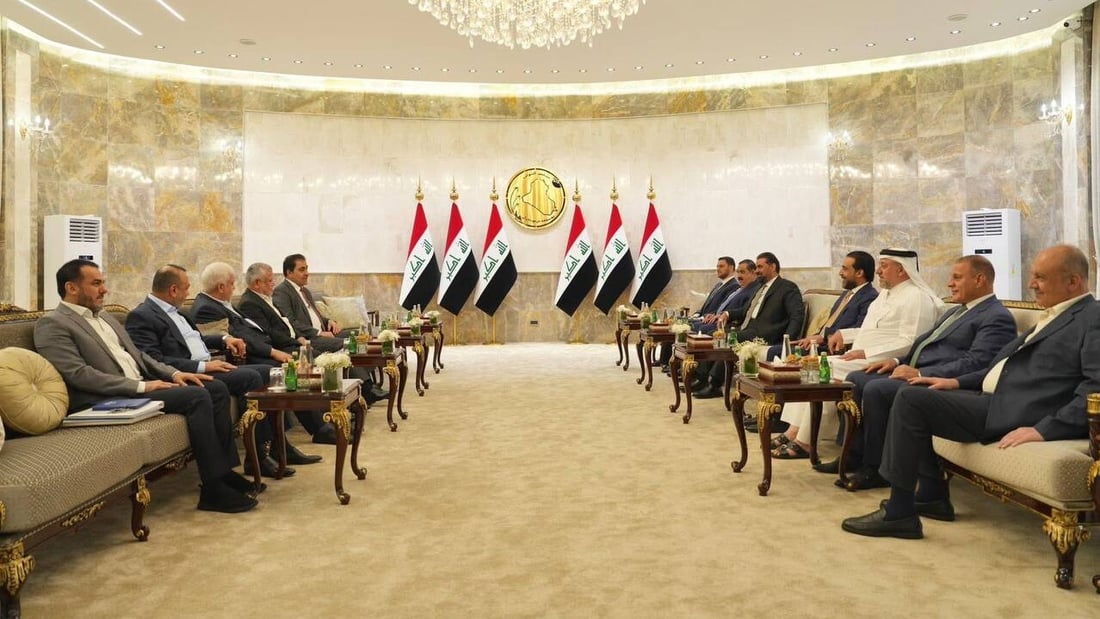
Sunni and Shiite political leaders meet at the residence of Parliament Speaker Haibat al-Halbousi in Baghdad
Sunni and Shiite blocs meet at Halbousi’s residence as cabinet negotiations intensify
BAGHDAD — Sunni and Shiite political blocs met Sunday evening at the residence of Parliament Speaker Haibat al-Halbousi without Prime Minister-designate Ali al-Zaidi, as negotiations over ministerial allocations continued to intensify.
Earlier, the Sunni Political Council convened at the office of Sovereignty Alliance leader Khamis al-Khanjar to discuss a political agreement paper addressing challenges facing liberated governorates. The document covers longstanding issues including legislation for a general amnesty law, the return of displaced people, ending accountability and justice measures and achieving balance in state institutions, with plans to present it to other political partners.
Abdul Amir al-Taiban, an adviser to the prime minister and leader in the Reconstruction and Development Coalition, said the next cabinet would be composed of younger figures with a technocratic character, with the Coordination Framework giving Zaidi room to select ministers, though disagreements persist over sovereign ministries — particularly oil and interior.
Negotiations over allocations have intensified. Early demands suggest Shiite groups alone could seek up to 20 ministries, with similar expectations from Sunni and Kurdish blocs. The Badr Organization is seeking two ministries and 20 senior positions; State of Law and Asaib Ahl al-Haq together may pursue six; Hikma is seeking two; and Sudani’s bloc, holding 46 seats, is aiming for at least five. Proposals also include four deputy prime ministers — two for the Shiite component and one each for Sunni and Kurdish representatives.
Zaidi remains in his first week as designate, with negotiations moving faster than observers expected. In his first official remarks he pledged he “will not respond to any personal demand” in forming his government. U.S. President Donald Trump has expressed support for his designation, calling for a government “free of terrorism” and urging the exclusion of armed factions from sovereign ministries. Zaidi became the first Iraqi prime minister-designate invited to visit Washington before forming a government.