
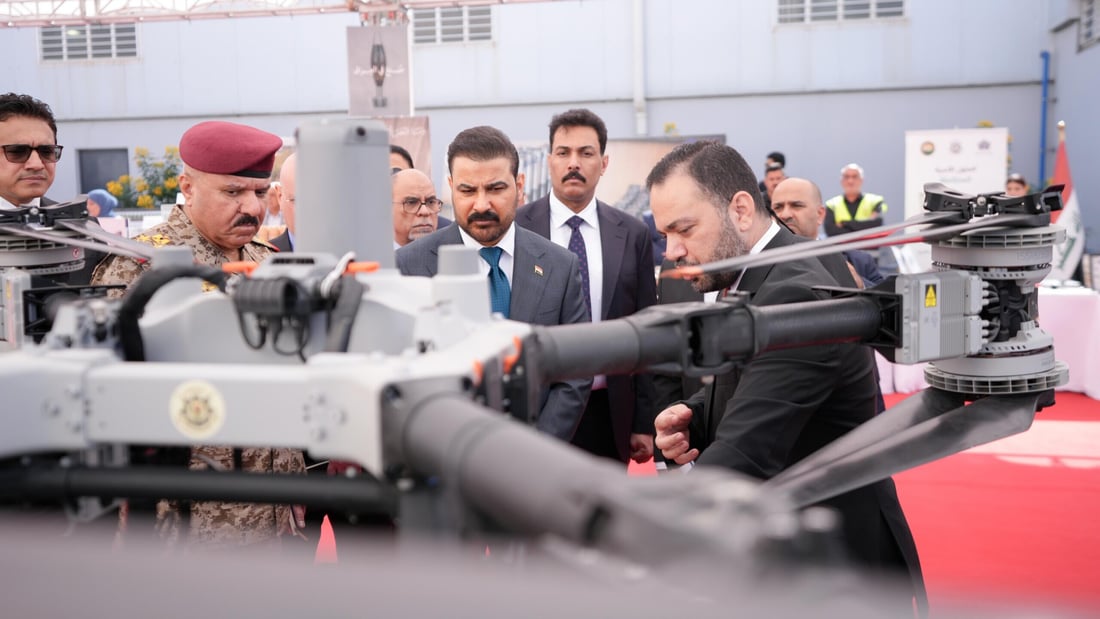
Iraqi Prime Minister Ali al-Zaidi inspects a drone system during a visit to the Military Industrialization Authority in Baghdad on Nov. 5, 2026.
Private partnerships encouraged
Zaidi orders military manufacturer to cut out arms middlemen
BAGHDAD — Prime Minister Ali al-Zaidi on Thursday ordered Iraq’s state military manufacturer to deal directly with original manufacturers and stop using intermediary companies in its contracts.
Zaidi gave the orders during a visit to the Defence Industries Commission, where he reviewed weapons, drones, surveillance equipment and armored vehicles that the commission makes or upgrades, his media office said in a statement.
The statement said dealing directly with parent manufacturers would make military contracts more transparent and cut off routes to corruption and illegal practices. It did not say how much of the commission’s purchasing goes through intermediaries or which contracts are affected.
The order comes weeks after the U.S. Treasury asked Baghdad to tighten oversight of government contracts, including the intermediaries and subcontractors that companies use, to stop state money reaching entities under Iran-related sanctions, sources told 964media in October.
Zaidi also called for wider partnerships with specialized companies and a role for Iraq’s private sector in developing military industries.
At a meeting with the commission’s leadership, he said Iraq had the expertise and technical capacity to make its own weapons and military equipment and to rely less on foreign suppliers. He called an advanced domestic defense industry essential to national sovereignty and security, and called for more investment in research and development to keep pace with advances in military manufacturing.
He told the commission to coordinate more closely with the defense and interior ministries, other security agencies and the Popular Mobilization Commission, the state body that runs the Popular Mobilization Forces, to identify their technical needs and match production to operational requirements. He also told officials to give the commission the resources it needs to expand production, so that more of the armed forces’ equipment can be made in Iraq.
Zaidi toured the commission’s facilities and an exhibition of light, medium and heavy weapons, ammunition, drone systems, monitoring and surveillance equipment, a radio reconnaissance station, armored vehicles and personnel carriers. The display also included civilian products made by the commission, which the government has tasked with expanding its industrial and technological capacity.
The commission has taken on a growing share of security work. In March 2026, former Prime Minister Mohammed Shia al-Sudani’s cabinet authorized the Interior Ministry to contract with the commission for a counter-drone system, amending an earlier cabinet decision, to strengthen Iraq’s defenses against drones.
In October 2024, the commission delivered a first batch of 50 locally assembled Abhar armored vehicles to the Interior Ministry. It said the vehicles’ armored bodies were built in Baghdad by Iraqi staff, while their engines were supplied by the U.S. automaker Ford. The vehicles are designed to carry and protect security personnel.
Mustafa Ati, then the commission’s chairman, said in April 2024 that Iraq was building facilities to make armored vehicles, drones, surveillance systems, communications equipment and ammunition. He said the commission had set up an integrated military industrial complex with private sector participation and had won contracts with the Interior Ministry, the PMF Commission and other security agencies. Three months later, Sudani opened several military production factories at the commission’s complex in Baghdad, including a light ammunition plant and a mortar shell factory.
Since July, the commission has come under the Office of the Commander-in-Chief of the Armed Forces, which answers to Zaidi. A July 22 order, seen by 964media, merged three security bodies into a single office that oversees the commission along with the defense and interior ministries, the intelligence and national security services and the PMF Commission.