
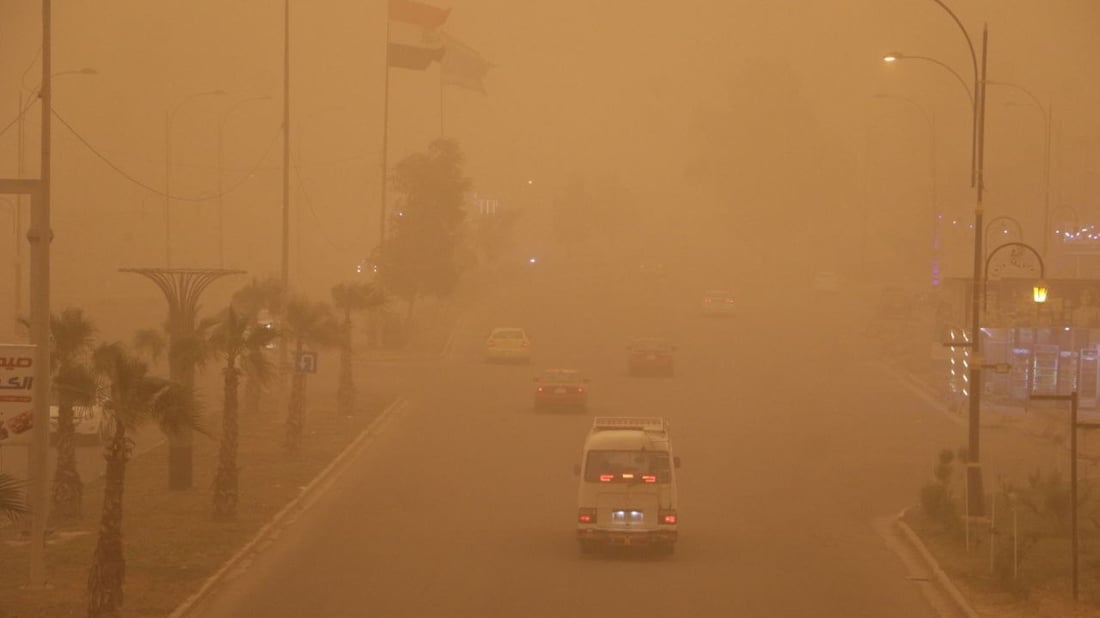
Vehicles move through a dense dust storm that sharply reduces visibility on a city road in Baghdad.
Group warns Iraq could face dust on 300 days a year within a decade
BAGHDAD — Iraq could see sand and dust storms on as many as 300 days a year within ten years as desertification spreads, the Green Iraq Observatory said, a twelvefold increase on the worst years of the late 20th century.
“The maximum number of dust storms during the period from 1951 to 1990 reached about 24 storms annually, but Iraq could witness 300 sand and dust storms annually within the next 10 years because of climate change,” the environmental group said. Three hundred days would mean dust on five days in six. It identified six major storm-generating hotspots, most in southern Iraq with others in the centre and west, and said international studies link their formation to desertification across large areas. Dust from them increasingly reaches Kuwait, Saudi Arabia, Qatar, the United Arab Emirates, Turkey and Iran.
The projection is the observatory’s own and has not been endorsed by government agencies.
Recent storms have filled hospitals. A storm on May 4 sent 1,133 people to hospital with breathing difficulties, 576 of them in Muthanna, 300 in Najaf and 200 in Baghdad. Two weeks later another wave brought 837 people in for treatment on a second consecutive day, with winds up to 90 km/h in parts of Anbar. More than 1,700 people were hospitalised across southern Iraq in April last year in a storm that grounded flights at Basra airport and closed government offices.
The Agriculture Ministry said in June it was preparing the results of Iraq’s first national study measuring desertification rates, beginning with districts in Dhi Qar, Wasit and Nineveh, and has pursued dune stabilisation, drought-resistant planting and satellite monitoring of vegetation and dune movement. Iraq and Kuwait announced a joint project on dunes in southern Iraq last year.