
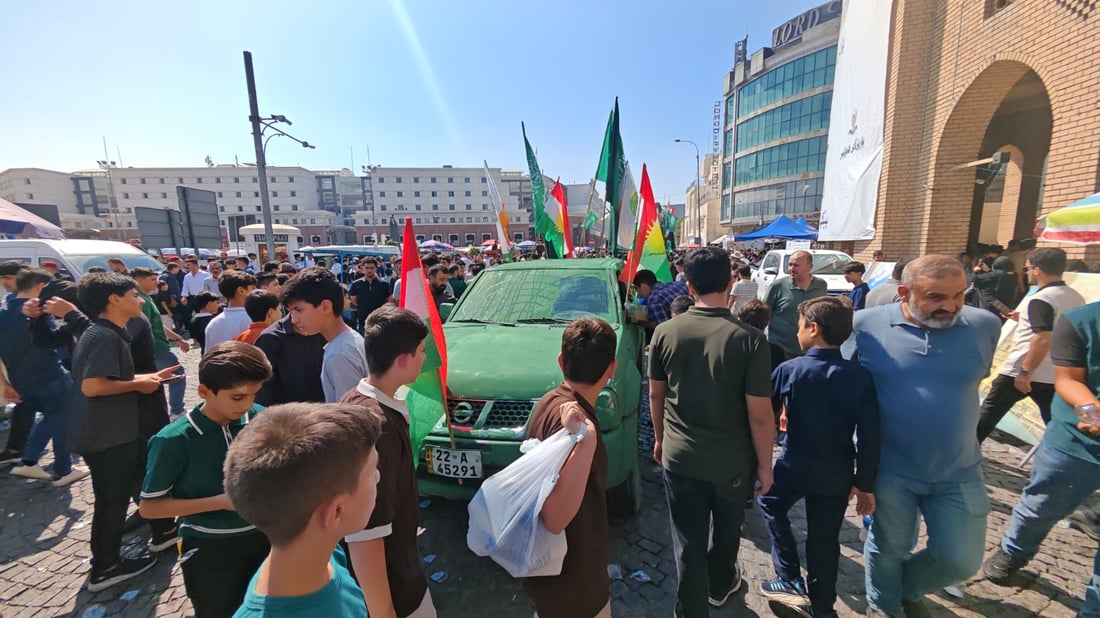
Erbil residents gather near the city’s historic citadel during celebrations marking the birthday of the Prophet Mohammed on Aug. 25, 2026. (Photo: 964media)
Iraq and Kurdistan Region mark Mawlid as free food, charity spread across the country
ERBIL — Iraq and the Kurdistan Region marked the Prophet Muhammad’s birthday on Tuesday with religious gatherings, free meals and sweets, a blood donation drive and other activities in Baghdad, Erbil, Sulaymaniyah and towns across the country.
The federal government declared the day a holiday for ministries and government institutions. It falls on 12 Rabi al-Awwal, and commemorations often continue through the month.
In Erbil, people gathered at mosques and around the citadel while sweets were handed out in the city centre and Qaysari bazaar. Religious gatherings had begun the previous evening at the city’s takyas, where participants recited dhikr and religious chants.
“The city of Sultan Muzaffar is devoted to the Prophet,” said Rebaz Mohammed, who had been awake since the dawn call to prayer. Barzi Farhad said: “Not in one sentence, nor even with a world of writing, can that feeling be expressed, because today is a celebration and we should wear our finest clothes.” Another resident said: “When you say Mawlid, you mean Erbil. This enthusiasm here has echoed across all four parts of Kurdistan.”
Nabaz Ismail, director of Erbil’s Religious Endowments, said people travel from across the Region and beyond for the celebrations. “Erbil has now become the capital of Mawlid in the whole world,” he said. “This love goes back 800 years to the era of Sultan Muzaffar al-Din. It has since become a beautiful culture of the people of Erbil.” Muzaffar al-Din, the city’s ruler in the late 12th and early 13th centuries, is credited with holding the first large-scale Mawlid festivals. Ismail said Mawlid would be marked at 6,224 mosques across Kurdistan, with the main Erbil celebration near the citadel, and asked people attending to keep the area clean: “I ask them to implement the message of the Prophet, to love their homeland and environment and not allow the environment to become polluted.”
A 964media reporter visited Sheikh Ahmed Karitani’s takya in Kuran on Monday evening, where reciters and participants held a dhikr gathering and men in traditional Kurdish dress exchanged greetings. “It is so joyful, so joyful — you would think it is a festival,” said chanter Kamaran Mohammed, who has attended for years. Idris Arif, who has served at the takya for more than 27 years, spoke of his happiness at the occasion and urged people to take on the Prophet’s attributes.
The day also brought a blood donation campaign in Erbil, where organisers expected more than 100 donors. Mustafa Abdullah, who organised it, said he has run an activity and given blood every year since learning his mother had cancer, and that much of his work focuses on cancer patients, who would be among those benefiting. “Today it is being held for a special occasion,” said Abdulqahar Ali, secretary of the Kurdistan Blood Donors Association. “For more than 15 years we have made this a culture for ourselves.”
In Baghdad, celebrations ran late into Monday night at the Abdul Qadir al-Gilani shrine, where participants sang praises of the Prophet. Women lit candles and made offerings, families gathered in the courtyard, and religious speakers from several countries took part. “The Prophet’s birthday, peace and blessings be upon him, is the beginning of love and faith and the beginning of the nation,” said Afif al-Din al-Gilani, custodian of the Qadiriya shrine in Sheikh Omar. “It is important that we bring people together through love, which comes from the heart. If it is achieved, harmony follows, which in turn leads to unity, and if that is achieved, the country is safe.”
Baghdad resident Maida Salim, who attends every year, said families have become used to coming and bringing their own food. “The feelings here are wonderful. We feel joy and happiness. Some people make offerings, some light candles, and others distribute sweets and food.”
In Sulaymaniyah, Mawlid was marked at mosques including the Grand Mosque, where food was prepared for worshippers and visitors. “It is the happiest day of life. Mawlid should be commemorated on the basis of reviving the traditions of the Prophet of Islam,” said cleric Hoshyar Jafarani, who described the day as marking the liberation of humanity from servitude to people toward the worship of God. Haji Iqbal Latif, who has cooked for the poor and for travellers at the mosque for 14 years, said meals had been prepared “for around 8,000 to 10,000 people.”
In Haji Awa, barbers gave free haircuts. “Today we have made haircuts free, and through this work we want God to be pleased with us,” said Rebaz Hakim, who said they started at 10 a.m. and would continue until midnight. “Most of those who have come to us have been children.”
A restaurant in Zarayan prepared 600 meals of rice, beans and freshly roasted chicken and distributed them to residents and travellers on the Sulaymaniyah-Sharazur road. “On the occasion of the birthday of our Prophet, peace be upon him, we have undertaken the preparation of these meals,” said cook Sarkawt Abdullah. In Sharazur, a fast food vendor who normally sells about 300 sandwiches a day, Sufi Abdullah, made 1,000 and gave them away.
Prime Minister Ali al-Zaidi congratulated Iraqis and Muslims on the anniversary, saying it “recalls the lofty values brought by Islam, foremost among them mercy, tolerance, justice, brotherhood and fraternity,” and calling it “an opportunity to renew the emphasis on the importance of solidarity and cohesion among all the honorable components of our people.”
The Prophet Muhammad was born in Mecca around 570 and died in Medina in 632. Muslims regard him as the final prophet of God, and the Qur’an as the revelation he received. Sunnis mark his birth on 12 Rabi al-Awwal and Shia on 17 Rabi al-Awwal.