
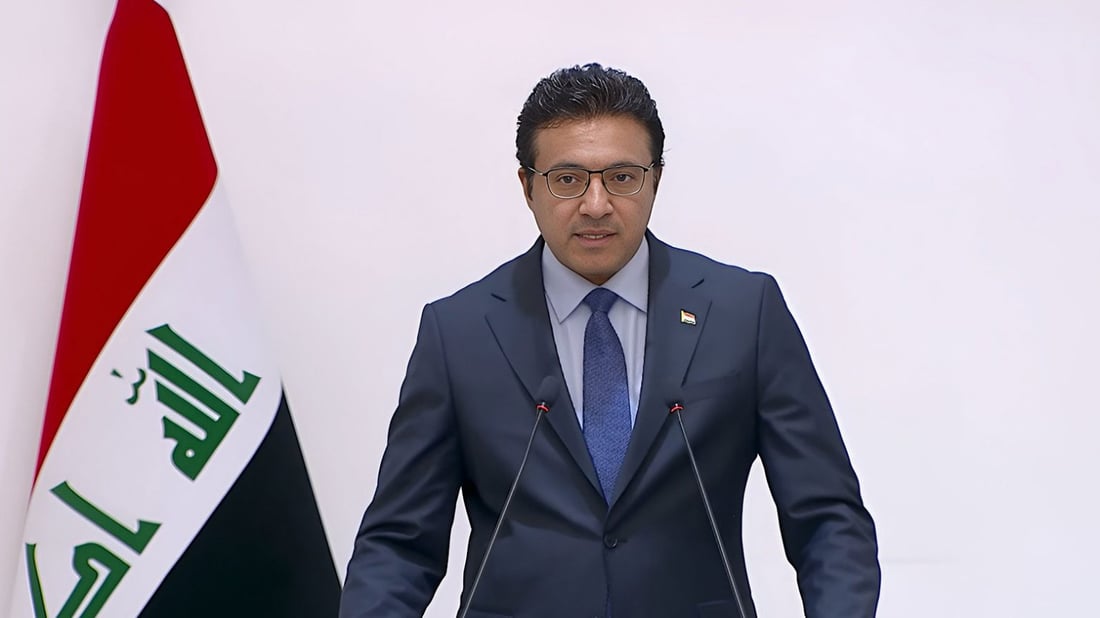
Government spokesperson Haider al-Aboudi speaks during a news conference in Baghdad
Drone network dismantled on the night troops deployed, spokesperson says
BAGHDAD — Iraqi intelligence and counterterrorism forces dismantled a network planning attacks with explosive-laden drones on Friday night, the government spokesperson said, the same night troops deployed across Baghdad and hours after Iran-aligned factions called off an attack of their own.
Haider al-Aboudi said the night involved two separate tracks: a precautionary deployment ordered by Prime Minister and Commander-in-Chief Ali al-Zaidi, and an operation by the Iraqi Intelligence Service and the Counter Terrorism Service. “The first track was precautionary because the commander-in-chief is moving toward ensuring that the state alone makes security decisions and exclusively possesses the means of force,” he said in a televised interview.
The agencies “successfully infiltrated a network, arrested its members and confiscated their equipment, including drones,” Aboudi said. “The operation was large.” The group had planned “to direct strikes against certain targets that I cannot disclose,” he said. He did not say who the network was, how many were arrested or what the targets were.
Iran-aligned factions said the same day they had postponed an attack on Saudi Arabia and U.S. military bases planned for Friday, standing down after an appeal from Badr Organization leader Hadi al-Amiri. Aboudi did not say whether the two were connected.
Asked how the government would deal with factions such as Harakat al-Nujaba and Kataib Hezbollah if they refuse to surrender their weapons, he said: “We do not hold anyone accountable based on their religious convictions. But when those convictions move outside the legal framework and are translated into armed or unlawful activity, that is where the state takes action by prosecuting… excuse me, not prosecuting, but addressing those who depart from the legal framework.” He did not set out what measures the government would take.
Zaidi has set Sept. 30, when the U.S.-led coalition mission ends, as the date for bringing all weapons under state control. Saraya al-Salam, Asaib Ahl al-Haq and the Imam Ali Battalions have moved to comply; Kataib Hezbollah, Harakat al-Nujaba and Kataib Sayyid al-Shuhada have refused.
U.S. and Saudi aircraft struck Popular Mobilization Forces sites in Baghdad, Wasit, Nineveh, Basra, Kirkuk, Karbala and Diyala in late July, killing at least 20 members and wounding 32, according to the force. U.S. Central Command said the strikes hit weapons-storage and logistics sites linked to Iran-backed groups after more than 30 drone attacks it attributed to Iran’s Revolutionary Guard.