
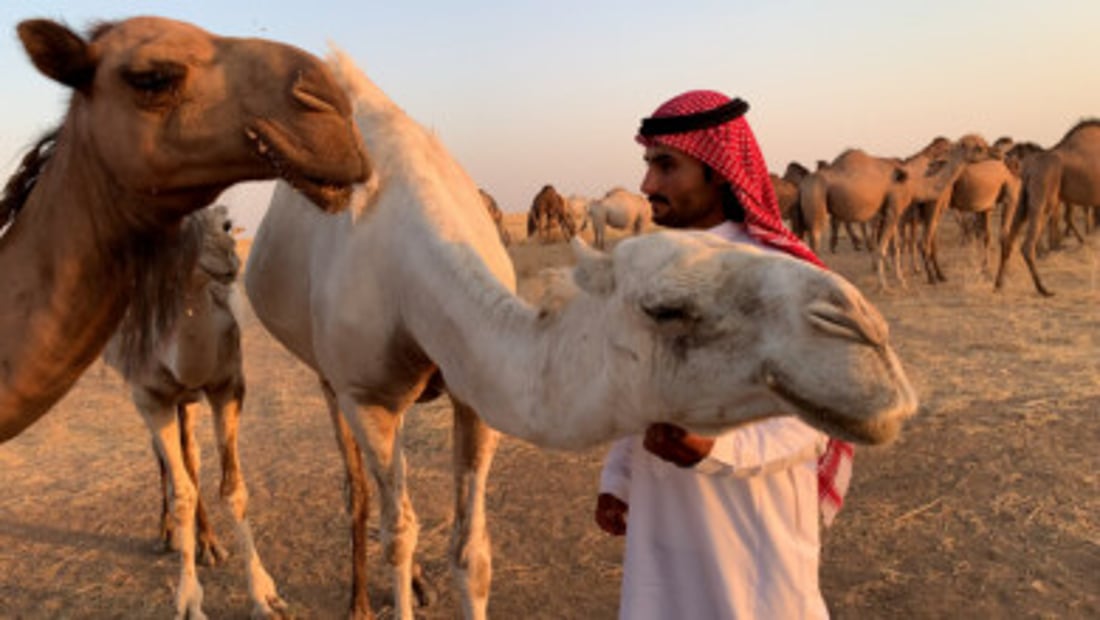
Generations of camel herding endure in Rabia despite shrinking pasture. (Photo: 964media)
Rabia
Camel breeding remains profitable despite challenges in western Nineveh
NINEVEH — Camel herders in the Rabia desert west of Nineveh governorate say water shortages, shrinking grazing land and restrictions on crossing a security berm between Nineveh and Salah al-Din are among the main challenges facing their trade, while maintaining that camel breeding continues to provide a profitable source of income.
Anad Yassin Rethaan, a camel herder, told 964media that his family has raised camels for generations.
“We inherited camel breeding from our fathers and grandfathers,” he said, adding that the family spends the summer in the Rabia desert before moving to the Jazira region during the winter in search of pasture.
Rethaan said limited grazing areas and water scarcity in the Jazira region are among the main difficulties they face. He called on authorities to facilitate passage across the security berm to reach more distant grazing areas.
Rabia is among western Nineveh’s main camel-breeding areas. Herders traditionally move seasonally between summer and winter grazing grounds, taking advantage of rainfall and natural pasture in the desert.
He said camels are given names based on their colors, including Al-Wadha, Al-Sha‘la and Al-Adhama, adding that one of the best-known camels in the herd is a she-camel named Hadeeba.
During dust storms, herders tie the camels’ legs together to prevent them from scattering, he said, explaining that the animals remain seated until the storm passes.
Another camel herder, Dheidan Yassin Al-Mashji, told 964media that the oldest camel in their herd is Hadeeba, which is about 18 years old.
He said camel breeding remains profitable, particularly during the Eid al-Adha season, with prices ranging from 1 million to 5 million Iraqi dinars ($662 to $3,311).
Eid al-Adha is one of the two major Islamic holidays. It commemorates the willingness of the Prophet Ibrahim to sacrifice his son in obedience to God before God provided a ram to sacrifice instead. For livestock breeders, Eid al-Adha is economically important because many Muslims who are able to do so purchase animals for ritual sacrifice during the holiday. Common sacrificial animals include sheep, goats, cattle and camels, depending on local traditions and family size.
Previous 964media reporting found prices increase during periods of higher demand, including Eid al-Adha and Muharram.
Al-Mashji said fewer young people are entering the profession than in previous years. He called on the government to support camel breeders by easing movement across the security berm between Nineveh and Salah al-Din, providing animal feed and veterinary treatment, and supporting the livestock sector.
He said a she-camel gives birth for the first time after a pregnancy of about 12 months and 15 days, then typically calves every three years depending on herd conditions and breeding practices.
Al-Mashji added that Bedouin herders generally prefer white camels, known as Al-Wadh, along with other colors including yellow ones, although he said prices do not vary according to color.
Earlier this month, 964media reported that activity has picked up at the livestock market in Najaf as demand for camels and other animals rises during Muharram, when Shiite processions buy livestock for meals served to pilgrims and visitors. The camel auction, south of the Bahr al-Najaf area, is held every Monday and Thursday and draws traders from across Iraq.
Muharram is the first month of the Islamic lunar calendar and holds particular significance for Shiite Muslims because it commemorates Imam Hussein, the grandson of the Prophet Muhammad, who was killed at the Battle of Karbala in 680. The 10th day, known as Ashura, is the focal point of mourning ceremonies.