
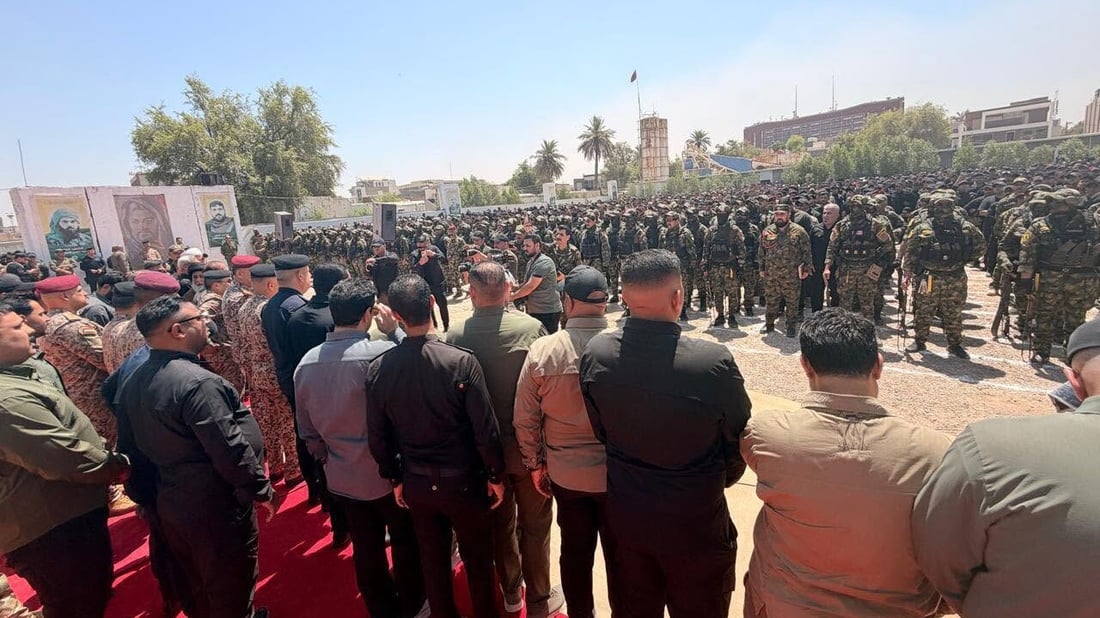
FILES: Members of the Imam Ali Battalions attend a ceremony as the group submits personnel and weapons records for Iraq’s state integration program.
Iraq building tiered risk framework to classify armed groups, source says
BAGHDAD — Iraq’s government is developing a system that sorts armed groups into three risk tiers as part of its drive to bring weapons under state control, a senior Iraqi security source told 964media.
The source, who spoke on condition of anonymity because they were not authorized to speak publicly, said Prime Minister Ali al-Zaidi’s government is building the framework using criteria including religious ideology, missile capabilities, drone ownership and foreign affiliations. The model draws on methodologies used by the U.S.-led international coalition and NATO, the source said.
The system is being developed by the supreme committee for disarmament and weapons control, established last month, in coordination with senior judicial authorities. The committee has recently expanded to include representatives from the Iraqi National Intelligence Service, the National Security Advisory, the Foreign Ministry’s Counterterrorism Department, the Central Bank of Iraq and other security and military institutions.
The source said the committee is preparing a national risk assessment matrix to give state institutions a unified framework for evaluating armed groups. Updated monthly, the classification will help guide policy ahead of deadlines that, under existing agreements the source did not identify, are expected to reach critical stages before the end of the year. The process will place greater emphasis on judicial assessments alongside military and security evaluations.
The matrix is not meant to issue legal rulings or designate new organizations, the source said, but to set standardized criteria for assessing each group individually, including whether it complies with government decisions.
Zaidi’s government is pursuing a plan to place weapons under state control, a policy dividing the Iran-aligned factions. Asaib Ahl al-Haq, Saraya al-Salam and the Imam Ali Battalions have moved to comply, while Kataib Hezbollah, Harakat al-Nujaba and Kataib Sayyid al-Shuhada have rejected disarmament, arguing their weapons remain necessary as long as U.S. forces are in Iraq.
The precise command structure for compliant factions has not been publicly detailed, with official statements using broad terms such as “integration” and “restructuring” without specifying whether fighters will be absorbed individually into army units or remain as intact formations.
During his meeting with U.S. President Donald Trump at the White House on July 14, Zaidi said the government intended to bring all weapons under state control after the coalition mission ends. “Whoever surrenders their weapons will turn into a political and civil entity,” he said. “After Sept. 30, there is no need for any faction. Factions are a need, not a profession. There is no justification for their existence after Sept. 30.” Sept. 30 is the conclusion date of the anti-ISIS coalition’s mission and the departure of American troops from Iraq.
A day before Zaidi’s Washington visit, the coalition known as the Islamic Resistance in Iraq rejected the trip, warning the government against signing agreements and calling for an end to the U.S. military presence in Iraq.
Earlier this month, former Prime Minister Mustafa al-Kadhimi expressed support for Zaidi’s efforts to strengthen state authority. Speaking on Al Arabiya TV, Kadhimi said his support was “not for a person as much as it is for the idea of the state,” adding that any Iraqi effort to restore the authority and prestige of the state and fight corruption and uncontrolled weapons should receive support.
Since the regional war between Iran and the U.S. and Israel began in late February, Iran-aligned factions under the Islamic Resistance in Iraq umbrella have carried out repeated drone, rocket and missile attacks on U.S. military and diplomatic targets in Baghdad and the Kurdistan Region, as well as on civilian and non-military targets, while the United States has struck positions linked to the Popular Mobilization Forces across multiple governorates, killing about 100 fighters.