
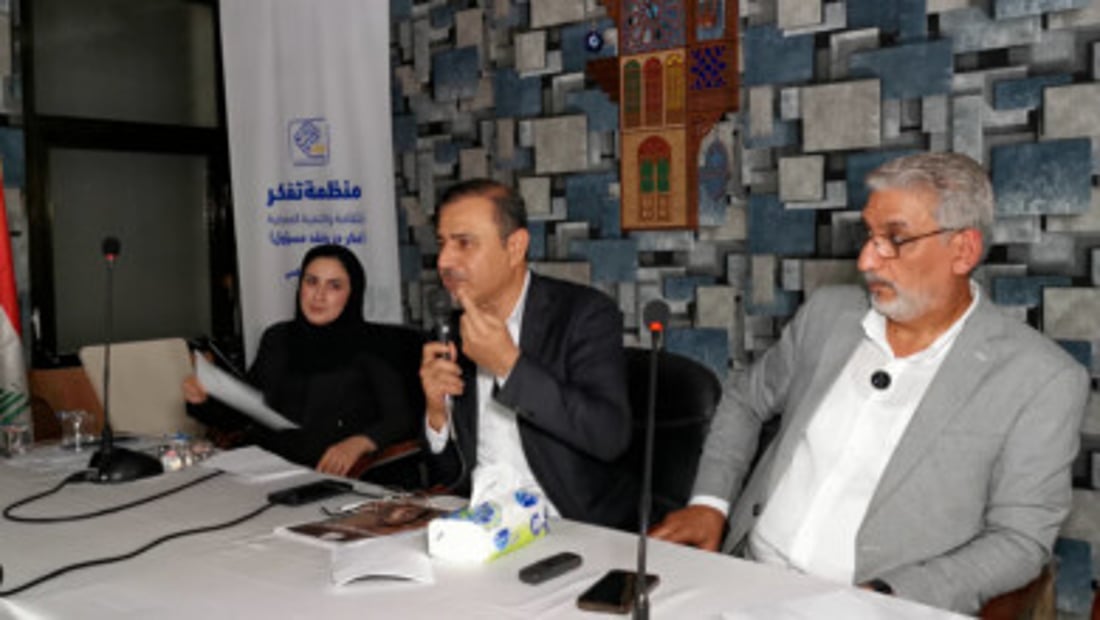
Researchers and academics participate in a seminar marking the anniversary of Iraqi sociologist Ali al-Wardi's death in Karbala. (Photo: 964media)
Author and sociologist
In Karbala, scholars ask what al-Wardi would make of Iraq today
KARBALA — Academics, researchers and members of the public gathered in central Karbala on Friday to mark the anniversary of the death of Iraqi sociologist Ali al-Wardi, using the occasion to examine how his theories on social conflict, values and Iraqi identity apply to present-day challenges.
The seminar, titled “Ali al-Wardi Today” and organized by the Tafakkur Organization and the Philosophical Forum, was moderated by researcher Haider al-Hajj and featured presentations by academic Fares Harram and sociology professor Fatima al-Thabet.
Widely regarded as one of Iraq’s most prominent writers, Wardi was a sociologist, professor and historian who studied in the United States during World War II and applied modern social theory to Iraqi society from the 1950s onward. Born in Baghdad in 1913, he died there in July 1995. His work, translated into Kurdish, Persian, Turkish and other languages, examined Iraqi society through the tension between tribal and urban identities and argued that the country is shaped by competing value systems rather than a single cultural identity. His books, including A Study of the Nature of Iraqi Society, Preachers of the Sultans and the multi-volume Social Glimpses from the Modern History of Iraq, remain among Iraq’s most widely read works on history and sociology, while also drawing criticism from religious, nationalist and ideological circles.
Participants argued that public debate in Iraq has become dominated by military and economic questions while neglecting culture and values, and asked whether Wardi’s framework could help address that gap.
“We have commemorated al-Wardi annually as an opportunity to restore him from populist circulation and return him to his critical intellectual space,” researcher Sateh Ammar told 964media. “Populist currents have begun consuming his legacy in an unfair and unobjective way.”
Harram said Iraq needs an intellectual framework capable of explaining its crises beyond material concerns. “He always looked beyond material crises, examining cultural issues and the value systems that shape Iraqi society rather than limiting analysis to economic and military factors,” he said. He said he had applied Wardi’s ideas to higher education, describing an “academic dissonance” in Iraqi universities that have modernized facilities and adopted international publishing standards while failing to distinguish original scholarship from the repetition of others’ ideas.
Salim Jawhar, director of the Tafakkur Organization, said the seminar sought to revisit Wardi’s analysis of social groups, competing cultures and conflicting values. “This thought may not appeal to everyone, but it remains a living and evolving body of work,” he said.
964media previously reported on a similar commemoration in Baghdad. In July 2024, the Al-Mada Foundation and Germany’s Goethe Institute marked the 29th anniversary of Wardi’s death with a session in which speakers described his writings as continuing to shape discussions of Iraqi identity, sectarianism and social change. Ali Hassan al-Fawaz, president of Iraq’s Writers’ Union, said discussing Wardi opens debate needed at Iraq’s current political, social and cultural crossroads, pointing to his work on the conflict between nomadic and settled life as a basis for scientific discussion.