
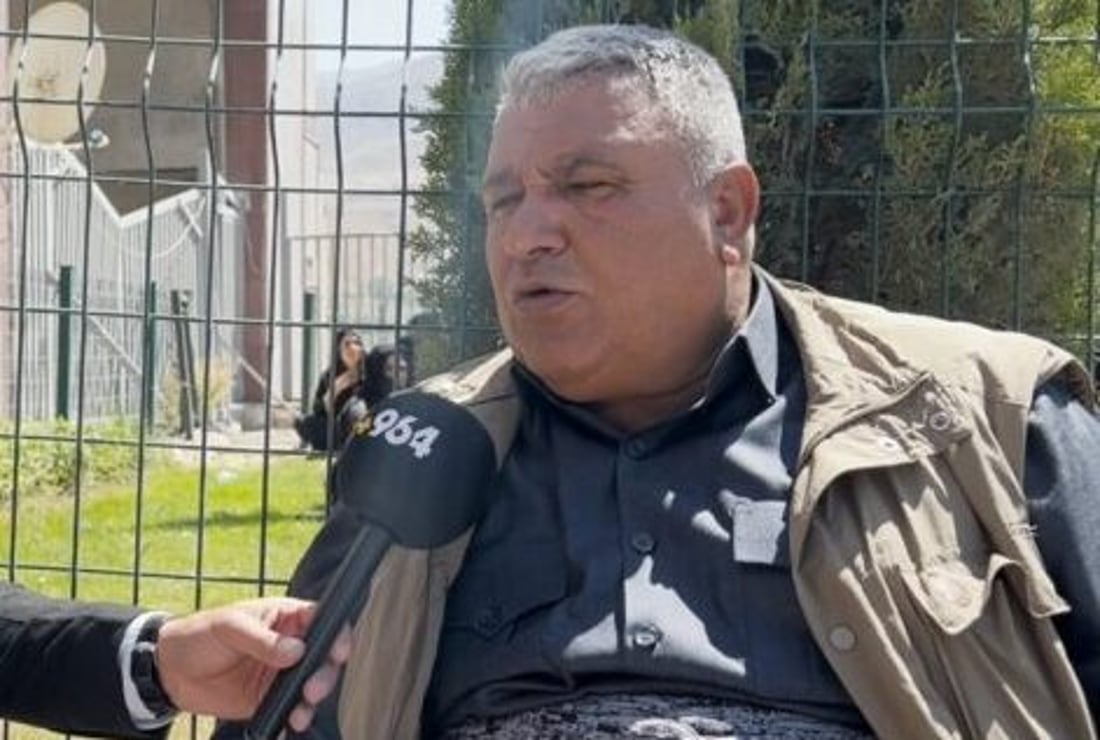
Suleiman Salih, father of Rebaz Suleiman Salih, speaks to 964media after his son's killing near the Iran-Iraq border. (Photo: 964media)
Sidakan
Iranian forces kill Kurdish herder near border, according to rights group
ERBIL — A 26-year-old Kurdish man was killed after Iranian soldiers opened fire near the Iran-Iraq border in the Khnera highlands of Erbil’s Sidakan sub-district, according to Community Peacemaker Teams and the victim’s family.
The Iraqi Kurdistan branch of Community Peacemaker Teams said Rebaz Suleiman Salih and his brother, Bewar, went to the Kani Spi highlands on Khnera mountain early Friday to bring back their livestock when soldiers from Iran’s Islamic Revolutionary Guard Corps opened fire.
The organization said Bewar escaped and returned to the family’s seasonal tent to alert relatives. After the shooting, it said, Revolutionary Guard soldiers took Rebaz’s body to a hospital in Iran’s Urmia province and confiscated all the family’s livestock. Iranian authorities held the body for two days before returning it Sunday, the group said.
Rebaz’s father, Suleiman Salih, told 964media his son had herded livestock in the area for years. “My son and several other people were used to herding livestock there. They went to that area every day. This time they opened fire on them, and one of my sons was killed,” he said. He said he was told Sunday that 850 sheep were also missing.
Community Peacemaker Teams said the family had suffered losses in the same region before. “This is not the first time Rebaz’s family has faced such an incident in the Khinera highlands during their nomadic life,” the organization said, adding that 36 of his relatives were killed and 14 wounded in a Turkish airstrike in the Kandakolan highlands on Aug. 15, 2000.
The killing comes as Community Peacemaker Teams has documented 751 attacks across the Kurdistan Region between Feb. 28 and May 28, during and after this year’s conflict involving the United States, Israel and Iran.
The report recorded 22 people killed and 112 injured. Those killed included 10 people affiliated with Iranian Kurdish opposition groups and 12 civilians, Iraqi Kurdish security personnel and other non-combatants. Erbil governorate recorded 588 attacks, more than three-quarters of the total. Sulaymaniyah recorded 135, while Duhok and Halabja recorded 22 and six. U.S. diplomatic and military facilities were the most frequently targeted, accounting for 281 attacks, while civilian and non-combatant infrastructure, including Kurdistan Region security facilities, residential areas, oil installations and telecommunications, was hit in 238, and Iranian Kurdish opposition groups and their camps in 232.