
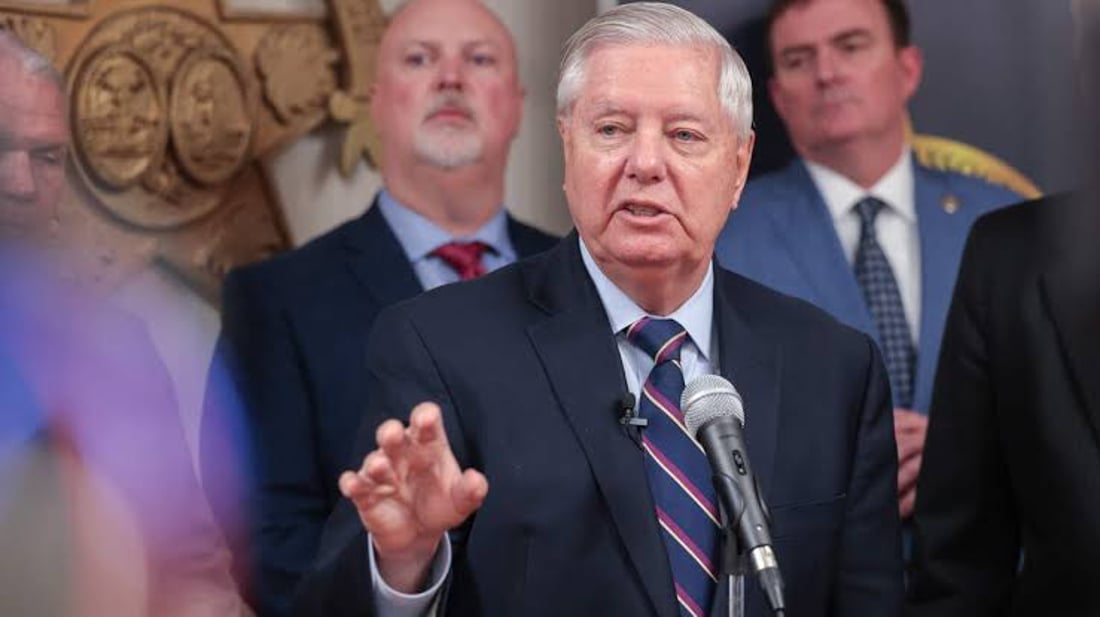
U.S. Sen. Lindsey Graham speaks at a news conference in Washington. Graham died July 11, 2026, at age 71, according to his office.
Lindsey Graham, US senator and leading advocate for Kurds, dies at 71
ERBIL — U.S. Sen. Lindsey Graham, a Republican from South Carolina who became one of the Senate’s most influential foreign policy voices and a leading advocate for the Kurdish cause in Syria, died Saturday after a “brief and sudden illness,” according to a statement from his office. He was 71.
His office said Graham died Saturday evening and that his family “appreciates prayers at this time and asks for privacy during this incredibly difficult period.” No cause of death was released. He had met Ukrainian President Volodymyr Zelenskyy in Kyiv on Friday and was scheduled to appear on NBC’s “Meet the Press” on Sunday.
Graham represented South Carolina in the U.S. Senate from 2003 and was seeking a fifth term this fall. He served four terms in the House before that, and spent 33 years in the U.S. Air Force and its reserve components as a military lawyer, retiring as a colonel in 2015, with reserve deployments to Iraq and Afghanistan. He had become one of President Donald Trump’s closest allies while remaining one of Congress’ most outspoken hawks on Iran, Russia and national security.
Graham was widely known in Iraq and Syria for his support of Kurdish forces. For years he argued that Kurdish fighters were among America’s most dependable partners against the Islamic State group and warned against abandoning them after U.S. withdrawals from northern Syria. In 2018 he visited Manbij in northern Syria, meeting the local military council that had driven ISIS from the city alongside the U.S.-led coalition.
Kurdish leaders across the region mourned Graham. Kurdish leader Masoud Barzani said he had learned of the death of “the friend of the Kurdish people” with deep sorrow, adding that Graham’s name and his record “as a loyal supporter of the Kurdish people’s legitimate rights will always remain highly in the memory of the people of Kurdistan.”
Kurdistan Regional Government Prime Minister Masrour Barzani said he had learned of Graham’s passing “with deep sorrow and sadness,” extending condolences to the senator’s family and to the leadership and members of the U.S. Senate. “The people of Kurdistan will always remember his friendship and steadfast support,” he said.
Kurdistan Region President Nechirvan Barzani called him “a valued friend of the people of Kurdistan,” writing on X that “his advocacy and unwavering support for Kurdistan will always be remembered with gratitude.”
In January, Graham announced the bipartisan Save the Kurds Act in response to attacks on Kurdish-controlled areas in northeastern Syria, calling Kurdish forces America’s “chief ally in destroying the ISIS caliphate” and warning that abandoning them would be “a disaster for America’s reputation and national security interests.” The bill sought to sanction governments or armed groups involved in attacks on Kurdish forces.
His death removes the Kurds’ most prominent defender in Congress at a sensitive moment. In recent months Trump has repeatedly accused unnamed Kurdish groups of keeping U.S. weapons intended for anti-government protesters in Iran, saying “the Kurds take, take, take” and, in June, “I’ll remember that, Kurds.” The Kurdistan Regional Government, its two ruling parties and Iranian Kurdish opposition groups have all denied receiving any such weapons, and no evidence of the shipments has been made public. With the bill still pending, it is unclear who will carry Graham’s advocacy forward.
Graham was also among Washington’s most outspoken voices throughout this year’s war with Iran, backing military action from the start while directing his criticism at the ceasefire agreements rather than at Trump himself. He called the April deal’s negotiating document “troubling,” praised Trump’s decision to keep the naval blockade of Iranian ports in place as “very smart,” and attacked proposed reconstruction funds for Iran as “akin to a Marshall Plan for Germany with the Nazis still in charge.” On CBS’s “Face the Nation” last month, he said of the renewed diplomacy, “Let’s try a diplomatic solution. I think it’s going to fail,” predicting Trump would otherwise seize the Strait of Hormuz by force and “obliterate” Iran if it resisted.
The Kurdish-led Syrian Democratic Forces, backed by the United States, played a central role in dismantling the Islamic State’s self-declared caliphate and continue to guard detention facilities holding thousands of ISIS fighters and their families.