
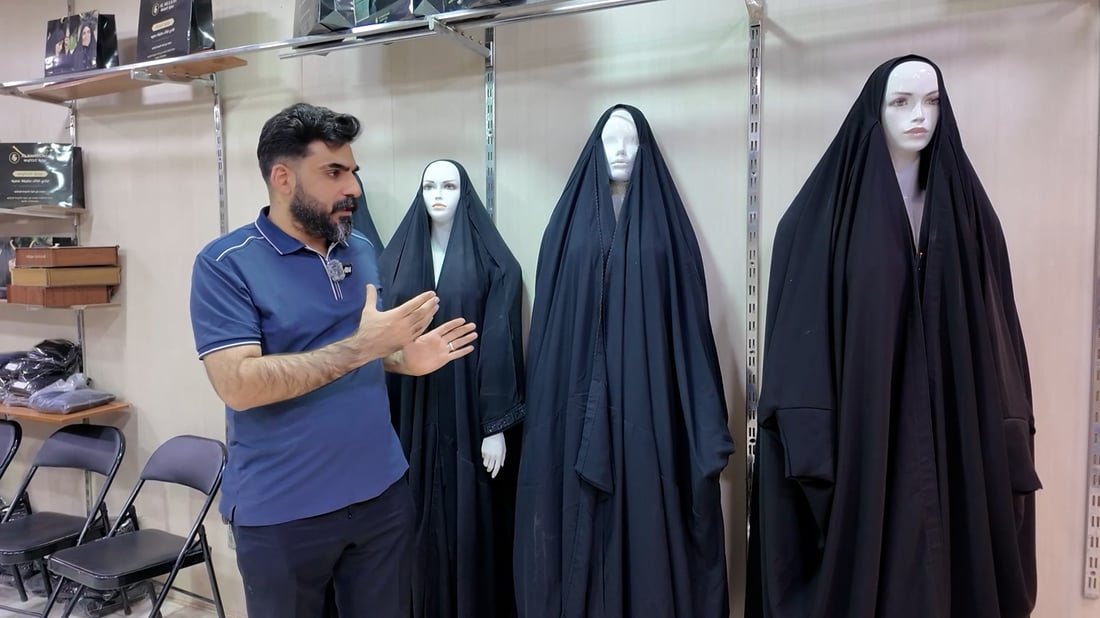
Mannequins display traditional Zainabi abayas inside a tailoring shop in Najaf’s old city as shop owner Maytham Al-Tabatabai explains the history and craftsmanship behind the garment. Photo by 964media.
Zainabi abaya keeps its hold on women’s fashion in Najaf
NAJAF — The Zainabi abaya remains the dominant style of women’s dress in Najaf and Iraq’s southern governorates, with tailors and shop owners saying demand for the loose traditional garment holds strong despite an influx of imported fabrics and newer designs.
Maytham al-Tabatabai, who owns an abaya shop in Najaf, said the garment was once known as the Najafi abaya and took the name Zainabi after 2003, when visitors from neighboring countries popularized it. “The name Zainabi abaya came in reference to Lady Zainab because it is a wide and modest abaya,” he said. The Zainabi differs from the Baghdadi abaya in its construction, he explained: it is made from two pieces of fabric joined down the middle for greater width and ease of movement, while the Baghdadi is cut from a single piece running head to toe. It remains the most popular style in Najaf, he said, unlike the narrower, more tailored Lebanese and Iranian designs.
Japanese fabric is the preferred cloth for its durability, al-Tabatabai said: a handmade abaya in Japanese fabric costs about 185,000 dinars ($120) and can last a decade, while cheaper versions in Korean and Chinese fabric start around 30,000 dinars ($19). The genuine Japanese cloth, he said, can be told by its edge, texture and a “Made in Japan” mark, though some Korean fabrics imitate it.
Tailors said the abaya holds its place above all for religious occasions. “The Iraqi Najafi abaya still maintains its place during pilgrimages and religious occasions,” said Nawras Yas, an abaya tailor, who said garments could be made by machine or by hand, with prices varying by fabric, workmanship and the customer’s wishes.
Ibrahim al-Khafaji, another Najaf tailor, said customers order custom abayas in Iraqi, Lebanese and other styles to their own measurements, with standard tailoring taking two to three days after measuring and hand sewing longer. “Hand sewing differs from machine sewing in terms of time, cost and precision,” he said. “Some women prefer it for occasions and weddings.” A machine-sewn abaya can be finished in an hour or two, Yas said, while a hand-sewn one typically takes four to five days.