
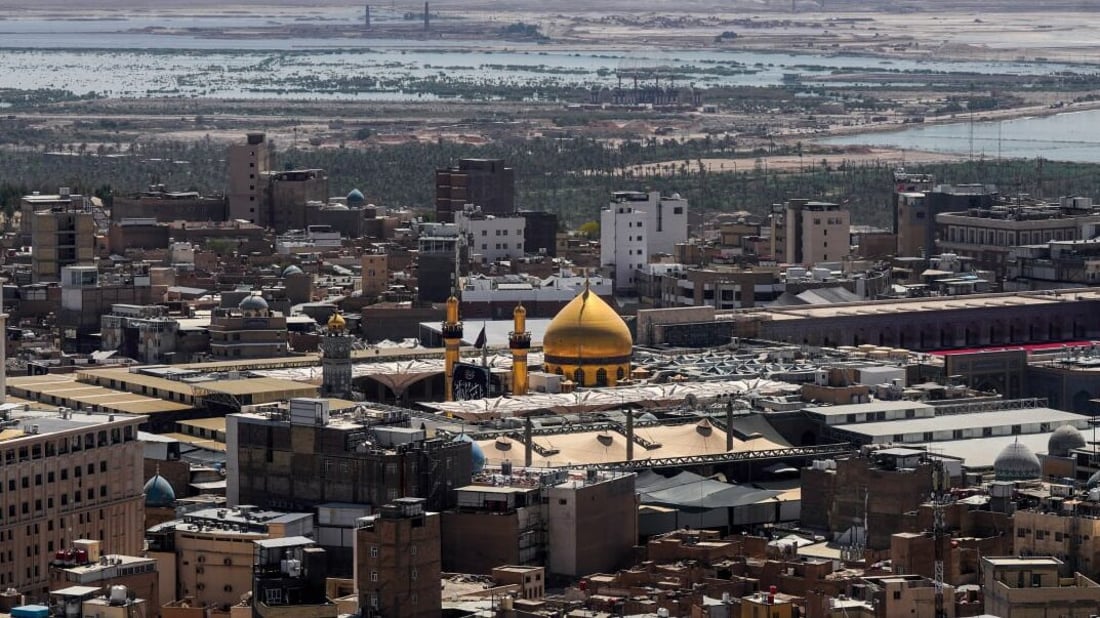
A view of Najaf city
Najaf divides governorate into 10 security zones for Arbaeen
NAJAF — Najaf police have adopted a “comprehensive” security and intelligence plan for the Arbaeen pilgrimage, dividing the governorate into 10 security zones and establishing joint operations rooms involving security forces, the Popular Mobilization Forces and government agencies, a police spokesperson said Thursday.
Mufid Salem al-Taher, spokesperson for the Najaf Police Command, said “the governorate serves as the gateway to Karbala and the starting point for many pilgrims traveling to commemorate Arbaeen.”
Arbaeen marks the end of the 40-day mourning period for Imam Hussein, grandson of the Prophet Muhammad, who was killed at the Battle of Karbala in 680. Millions of pilgrims from Iraq and abroad travel on foot to Karbala to visit his shrine, with many also stopping in Najaf at the shrine of Imam Ali. Pilgrims have already begun walking from Ras al-Bisha in Basra’s al-Faw district toward Karbala, with one procession telling 964media its journey from Iraq’s southernmost point would take about 17 days.
He said the police command had held planning meetings and prepared security and organizational measures for the pilgrimage based on intelligence assessments. The plan reduces the number of deployed military personnel while placing greater reliance on security, intelligence, civilian and organizational efforts.
For 2026, Arbaeen is expected to fall on Aug. 5, though the exact date depends on the sighting of the moon.
Taher said several operations rooms have been opened across the governorate, with participation from the Popular Mobilization Forces and the Border Forces Command. He said authorities divided Najaf into 10 security zones because of the distribution of religious shrines across the governorate. The plan aims to secure the movement of pilgrims traveling to the sites, with particular focus on central Najaf.
Najaf is one of the holiest cities in Shia Islam and is home to the Imam Ali Shrine, where Imam Ali ibn Abi Talib, the cousin and son-in-law of the Prophet Muhammad and the first imam in Shia Islam, is buried. The city is a major destination for religious pilgrimage throughout the year and serves as a principal starting point for pilgrims traveling on foot to Karbala during Arbaeen. Najaf also hosts the Hawza, one of the world’s leading centers of Shia religious scholarship, attracting students and clerics from Iraq and abroad.
The joint operations rooms include representatives from the local and federal governments to coordinate services for pilgrims and mourners. Taher added that authorities are coordinating with the administrations of religious sites, including the Imam Ali Shrine and the Kufa Mosque and Shrine.
Transportation and crowd management are central to the annual government plan because pilgrims cross several governorates before reaching Karbala. During the 2025 pilgrimage, the Imam Hussein Shrine authority said more than 22 million pilgrims took part, while Najaf authorities said 17 million entered the governorate, with public agencies, religious institutions and private operators deploying buses and other vehicles.
Earlier this month, Iraq’s Higher Committee for Mass Pilgrimages reviewed security and public-service plans for the Arbaeen pilgrimage, including arrangements at border crossings and measures to manage the movement of millions of pilgrims from Iraq and abroad.