
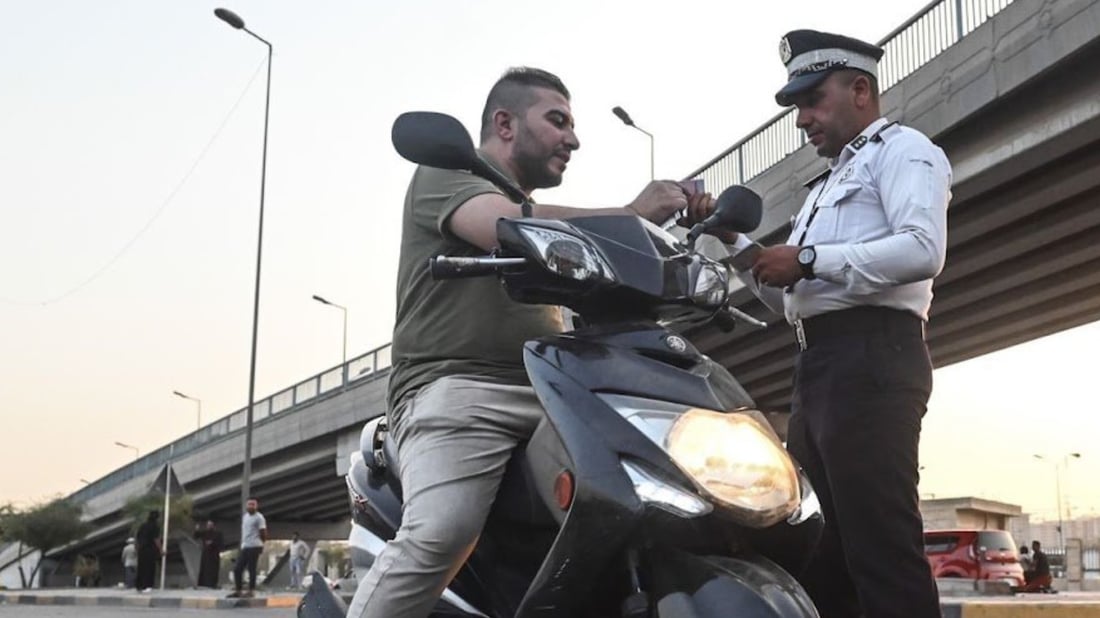
An Iraqi traffic officer checks documents of a motorcyclist at a roadside checkpoint in Baghdad.
Rules overhaul
Legal window tinting, lower fines proposed in Iraq traffic law overhaul
BAGHDAD — Iraq could allow limited vehicle window tinting nationwide under proposed amendments to the country’s traffic law, reversing a longstanding federal restriction while cutting most traffic fines, abolishing the system that doubles unpaid penalties and tightening driving tests, traffic officials said Thursday.
Traffic Director Lt. Gen. Uday al-Hassani told the Iraqi News Agency the amended draft law had been discussed with parliament’s Security and Defense Committee and included proposals prepared by the General Traffic Directorate to ease the burden on motorists.
The proposal would allow motorists to tint vehicle windows by 20% to 30% free of charge, with the General Traffic Directorate carrying out the work. Free tinting would carry the directorate’s logo and a white marking, while paid tinting would carry a brown marking.
Hassani said the directorate had also coordinated procedures with traffic authorities in the Kurdistan Region so tinting authorized by either side would be recognized throughout Iraq. The Kurdistan Region has allowed licensed vehicle window tinting for several years under a permit system with annual fees, while federal Iraq has largely prohibited the practice under Traffic Law No. 8 of 2019.
Under the proposed amendments, most traffic fines would first be reduced by 50% and then by a further 25%. The draft would also abolish the system that increases unpaid fines over time, while ending the current discount for motorists who pay within three days.
The proposed reductions come despite Iraq recording 11,763 traffic accidents and 2,719 deaths in 2024, excluding the Kurdistan Region. Official statistics attributed nearly four in five crashes to driver error.
One penalty would increase. Driving against traffic would carry a fine of 500,000 Iraqi dinars (about $379 at the official rate).
The draft would retain the minimum driving age of 18 while making licensing examinations more rigorous and would set maximum speed limits of 140 km/h on expressways, 120 km/h on highways outside cities and 100 km/h on urban expressways.
Hassani claimed Iraq had one of the region’s lowest traffic accident rates, citing a figure of 2.2 based on the number of crashes relative to the population and vehicle fleet. He did not specify the unit or reporting period. WHO’s latest comparable estimate put Iraq’s road-traffic mortality rate at 21.5 deaths per 100,000 people in 2021.
The proposals build on amendments to Traffic Law No. 8 of 2019 that parliament has been reviewing since earlier this year. Lawmakers have already indicated the changes would reduce what they described as excessive fines, scrap the penalty-doubling system and revise rules covering vehicle registration, ownership transfers and annual inspections.
Parliament completed a first reading of the draft before the legislative recess and is expected to begin a second reading when lawmakers return. MPs have previously said any changes would apply only to future traffic violations, with existing fines remaining payable as state revenues unless waived by the government.