
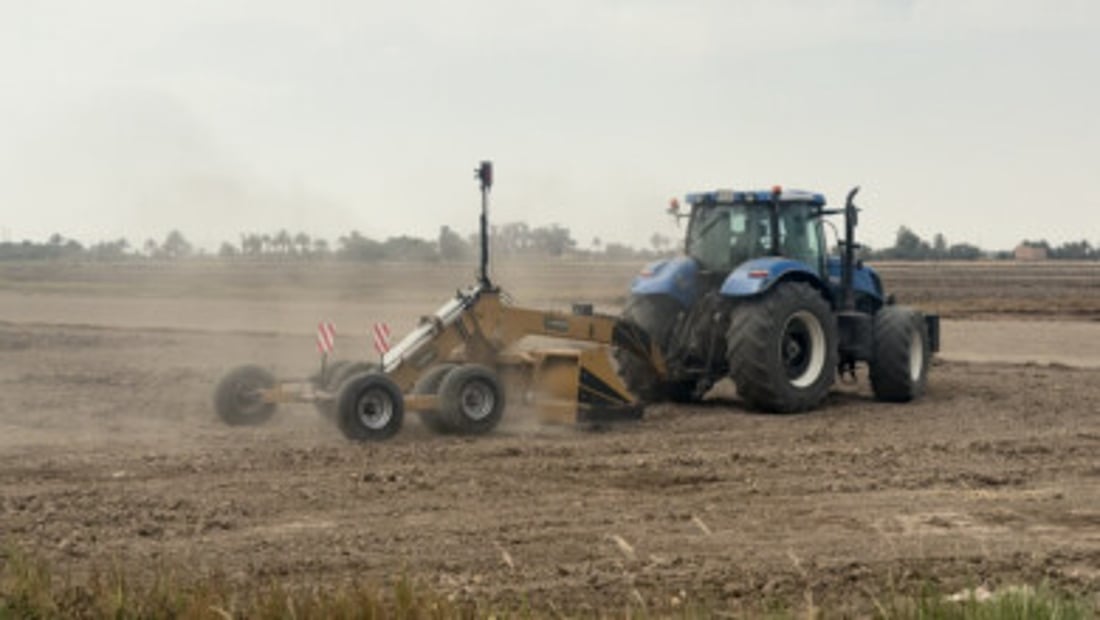
Farmers in Mishkhab prepare fields for the 2026 rice planting season. (Photo: 964media)
Najaf
Iraq’s famed amber rice heartland turns to less thirsty jasmine variety
NAJAF — Farmers in Najaf’s Mishkhab district, the historic home of Iraq’s prized amber rice, are planting the jasmine variety instead as cultivation resumes after years of drought. Growers say jasmine closely resembles amber but needs less water, making it a safer choice even as supply improves somewhat this season.
964media documented the opening days of the planting season as farmers plowed and leveled fields, broadcast seeds, covered them with soil and opened irrigation channels. Farmer Salem Najm said most growers had agreed to plant jasmine this year, with amber accounting for no more than 1% of planted area because it is expensive, sensitive and water-hungry. “Amber rice has become a rare commodity, like the dollar, because of strong demand for all its varieties,” he said. “Today farmers are looking for quantity and economic returns more than quality.”
Amber rice, traditionally planted in June and harvested in October, is prized for its aroma and is a staple of Iraqi celebrations; the word “amber” in Iraqi dialect refers to any sweet-smelling fragrance. Najm said environmental decline had driven many farming families away. “Sometimes only one person remains in a household, struggling to keep farming alive,” he said.
Rahim al-Fatlawi, director of the Mishkhab Agriculture Directorate, said rice cultivation had steadily declined since 2003 as water shortages worsened. Cultivation peaked in 2010 at around 35,000 dunams (8,648 acres) in the district before falling to about 11,117 dunams (2,747 acres) in 2015 and 2016. By 2022 only 466 dunams (115 acres) remained, dedicated solely to seed production, and in 2025 the area shrank to just 200 dunams (49 acres) at a closed research station. Al-Fatlawi said the improved water supply in 2026 offered “good signs” that Mishkhab may begin restoring its agricultural identity.
This year’s rainfall boosted Iraq’s strategic water reserves by about 6 billion cubic meters, with inflows to the Tigris and Euphrates raising storage across the country, a turnaround after reserves fell to their lowest in roughly 80 years in 2025 amid prolonged drought and reduced upstream flows from Turkey and Iran. In April, lawmaker Faleh al-Khazali said the improved reserves had set the stage for a favorable amber rice season this summer.