
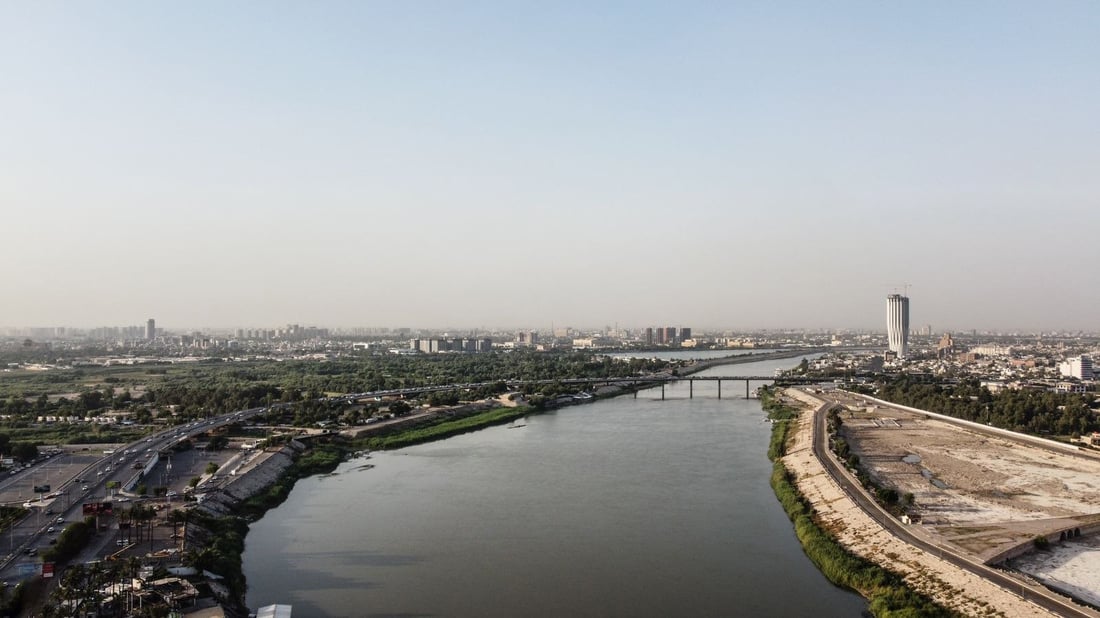
A view of the Tigris River flowing through Baghdad, with bridges and urban areas visible along its banks.
Baghdad says tap water safe as Tigris pollution concerns persist
BAGHDAD — Baghdad Municipality says drinking water from its treatment plants is safe for consumption, while outlining plans for several wastewater treatment projects.
Municipality spokesman Uday al-Jandil said the municipality had completed several wastewater projects and “has the capacity to treat all of these waters” in the capital, but that expanding capacity requires funding. He said a treatment plant in the Rustamiyah area, with a design capacity of 105,000 cubic meters per day, was preparing to open, and that work had begun on the Al-Khansa sewer line on the Rusafa side, planned for 200,000 cubic meters per day. Designs and consultancy studies are complete for a plant in Al-Bu’aitha on the Karkh side, planned for 351,000 cubic meters per day.
On drinking water, al-Jandil said all treatment plants were “operating with high efficiency” and producing water “in compliance with the standards approved by the Ministry of Health and the World Health Organization.” He said the municipality’s laboratories test treated water continuously, with results confirming its safety.
The assurances, however, concern treated drinking water, not the state of the Tigris itself, which remains polluted. Al-Jandil said contamination of the river “is not new, but the result of accumulations that have extended for many years,” and that the municipality was working with other authorities to reduce it.
Pollution of the Tigris in Baghdad is a longstanding problem linked to untreated sewage, industrial waste and reduced river flow from low rainfall and diminished upstream supply.
The situation echoes elsewhere in Iraq. Earlier this week, Najaf authorities announced measures to reduce pollution in the Euphrates, where the sewerage directorate has said treatment capacity has not kept pace with urban growth.
In late April, the Environment Ministry called for sewage treatment plants in all cities to protect the Tigris and Euphrates, saying more than two billion cubic meters of wastewater could be recovered annually with proper infrastructure.
River pollution has been repeatedly documented: contamination from the Diyala River forced northern Wasit treatment plants to shut down in April after pollutants reached the Tigris, and mass fish deaths at floating farms along the river have also been recorded.