
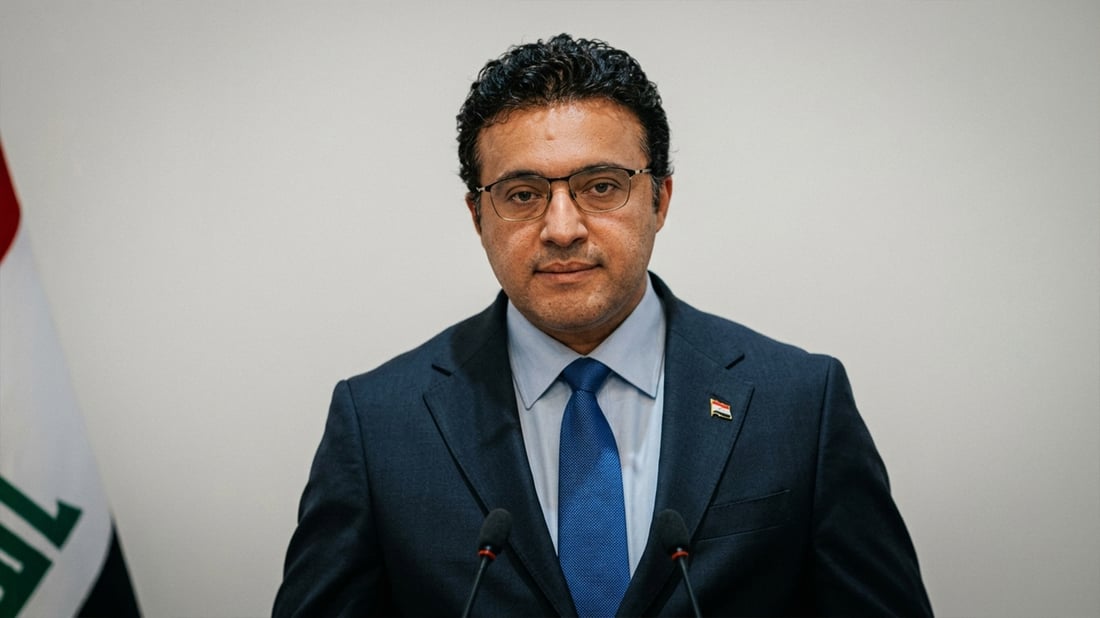
Iraqi government spokesman Haider al-Aboudi
Government spox: Iraq to build floating gas terminals at Khor al-Zubair with US firms
BAGHDAD — Iraq is moving toward establishing floating gas terminals at Khor al-Zubair with U.S. companies to help secure fuel for power generation, government spokesman Haider al-Aboudi said Wednesday, following U.S. presidential envoy Tom Barrack’s visit to Baghdad.
Aboudi said the planned terminals were discussed as part of efforts to expand economic and security cooperation ahead of Prime Minister Ali al-Zaidi’s expected White House visit next month. Meetings with Barrack included easing the entry of U.S. companies into energy and electricity projects and “setting indicators for implementing floating liquefied gas stations in Khor al-Zubair by specialized American companies,” he told the state news agency. The project would let Iraq receive imported liquefied gas and convert it for use by national power plants, particularly during peak consumption.
The discussions follow earlier Iraqi-U.S. talks in Baghdad on economic cooperation, U.S. investment and electricity projects, including Excelerate Energy’s planned floating liquefied natural gas import terminal at Khor al-Zubair.
Aboudi tied the government’s economic approach to internal security, saying it leads directly to “restricting weapons to the state, and unifying the security decision-making system under the authority of the commander in chief of the armed forces.” He said the decision to restrict weapons to state control is an Iraqi national one. Earlier this month, the Coordination Framework endorsed a plan to restrict weapons to state control and authorized Zaidi to implement it, and a government committee including the Defense Ministry, Interior Ministry, Joint Operations Command and the PMF was formed to oversee the handover of weapons, equipment and military sites. Asaib Ahl al-Haq, Saraya al-Salam and the Imam Ali Battalions have backed the initiative, while Kataib Hezbollah, Harakat al-Nujaba and Kataib Sayyid al-Shuhada have rejected disarmament.
Aboudi said Iraq is nearing the end of the international coalition presence by September, after a period that began with the 2014 war against the Islamic State. “With the end of this foreign presence, the requirements of the stage of comprehensive development that the Iraqi street aspires to begin,” he said.
For years, Iraq has relied heavily on Iranian gas to fuel many of its power plants, a dependence driven by insufficient domestic production and processing capacity. Officials have repeatedly warned that disruptions to Iranian supplies could sharply reduce electricity generation during the summer peak. The issue became more urgent after the United States ended a key sanctions waiver that had allowed Iraq to keep importing Iranian energy, pushing Baghdad to accelerate the search for alternatives.