
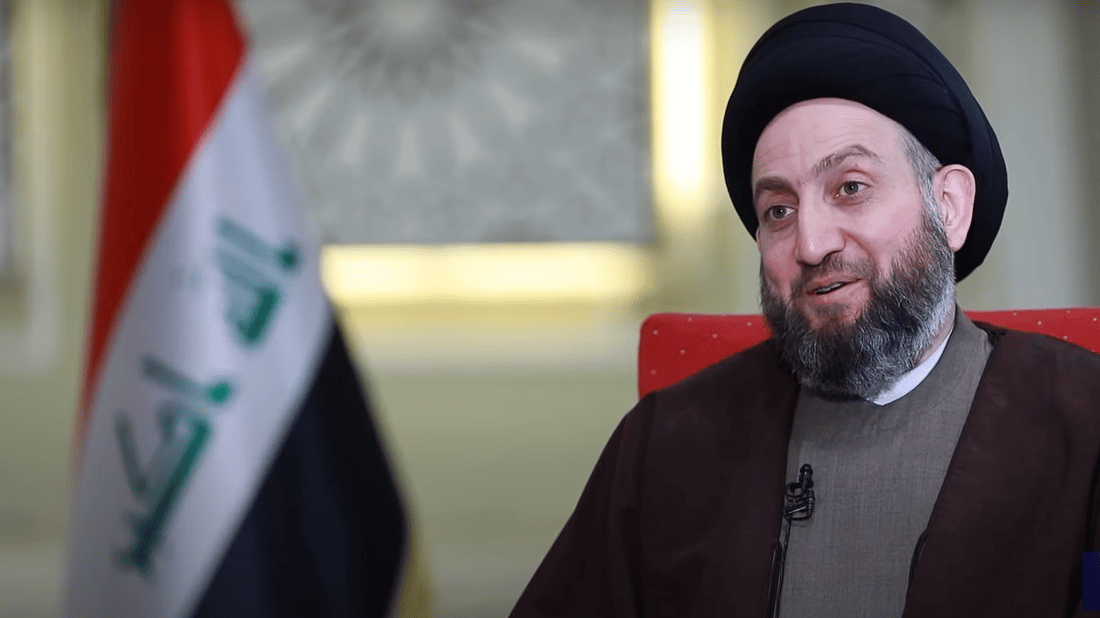
Ammar Al-Hakim, head of Al-Hikma Movement
Hakim welcomes Sadr move on Saraya al-Salam, says other factions ready to follow
NAJAF — Al-Hikma Movement leader Ammar al-Hakim welcomed a move by Sadrist Movement leader Muqtada al-Sadr to integrate Saraya al-Salam into state institutions, saying other armed factions have also shown willingness to respond to calls to place weapons under state control.
Speaking at a press conference in Najaf, Hakim said, “Other factions have responded to these calls,” while noting that some armed groups are waiting for the international coalition’s mission in Iraq to conclude by September 2026 before taking similar measures.
Hakim said the Coordination Framework recently held a meeting dedicated to the issue of weapons and armed factions, where participants affirmed their commitment to the Iraqi Constitution, the Popular Mobilization Forces law, the government program and recommendations from the country’s religious authority calling for “restricting weapons to the hands of the state.”
Iraq’s Coordination Framework said Monday it supports restricting weapons to state control and separating the Popular Mobilization Forces from political, partisan and social affiliations, authorizing Prime Minister Ali al-Zaidi, as commander-in-chief, to take the decisions needed to implement the policy.
The announcement follows cleric Muqtada al-Sadr’s earlier decision to integrate his armed wing, Saraya al-Salam, into the Iraqi armed forces. Asaib Ahl al-Haq also announced Tuesday the formation of a central committee to implement the separation of its forces from the Popular Mobilization Forces and place its weapons under state control.
Not all factions have endorsed the direction. Kataib Hezbollah, one of the most powerful Iran-backed militias in Iraq and a key component of the Islamic Resistance in Iraq, has repeatedly rejected calls to disarm, arguing its weapons are tied to Iraq’s security and the presence of foreign forces, and has said it will not discuss relinquishing them until foreign forces leave. Other Iran-aligned factions have similarly linked any future disarmament to broader arrangements on foreign military presence.
The US State Department’s Rewards for Justice program has offered up to $10 million each for information on three faction leaders: Harakat al-Nujaba founder Akram al-Kaabi, Kataib Hezbollah leader Ahmad al-Hamidawi and Kataib Sayyid al-Shuhada secretary-general Abu Ala al-Walaei.
Since the regional war began in late February, Iran-aligned factions under the Islamic Resistance in Iraq umbrella have carried out repeated drone, rocket and missile attacks on US military and diplomatic targets in Baghdad and the Kurdistan Region, while the United States has struck PMF-linked positions across multiple governorates, killing dozens of fighters.