
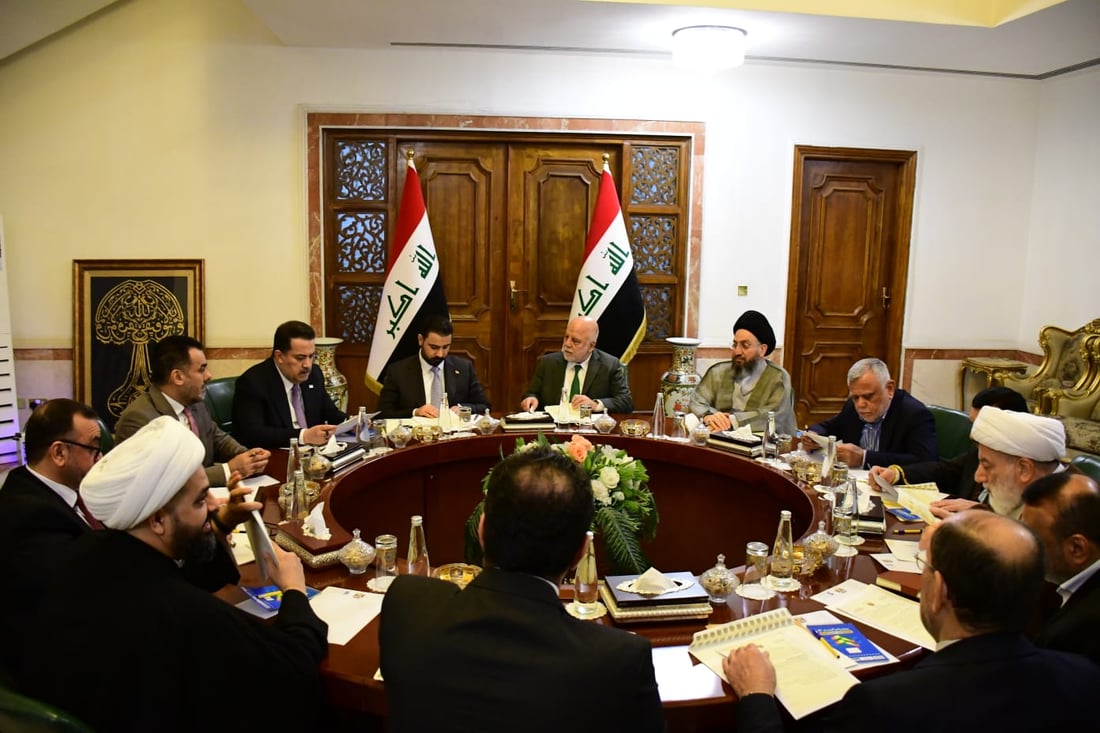
FILES: Leaders of Iraq’s Coordination Framework meet in Baghdad.
Militia ties
Coordination Framework backs weapons restriction, authorizes Zaidi to act
BAGHDAD – Iraq’s Coordination Framework said Monday it supports restricting weapons to state control and separating the Popular Mobilization Forces from political, partisan and social affiliations, authorizing Prime Minister Ali al-Zaidi, as commander-in-chief, to take the decisions needed to implement the policy.
The position was announced after the coalition’s 279th regular meeting, held at the office of former Prime Minister Haider al-Abadi and attended by al-Zaidi. Participants discussed what the framework described as national and security priorities.
In a statement, the coalition stressed that “the choice of the political system and its representatives is an exclusive right of the Iraqi people, who made great sacrifices in defense of their state and democratic system,” and that “the decision of war and peace is a sovereign national decision” belonging to the Iraqi people through constitutional institutions, adding that “any act outside this framework constitutes a violation of the law and the principles of the constitutional state.”
The statement reaffirmed the PMF’s status as a state institution “committed to the constitution, applicable laws and the orders of the Commander-in-Chief,” while backing its separation from political and social frameworks. The framework said its position rests on the Iraqi Constitution, directives of the country’s senior religious authority, PMF Law No. 40 of 2016, the government program approved by parliament, and the need to maintain cooperation with the international community and complete plans to end the international coalition’s mission in Iraq.
The move comes amid renewed debate over weapons restriction driven by US pressure on Baghdad and growing discussion among major Shiite political forces. Last week, Muqtada al-Sadr announced that Saraya al-Salam, the armed faction affiliated with his movement, would integrate under state authority, expressing hope other PMF factions would “separate themselves from partisan and sectarian orders.” Al-Zaidi welcomed the move as “an important step” toward consolidating state authority over weapons.
Not all factions have endorsed the direction. Kataib Hezbollah has repeatedly rejected calls to disarm, arguing its weapons are tied to Iraq’s security and the presence of foreign forces, and has said it will not discuss relinquishing them until foreign forces leave. Other Iran-aligned factions have similarly linked any future disarmament to broader arrangements on foreign military presence and Iraq’s security framework.