
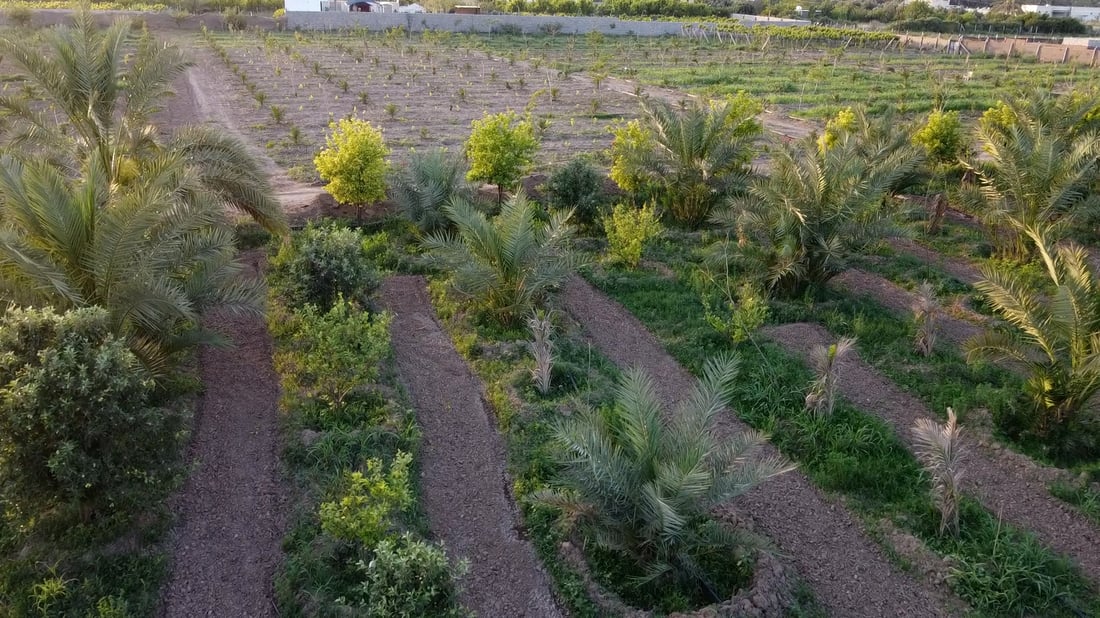
Rows of young date palms and cultivated plots are seen at a farm in Balad, Salah al-Din governorate, where local growers have begun producing Medjool and Barhi palm saplings using tissue culture techniques. Photo by 964media.
Balad farmers produce premium date palm saplings locally for first time
SALAH AL-DIN — Farmers in the town of Balad have begun locally producing Medjool and Barhi date palm saplings for the first time this year, reducing reliance on imports from southern Iraq and addressing long-standing complaints about fraud and mislabeling of varieties.
For years, growers in Balad depended on southern governorates, traditionally known for premium date varieties, to source saplings. Farmers said they frequently encountered pricing problems and uncertainty over whether saplings matched the advertised variety.
Farmer Ali Hassan told 964media that project owner Ammar Saeed had ended those concerns by guaranteeing the authenticity of varieties and providing direct follow-up inside orchards. “They are no longer forced to buy from other governorates and face fraud or loss of rights,” he said.
The project relies on tissue culture propagation using French and American technologies. Saeed purchases Medjool and Barhi saplings from Al-Basheer Company, which works with international agricultural development firms, and sells them with written guarantees for both variety and growth. He also provides farmers with monthly and annual cultivation instructions for 5,000 dinars ($3.27).
Saeed sells Medjool saplings at 155,000 dinars ($101.31) at a height of 170 centimeters, compared with a common market price of 175,000 dinars ($114.38) elsewhere in Iraq. He said one kilogram of high-quality Medjool dates can fetch 25,000 dinars ($16.34). “The palm tree is a global product comparable to oil, wheat and barley,” he said.
Tissue-cultured saplings are kept in nursery containers for at least one year before reaching heights of 140 to 170 centimeters. Newly planted Medjool palms can produce two to three offshoots in the first year, rising to between 10 and 20 per tree within three years, according to growers.